
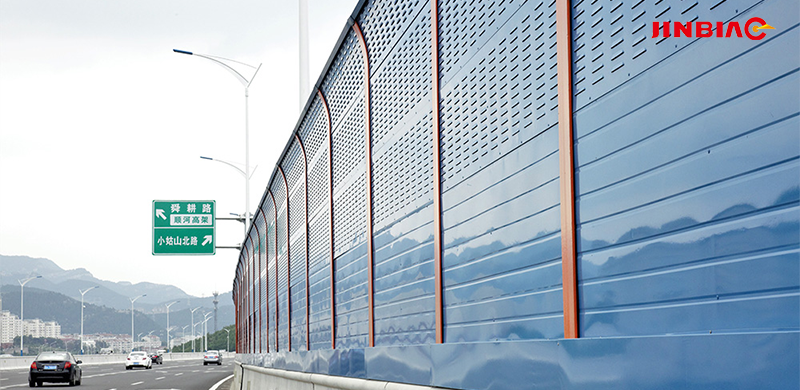
At the eastern portal of the Tiger Mountain Tunnel on the Second Ring South Road in Jinan, Shandong Province, one of the largest urban tunnel noise barrier systems in the city now protects nearby residential communities from traffic noise. The Tiger Mountain tunnel noise barrier stands more than 6 meters high, combining a steel supporting frame with transparent acrylic panels and a curved top profile — a design developed specifically to contain the intense noise generated by vehicles entering and exiting the tunnel portal.
Project Background: A Livability-First Urban Infrastructure Program
The Tiger Mountain Tunnel is part of the Jinan Southeast Second Ring Project, a major municipal initiative addressing two of the city’s most pressing issues: traffic congestion and air quality. The project opened new southern and eastern exits from the city, linking the southern mountain area with Tai’an and boosting economic development across the provincial capital region. As the elevated highway network expanded, however, the tunnel portal brought heavy traffic close to established residential neighborhoods, creating a new source of noise disturbance for local residents.
The tunnel mouth sits within a short distance of residential buildings. Without effective mitigation, the sudden acceleration and deceleration of vehicles at the portal — combined with the acoustic amplification effect of the tunnel structure itself — would generate noise levels far above acceptable limits for the surrounding community. Installing a tunnel noise barrier at the portal became an essential measure to protect residential quality of life.
The Acoustic Challenge of Tunnel Portals
Tunnel portals present a unique acoustic problem that ordinary roadside barriers cannot fully solve. Inside the tunnel, engine noise, tire noise, and aerodynamic sound are trapped and amplified by the hard tunnel surfaces; at the portal, this accumulated sound energy is released suddenly into the open air. The transition zone — where vehicles decelerate entering and accelerate exiting — also generates concentrated noise from braking, gear changes, and increased engine load. Research on highway tunnel acoustics shows that noise levels in the immediate vicinity of a portal can exceed those of equivalent open-road sections by several decibels, with the most intense impact felt by residents in the direct line of sight of the tunnel mouth.
This is precisely the situation at Tiger Mountain. The tunnel exit faces an area of established residential buildings at close range, meaning the noise arriving at the nearest facades combined direct vehicle noise with the tunnel’s amplification effect. Designing a tunnel noise barrier for this site required a solution that addressed not only the horizontal spread of sound but also the upward diffraction over the barrier top — the dominant noise path when the source is elevated on a viaduct or embankment. The curved-top profile was selected specifically to interrupt this upward path: the arch redirects sound energy upward and outward, diffracting it over the barrier crest and dispersing it away from the residential zone.
The Curved-Top Acoustic Screen Design
Engineers specified a 6-meter-high acoustic screen with a curved top spanning the tunnel entrance area. The distinctive arched crown is a purpose-designed acoustic solution: the curved geometry reflects and diffracts sound waves upward and outward, preventing noise from escaping directly toward nearby homes. This configuration is particularly effective at tunnel portals, where noise radiates in complex patterns as vehicles transition between the enclosed tunnel environment and the open road.
The supporting structure consists of steel frames erected at the tunnel exit, engineered to withstand wind loads, vehicle-induced vibration, and long-term exposure to the elements. Transparent acrylic panels were mounted within the steel frames to form the barrier surface. The combination of robust steel support and lightweight transparent panels creates a structure that is both acoustically effective and visually unobtrusive.
Why Transparent Acrylic Panels
The choice of transparent acrylic panels for the Tiger Mountain tunnel noise barrier was driven by three practical considerations:
- Preserving visibility and natural light — unlike solid opaque barriers, transparent panels allow drivers and nearby residents to maintain sightlines and natural daylight, avoiding the visual enclosure effect that solid barriers create around tunnel approaches
- Scenic integration — the tunnel is set against forested mountain slopes; transparent panels keep the natural landscape visible, preserving the visual character of the area while controlling noise
- Low maintenance durability — high-grade acrylic resists UV degradation, impacts, and weather exposure, maintaining optical clarity and structural integrity over a long service life
Acrylic (PMMA) is the most widely specified transparent material for highway noise barriers because of its excellent light transmission, impact resistance, and weatherability. The curved-top transparent acoustic screen at Tiger Mountain demonstrates how transparent tunnel noise barrier panels can deliver acoustic performance without sacrificing views.
Acoustic Performance and Noise Reduction
The curved-top configuration, combined with the height of the structure, provides effective sound attenuation for the residential buildings closest to the tunnel portal. The arched profile scatters sound energy in different directions, reducing the coherent transmission of noise toward the community. Field measurements after installation confirmed that noise levels at the nearest residential facades were reduced to within acceptable standards, meeting the acoustic design targets set for the project.
The Tiger Mountain installation is recognized as one of the largest tunnel noise barrier systems in the urban area, and its performance has validated the curved-top transparent screen approach for other tunnel portal applications.
Engineering and Installation
Installation of the Tiger Mountain tunnel noise barrier was carried out in stages around the tunnel portal, with careful coordination to avoid disruption to traffic operations. Key engineering considerations included:
- Wind load resistance — the 6-meter height creates significant wind exposure; the steel frame and anchor system were designed to resist local wind pressures with adequate safety margins
- Foundation anchorage — posts were anchored to reinforced concrete foundations at the tunnel approach, ensuring stable support under dynamic vehicle-induced loads
- Panel fixation — acrylic panels were secured with engineered clamping systems allowing thermal expansion and contraction while maintaining acoustic seals
- Drainage and maintenance access — the design includes provisions for cleaning and panel replacement, ensuring the transparent panels maintain optical clarity over the long term
Results and Community Impact
Since completion, the Tiger Mountain tunnel noise barrier has delivered measurable improvements for the surrounding community. Residents in buildings closest to the tunnel portal now experience significantly reduced traffic noise, while the transparent design preserves views of the forested mountains and maintains a light, open environment at the tunnel approach. The project demonstrates that effective urban noise control and livability are not mutually exclusive — with the right tunnel noise barrier design, both can be achieved simultaneously.
Conclusion
The Tiger Mountain Tunnel noise barrier project in Jinan showcases the practical advantages of curved-top transparent acoustic screens for tunnel portal applications in dense urban environments. By combining a 6-meter-high steel structure with transparent acrylic panels, the project delivers strong noise reduction, preserves natural light and scenic views, and meets the acoustic needs of nearby residential communities. For cities facing similar challenges — tunnel portals or elevated highways running close to residential areas — the Tiger Mountain approach offers a proven, visually considerate model for tunnel noise control.
Post time: Aug-21-2026