
What Is an Aluminum Plate Noise Barrier?
An aluminum plate noise barrier is essentially an engineered composite structure designed to achieve acoustic performance that a single metal sheet cannot. While retaining the inherent advantages of aluminum—lightweight, fire-resistant, weather-resistant, and eco-friendly—it significantly enhances noise reduction performance, offering a balanced solution that combines rigidity and flexibility.
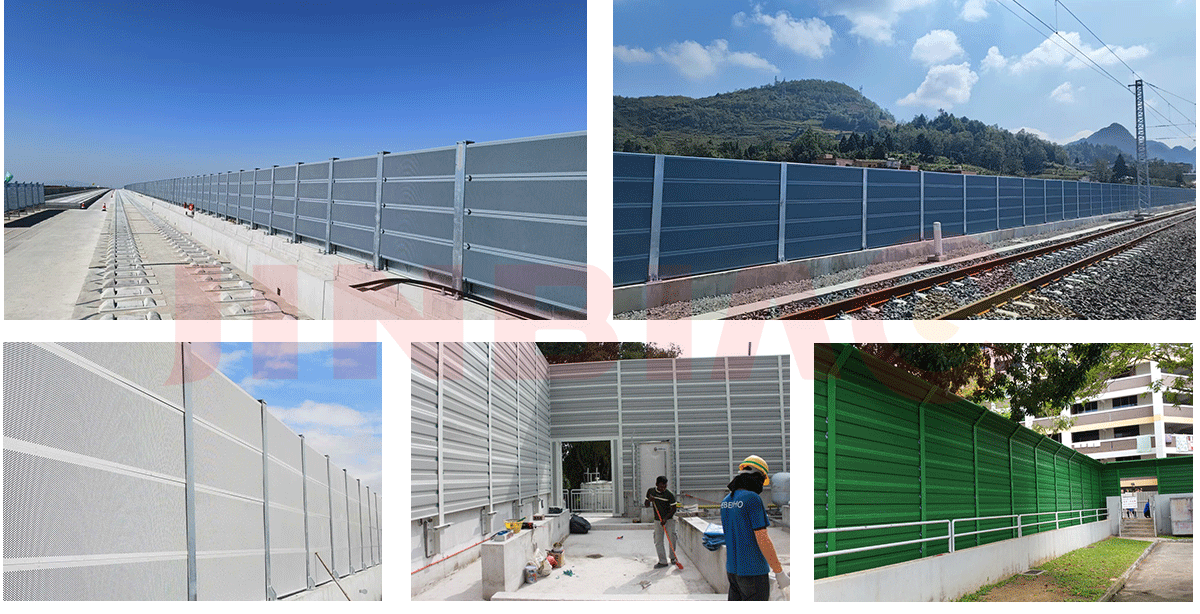
Structural Breakdown: Building a “Sound Wave Labyrinth”
This composite system typically consists of three layers, forming an efficient sound energy dissipation mechanism:
Outer and Inner Layers:
These are made of perforated aluminum panels or solid aluminum sheets. The perforated surface allows sound waves to enter the panel, while the back panel provides structural strength.
Core Layer (Acoustic Insulation + Honeycomb Core):
This is the key to sound insulation. The insulation material, with its fibrous or microporous structure, causes vibrations and air friction when sound waves pass through, converting sound energy into heat. Meanwhile, the honeycomb core creates multiple sealed cavities that block and reflect sound transmission.
Composite Structure Advantage:
These layers work together to achieve a combined effect of sound absorption, insulation, and dissipation.
Key Advantages of the Composite Structure
1. Acoustic Performance
The benefits of the composite design are clearly reflected in performance data. Compared to standard hollow aluminum honeycomb panels, reinforced panels filled with acoustic insulation achieve significantly higher sound insulation ratings, reducing noise energy by an additional order of magnitude.
Their sound absorption coefficient can exceed 0.9. In some configurations, the average sound insulation can reach 37 dB, with overall noise reduction of 20–30 dB under certain test conditions.
2. Reliable Fire Safety Performance
With increasing emphasis on fire safety, aluminum plate noise barriers offer clear advantages:
- Non-combustible Base Material: Aluminum alloy itself is non-combustible.
- A-Class Core Materials: Core materials such as rock wool and glass wool are A-class fire-rated, providing excellent fire resistance without producing toxic smoke.
- Balanced Safety and Sustainability: PET polyester fiber can achieve B-class fire ratings while offering improved environmental performance.
3. Environmental and Health Benefits
- Formaldehyde-Free: Panels can be manufactured using E0-grade adhesives, ensuring no harmful emissions.
- Recyclable Materials: Aluminum and certain insulation materials (e.g., rock wool, glass wool) are recyclable, supporting green building and circular economy practices.
4. Flexible Application Scenarios
The composite structure allows broad adaptability across different environments:
- Industrial & Transportation: High-speed railways, subways, bridges, highways
- Industrial Facilities: Factories, workshops, equipment rooms, substations, metro platforms
5. High Strength with Lightweight Design
Despite increased thickness, the panels remain lightweight:
- Lightweight & Strong: A 15mm aluminum honeycomb panel weighs only about 6 kg/m², much lighter than solid panels.
- Easy Installation: Reduced weight improves installation efficiency and shortens project timelines.
Comparison of Insulation Materials
| Property | Glass Wool | Rock Wool | PET Polyester Fiber |
|---|---|---|---|
| NRC (Sound Absorption) | High (0.75–0.95) | Very High (0.80–0.95) | Good (0.70–0.85) |
| Fire Rating | A-Class (Non-combustible) | A-Class (Non-combustible) | B-Class (Combustible) |
| Moisture Resistance | Moderate | Relatively Poor | Excellent |
| Environmental Impact | May release fibers | May release fibers | Non-toxic, dust-free |
Overall, aluminum plate noise barriers with insulation achieve a performance leap through intelligent material integration—truly a case of “1 + 1 > 2.” They overcome the limitations of traditional soundproofing materials such as excessive weight, poor moisture resistance, and low fire performance, while offering outstanding advantages like A-class fire resistance, formaldehyde-free composition, and recyclability.
FAQ
Q1: What is the typical thickness of aluminum panels?
A: Aluminum panels usually range from 0.8 mm to 2.0 mm, depending on project requirements.
Q2: Can aluminum noise barriers withstand extreme weather?
A: Yes, they are highly resistant to corrosion, UV exposure, and temperature changes.
Q3: Are aluminum plate noise barriers customizable?
A: Absolutely. They can be tailored in size, color, perforation pattern, and structure.
Q4: How effective are they in noise reduction?
A: They can reduce noise levels by 10–30 dB depending on design and installation.
Post time: Apr-13-2026