
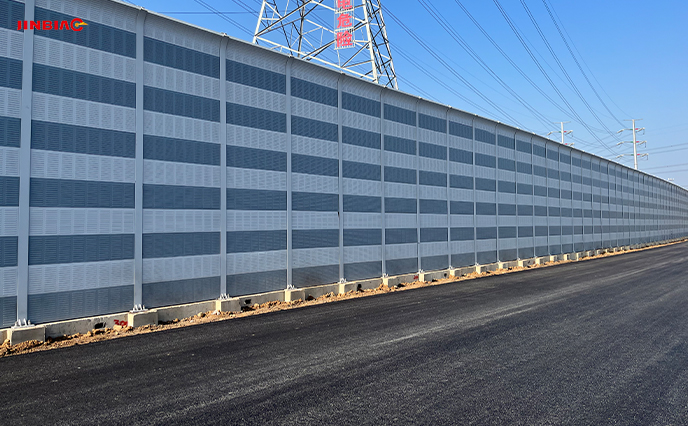
1. What Is a Curved Noise Barrier?
A curved noise barrier is a type of sound control structure featuring a rounded or arched top design. It is primarily used to block and absorb the propagation of sound waves. Compared with traditional vertical noise barriers, the curved top structure can more effectively alter the path of sound waves, reduce diffraction, and significantly improve noise reduction performance.
The basic principle of a noise barrier is to obstruct the direct transmission of sound waves. When sound waves encounter a barrier, part of the energy is reflected, part is absorbed, and some diffracts over the top. In conventional vertical barriers, this top-edge diffraction is more pronounced. However, curved noise barriers optimize the top geometry to redirect diffracted sound waves upward, thereby reducing noise levels on the protected side.
2. Structural Features of Curved Noise Barriers
A typical curved noise barrier consists of the following components:
Foundation Structure: Installed underground or on a surface base to ensure overall stability.
Posts/Columns: Usually made of H-shaped steel or other high-strength materials, serving as the main support framework.
Barrier Panels: The core part of the system, often composed of metal sheets, sound-absorbing materials, and transparent elements.
Curved Top Section: The defining feature that differentiates it from standard barriers; can be designed as semi-circular or arc-shaped depending on project requirements.
3. Key Advantages of Curved Noise Barriers
1>High Structural Strength
The curved design offers superior mechanical performance by effectively distributing wind loads. It provides better wind resistance than conventional vertical barriers and reduces stress concentration by minimizing sharp-angle connections, thereby lowering structural fatigue risk.
2>Enhanced Aesthetic Appeal
The streamlined, curved appearance aligns well with modern urban design. When combined with transparent materials, it helps reduce visual obstruction and improves driver comfort by maintaining visibility.
3>Strong Adaptability
The curvature and material combinations can be flexibly customized according to noise source characteristics and protection requirements, allowing for highly targeted acoustic solutions.
4.Common Types
Depending on materials and application scenarios, curved noise barriers can be categorized as follows:
Metal Curved Noise Barrier
Made of galvanized steel or aluminum panels with sound-absorbing filling materials.
Applications: Highways, urban viaducts, industrial zones
Transparent Curved Noise Barrier
Constructed using laminated glass or polycarbonate sheets.
Applications: Areas requiring natural light and clear visibility
Composite Curved Noise Barrier
Combines metal and transparent materials.
Applications: Projects balancing noise reduction and landscape design
Micro-Perforated Curved Noise Barrier
Uses micro-perforated acoustic panels for enhanced sound absorption.
Applications: Noise-sensitive environments
5. Application Scenarios
Curved noise barriers are widely used in:
Road Traffic: Highways, expressways, viaducts, and arterial roads near residential areas, schools, and hospitals
Rail Transit: High-speed railways, conventional rail lines, and above-ground metro sections
Industrial Noise Control: Factory boundaries, cooling towers, HVAC units, substations, and other equipment
Construction Sites: Temporary or permanent acoustic enclosures
6. Design and Installation Considerations
In practical engineering applications, the design of curved noise barriers should consider:
Noise Source Characteristics: Frequency distribution, sound pressure levels, and source height
Protection Targets: Location, height, and function of sensitive buildings
Environmental Conditions: Wind loads, seismic requirements, and temperature variations
Landscape Integration: Harmony with surrounding architecture and greenery
Cost Efficiency: Full lifecycle cost including materials, installation, and maintenance
During installation, it is essential to ensure precise foundation alignment, vertical accuracy of posts, and proper sealing between panels to prevent sound leakage through gaps.
As an innovative product combining acoustic theory with engineering practice, curved noise barriers demonstrate significant advantages in modern noise control. They not only overcome the limitations of traditional vertical barriers but also offer improvements in structural safety, aesthetic integration, and environmental adaptability.
With increasing public demand for better acoustic environments, curved noise barriers are set to play a vital role in building quieter and more livable cities.
If you are seeking an effective noise control solution, curved noise barriers are undoubtedly worth considering. It is recommended to consult professional acoustic experts and qualified manufacturers during the early project stage to achieve optimal noise reduction performance and cost efficiency through customized design.
Post time: Mar-30-2026