
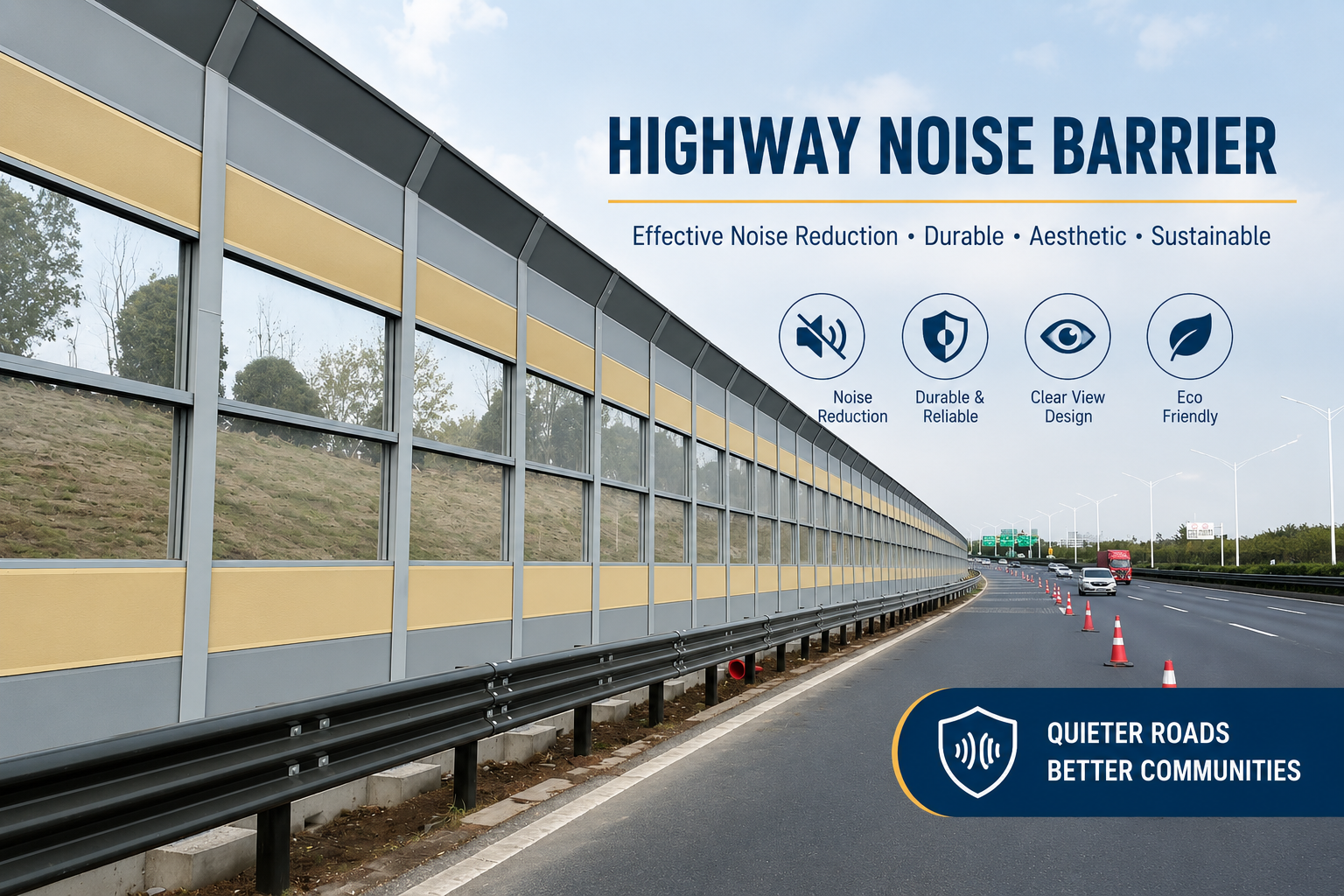
As urbanization and transportation networks continue to expand, highway traffic noise has become a major environmental concern for communities located near busy roads. Excessive traffic noise can negatively impact quality of life, public health, and property values. To address this issue, highway noise barrier systems have become one of the most effective and widely used solutions for traffic noise control.
A properly designed highway noise barrier can reduce noise levels by 10 dB or more, which is perceived as cutting traffic noise roughly in half. Whether you are planning a new expressway, upgrading an existing road, or seeking a customized acoustic barrier solution, understanding the different types of noise barriers is essential.
This guide explores the major categories of highway noise barriers, including their acoustic characteristics, structural designs, and material options.
Types of Highway Noise Barriers by Acoustic Performance
1. Reflective Highway Noise Barriers
Reflective highway noise barriers are constructed from dense, non-porous materials that block and reflect sound waves back toward the roadway. Instead of absorbing noise, these barriers prevent sound from traveling into nearby communities.
Common materials include:
• Concrete panels
• Steel panels
• Aluminum panels
Advantages
• Cost-effective solution
• Durable and long-lasting
• Easy to manufacture and install
Applications
Reflective road noise barrier systems are suitable when sensitive receptors are located on only one side of the roadway and reflected noise will not adversely affect neighboring areas.
2. Absorptive Traffic Noise Barriers
Absorptive traffic noise barriers incorporate sound-absorbing materials that convert sound energy into heat, significantly reducing reflected noise.
Common absorbing materials include:
• Rock wool
• Glass wool
• Porous concrete
• Mineral fiber materials
Compared with reflective systems, absorptive acoustic barriers help prevent sound from bouncing between barriers on opposite sides of the highway.
Advantages
• Superior noise reduction performance
• Reduced sound reflection
• Improved acoustic environment
Applications
Urban expressways, elevated highways, and locations where sound barrier walls are installed on both sides of the road.
3. Composite Sound Barrier Walls
Composite sound barrier wall systems combine sound insulation and sound absorption within a single structure.
Typically, the side facing traffic incorporates absorptive materials, while the opposite side provides strong sound insulation. This design delivers optimal noise reduction performance and is now the preferred solution for many highway noise barrier projects worldwide.
Advantages
• Excellent acoustic performance
• Reduced reflection and transmission
• Suitable for strict environmental standards
Applications
Highways, bridges, railways, and transportation corridors requiring high-performance noise control.
Types of Noise Walls by Structural Design
1. Vertical Noise Walls
Vertical noise walls are the most common and economical design. The panels are installed perpendicular to the ground, creating a straightforward barrier between traffic and surrounding communities.
Benefits
• Simple structure
• Fast installation
• Low maintenance costs
Best For
Standard highway and road noise barrier projects.
2. Curved-Top Noise Barriers
Curved-top highway noise barriers feature an arc-shaped upper section that bends toward the traffic source.
The curved design increases the sound path length and helps redirect sound waves upward, reducing diffraction over the barrier.
Benefits
• Improved acoustic performance
• Modern appearance
• Better visual appeal
Best For
Urban highway projects and aesthetically sensitive areas.
3. T-Shaped and Bent Acoustic Barriers
T-shaped, Y-shaped, and inverted L-shaped acoustic barrier designs extend the top of the barrier toward the roadway.
Research has shown that these specialized shapes can significantly improve the insertion loss of a traffic noise barrier without substantially increasing barrier height.
Benefits
• Enhanced noise reduction
• Improved sound diffraction control
• Greater efficiency than traditional vertical barriers
Best For
Roadways with strict noise mitigation requirements.
4. Semi-Enclosed Highway Noise Barrier Systems
Semi-enclosed highway noise barrier systems include side walls combined with a partial roof structure.
This design creates a partially enclosed acoustic space that offers substantially greater noise control than conventional barriers.
Benefits
• Significant reduction in traffic noise
• Effective for elevated roads
• Improved protection for nearby communities
Best For
Urban viaducts and densely populated areas.
5. Fully Enclosed Noise Wall Systems
Fully enclosed noise wall systems completely surround the roadway, creating a tunnel-like structure.
These systems provide the highest level of traffic noise control and can achieve noise reductions exceeding 20 dB.
Benefits
• Maximum acoustic performance
• Excellent environmental protection
• Suitable for strict noise regulations
Best For
High-density urban environments, residential districts, hospitals, and schools.
Types of Highway Noise Barriers by Material
Concrete Noise Barriers
Concrete remains one of the most widely used materials for highway noise barrier construction.
Its popularity stems from:
• Exceptional durability
• Long service life
• Resistance to weather and corrosion
• Low maintenance requirements
Concrete sound barrier walls can be manufactured with decorative textures that mimic stone, brick, or wood surfaces.
Metal Noise Barriers
Metal noise barriers typically use:
• Galvanized steel
• Aluminum
• Stainless steel
Perforated metal panels filled with sound-absorbing insulation create highly effective acoustic barrier systems.
Advantages
• Lightweight construction
• High structural strength
• Fast installation
• Customizable colors and finishes
Metal road noise barriers are commonly used along highways, railways, and industrial facilities.
Transparent Noise Barriers
Transparent highway noise barrier systems are manufactured from:
• Polycarbonate (PC)
• Acrylic (PMMA)
These barriers maintain visibility while reducing traffic noise, making them particularly popular in scenic areas and urban environments.
Advantages
• Excellent transparency
• Modern appearance
• Improved driver visibility
• Enhanced community acceptance
Photovoltaic Noise Barriers: The Future of Highway Noise Control
Photovoltaic Noise Barriers (PVNBs) combine the functions of a highway noise barrier and a solar power generation system.
Solar panels integrated into the noise wall structure generate renewable energy while simultaneously reducing traffic noise.
Key Benefits
• Dual-purpose infrastructure
• Renewable energy generation
• Reduced carbon emissions
• Improved land-use efficiency
• Support for sustainable transportation projects
As governments continue investing in green infrastructure, photovoltaic acoustic barriers are expected to become an increasingly important part of future highway developments.
How to Choose the Right Highway Noise Barrier
Selecting the best highway noise barrier requires evaluating multiple factors:
Noise Reduction Requirements
Determine the required insertion loss and local environmental standards.
Site Conditions
Consider roadway geometry, available space, terrain, and nearby structures.
Material Selection
Choose between concrete, metal, transparent panels, or composite systems based on performance and budget.
Aesthetic Considerations
Ensure the sound barrier wall complements the surrounding landscape and community environment.
Lifecycle Cost
Evaluate both initial installation costs and long-term maintenance expenses.
Sustainability Goals
Consider photovoltaic noise barriers if renewable energy generation is a project objective.
Conclusion
There are many types of highway noise barriers available today, ranging from reflective and absorptive systems to advanced composite, semi-enclosed, and fully enclosed structures. Material options such as concrete, metal, transparent panels, and photovoltaic systems allow engineers and project owners to tailor solutions for specific performance, budget, and aesthetic requirements.
Whether you are planning a highway noise barrier, road noise barrier, traffic noise barrier, acoustic barrier, sound barrier wall, or noise wall project, choosing the right system is essential for achieving effective and long-lasting noise control.
As a professional highway noise barrier manufacturer, we provide customized noise barrier solutions for highways, railways, bridges, industrial facilities, and urban infrastructure projects worldwide. Contact us today for expert recommendations and project support.
FAQ
1.What are the main types of highway noise barrier?
Absorptive metal systems, reflective metal or concrete systems, transparent barriers, curved-top and fully enclosed designs are the principal types.
2.Which type suits a bridge or viaduct?
Lightweight systems are preferred because of the structural loading, so aluminium or thin metal panels with transparent sections are commonly used on bridges.
3.Which type suits a residential area?
Absorptive barriers are typically chosen where dwellings sit close to the road, often with transparent upper panels to reduce the visual impact.
4.Can different barrier types be used on one project?
Yes – it is common for the barrier type to change along a corridor as height requirements, structure and view considerations change.
Post time: Jul-13-2026