
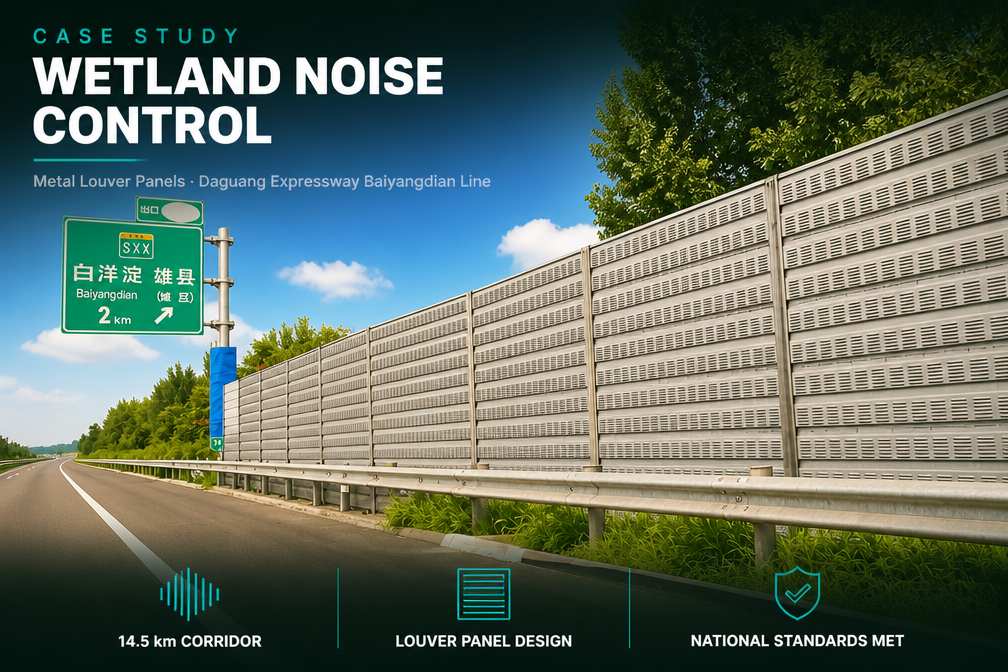
On the Baiyangdian branch line of the Daguang Expressway in Xiongxian, Hebei Province, a 14.5-kilometer corridor of highway noise barriers now protects one of China’s most ecologically valuable landscapes. The Baiyangdian expressway noise barrier project, supplied by Hebei Jinbiao, uses a vertical standing-panel design with metal louver-type noise barrier panels — a configuration chosen for easy installation and effective suppression of traffic noise. The line, fully open to traffic with noise reduction meeting national standards, demonstrates how modern sound barrier systems can deliver effective noise control while respecting the character of a protected wetland environment.
Project Background: Balancing Connectivity and Quiet
The construction of the expressway and the convenience it brings have indeed provided many benefits to the residents of villages along the route. With the growth of traffic volume, however, came a familiar problem: traffic noise began to affect the daily lives of residents in surrounding villages. In order to solve this noise problem properly, the relevant authorities studied the situation and designed and installed noise reduction barriers. Today, more and more projects along the road network use this approach to block traffic noise, and noise barriers are increasingly accepted as a standard part of highway construction.
This is precisely the context of the Baiyangdian branch line. The new expressway opened a fast corridor into the region — but it also introduced continuous traffic noise to a landscape of exceptional ecological value. Installing highway noise barriers along the corridor became essential to reconcile the needs of transportation and environmental quality.
The Noise Barrier Design: Vertical Panels with Metal Louvers
The noise barrier system along the Baiyangdian branch line adopts a vertical standing-panel design. The screen bodies are metal louver-type noise barrier panels — panels formed with a louvered profile that both reflects and diffuses sound energy, effectively suppressing the propagation of vehicle noise from the road toward surrounding areas. The louvered configuration is a proven acoustic treatment for highway applications, providing consistent attenuation across the traffic noise spectrum while remaining lightweight and easy to handle.
Key features of the barrier system include:
- Metal louver panels — the louvered metal surface diffuses and absorbs sound energy from passing vehicles, reducing noise reaching sensitive receptors on both sides of the corridor
- Easy, fast installation — the modular panels and simple fixing system allow rapid on-site assembly, minimizing disruption to traffic and the surrounding environment during construction
- Hot-dip galvanized steel structure — posts and framing are protected against corrosion to ensure a long service life in the humid wetland environment
- Durable, low-maintenance materials — components are selected to withstand moisture, seasonal temperature swings, and long-term UV exposure typical of the wetland climate
Project Overview: The Baiyangdian Branch Line
The completion and opening of the Daguang Expressway brought Xiongxian into Beijing’s one-hour transportation and living circle, strengthening the county’s position at the center of the Beijing-Tianjin-Baoding triangle. Taking the expressway as an opportunity, the county further improved its road network and began the construction of the Daguang Expressway Baiyangdian branch line. The line starts at K62+700 on the Beijing-Hengshui section, runs westward through the south of Longwan Village in Xiongxian, crosses the Daqing River, passes Wangjiafang and Huangwan Village, and terminates at the Baigou New City Expressway — a total length of 14.567 kilometers.
Hebei Jinbiao supplied the highway noise barrier products for this section. The road works and the noise barrier works have now been fully completed, the line is open to traffic, and the noise reduction performance complies with applicable standards.
The Ecological Significance of Baiyangdian
Baiyangdian is the largest freshwater lake wetland system in the North China Plain, comprising more than 140 lakes and covering an area of approximately 366 square kilometers. The wetland serves as a critical habitat for migratory birds on the East Asian-Australasian Flyway, hosting hundreds of bird species and serving as a vital water source for the region. As the ecological core of the Xiong’an New Area, the protection of Baiyangdian’s acoustic and ecological environment is a matter of national importance.
Noise pollution is a recognized stressor for wetland ecosystems. Prolonged exposure to traffic noise can interfere with bird communication, breeding behavior, and habitat use, and it degrades the natural soundscape that defines the wetland experience. The noise barrier system installed along the Baiyangdian branch line was therefore designed not merely to protect human residents, but to preserve the acoustic ecology of the wetland itself.
Acoustic Performance and Standards Compliance
The metal louver noise barrier system was engineered to meet the acoustic requirements of the project specification. Following the full completion of the line, noise levels at sensitive receptor locations — including residential areas along the corridor — were confirmed to comply with national noise standards for highway projects. The barriers deliver consistent attenuation of traffic noise, ensuring that the operational expressway does not degrade the acoustic environment of the adjacent wetland and communities.
The performance of the Baiyangdian noise barrier installation validates the effectiveness of metal louver panels in sensitive ecological corridors. The combination of reflection, diffusion, and sound absorption in a single lightweight panel system provides a practical, cost-effective solution that can be replicated across similar projects.
Integration with the Landscape
Beyond acoustic performance, the design of the Baiyangdian expressway noise barrier paid careful attention to visual integration with the wetland landscape. The neutral metallic finish of the panels blends with the natural tones of the wetland environment, while the compact vertical profile of the barrier minimizes visual intrusion on the surrounding countryside. This dual focus on acoustic and visual quality reflects a broader trend in highway engineering: modern expressway noise barrier design treats barriers not as utilitarian walls, but as integrated elements of the landscape.
By planning the barrier alignment to follow the road corridor closely and using modular components, the project minimized its footprint on adjacent wetland areas while delivering full noise protection.
Conclusion
The Baiyangdian expressway noise barrier project on the Daguang Expressway branch line is a model of responsible infrastructure development in an ecologically sensitive region. By combining metal louver panels with a vertical standing-panel design, durable galvanized steel structures, and careful landscape integration, the project delivers effective noise reduction for communities and wetland habitats alike — with measured performance meeting national standards. For engineers and agencies planning expressway projects through wetlands, nature reserves, or other sensitive environments, the Baiyangdian approach offers a proven template for reconciling mobility, quiet, and ecology.
Post time: Aug-24-2026