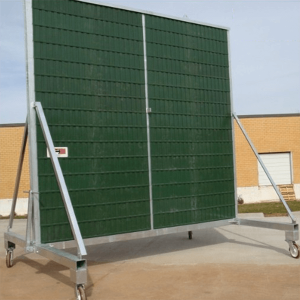
A louver noise barrier is an acoustic screen built from angled metal blades rather than a solid panel, so that it reduces noise while air continues to move through it. It is specified where a solid wall would be unacceptable because something behind it has to breathe: cooling towers, plant rooms, generator test cells, substation equipment, kitchen extract, and mechanical areas where heat has to leave and a fan cannot be relied on. The blades deflect and absorb sound; the open area keeps the airflow.
How a louver noise barrier reduces noise
A solid panel stops sound by mass and blocks air with it. A louver noise barrier takes a different route: the blades are set at an angle so that a sound path has to bend around them, and each bend costs energy, while an air path straight through the gap stays open. Behind the blades sits an absorptive infill, usually mineral wool behind a protective facing, so that the energy which does enter the cavity is absorbed rather than reflected back out. The result is a screen that attenuates less than a solid wall of the same size but does it without stopping ventilation.

Where airflow decides the louver noise barrier design
The most common mistake is treating a louver noise barrier as a wall with holes in it. The louver is sized by the equipment behind it first — how much air it moves, what temperature rise it can tolerate, and whether the airflow path is horizontal or vertical — and only then by the acoustic target. A cooling tower that loses its draught will lose its performance, and the noise complaint is replaced by an operational one.
The louver noise barrier trade-off
Louver performance moves in the opposite direction to airflow. Close the blades, overlap them more, or add depth, and attenuation improves while free area and airflow fall. Open it up and the fan works properly while more noise escapes. There is no louver that is simultaneously fully open and acoustically solid, which is why a specification should state both a free-area target and an acoustic target, and accept that the two will meet somewhere in the middle. A supplier quoting an attenuation figure without quoting the free area has quoted half a product.
Blade geometry
Three parameters do the work: blade angle, blade pitch and blade depth. Steeper blades and tighter pitch give more attenuation and more resistance to airflow; deeper blades add a longer path for the sound to travel. Blades are typically formed from galvanised steel or aluminium sheet, and where the screen is also visible from a public road the blade face is powder coated to a specified RAL colour so the louver reads as part of the elevation.

Materials, coating and service life
Galvanised steel is the default structural choice, with hot-dip galvanizing to a recognised standard for the frame and fixings and a powder coat where colour matters. Aluminium is used where weight is critical — roof-mounted screens, plant decks with limited load capacity — and requires its own coating system to survive coastal or industrial atmospheres. Because a louver noise barrier has many edges and cut faces, the detailing of those edges controls how long it lasts: an unsealed cut on a coated blade is where corrosion starts.
Combining louver screens with absorptive panels
Louver sections are often used only where ventilation is required, with solid absorptive panels making up the rest of the run. That hybrid is usually the economical answer: the louver does the job the solid panel cannot, and the solid panel does the acoustic work at a lower cost per square metre.

Typical louver noise barrier specification
| Item | Typical range |
| Blade material | Galvanised steel or aluminium sheet |
| Blade form | Angled single or double-deflection blades |
| Infill | Mineral wool or fibreglass behind a protective facing |
| Frame | Galvanised steel posts, powder coated to RAL where visible |
| Finish | Hot-dip galvanised and/or powder coated |
| Free area | Set by the airflow requirement of the equipment served |
| Mounting | Ground-mounted screen, plant enclosure wall, or roof-level acoustic screen |
What to send for a quotation
The equipment behind the screen and its airflow requirement, the acoustic target at the nearest receiver, the available opening size and whether the airflow is horizontal or vertical, the colour requirement and whether the screen is visible from a public area, and the exposure — coastal, industrial or inland.
FAQ
1.How does a louver noise barrier reduce noise while allowing ventilation?
Angled metal louvers deflect and absorb sound while letting air pass through, preventing wind-pressure build-up – suited to cooling towers, plants and equipment areas.
2.What materials are used for louver panels?
Galvanized steel or aluminum sheet with powder coating or hot-dip galvanizing for long outdoor service.
3.Where are metal louver noise barriers commonly installed?
Highways, railways, bridges, industrial plants, cooling towers and mechanical-equipment areas where both noise control and airflow are required.
4.Does the louver system include sound-absorbing infill?
Internal sound-absorbing infill such as mineral wool can be added to further improve absorption performance.
5.Can louver panels be produced to custom sizes and colors?
Yes – panels are fabricated to project drawings with custom dimensions and RAL color options.
6.Is a louver noise barrier as good as a solid wall acoustically?
No. It attenuates less than a solid panel of the same size because the open area lets sound through. It is chosen where ventilation is mandatory, and the remaining run is normally built from solid absorptive panels.