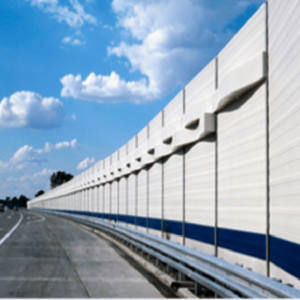
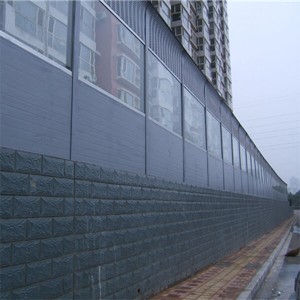
A polycarbonate noise barrier is a sound barrier built with transparent polycarbonate panels instead of glass or acrylic. The panels keep the view and the daylight open while the barrier reduces traffic noise, and the material is chosen where a transparent wall also has to survive impact — stones thrown from an overpass, vandalism on an urban viaduct, a vehicle strike on a bridge deck. Polycarbonate deforms under that kind of load rather than shattering, which is the single reason it displaces glass on most transport projects.
Why a polycarbonate noise barrier rather than glass or acrylic
Glass gives the highest optical clarity but fails as fragments, and a barrier above a live carriageway cannot shed fragments. Acrylic is clear and UV-stable but brittle under a sharp blow. Polycarbonate sits between them: slightly lower clarity, considerably higher impact resistance, and roughly half the weight of glass, which keeps post loads and foundations lighter. A polycarbonate noise barrier is therefore the usual answer wherever the transparent tier is exposed to people, traffic or debris.

Polycarbonate noise barrier: solid sheet or multiwall
Two panel forms are used, and they are not interchangeable. A solid polycarbonate sheet is the clearest option and behaves like a simple mass barrier. A multiwall or twin-wall sheet has internal ribs, which adds stiffness and a layer of trapped air, so a thinner multiwall panel can match the sound insulation of a thicker solid one at lower weight — but it reads slightly milky, gathers dust in the flutes if the edges are not sealed, and can show condensation inside the cavity if the panel is installed without ventilation. On a highway barrier where the point is to see through, solid sheet is usually specified; multiwall is more common on industrial screens and plant enclosures.
Thermal movement in a polycarbonate noise barrier
Polycarbonate expands roughly seven times as much as steel per degree of temperature change. A three-metre panel on a site that swings forty degrees will move by close to ten millimetres, and if the frame clamps it rigidly that movement goes into the sheet as stress — causing bowing, crazing at fixings, or gasket failure. A properly detailed polycarbonate noise barrier therefore uses oversized rebates, slotted or floating fixings, and gaskets that allow the panel to slide. This is the detail that separates a barrier that survives five summers from one that does not, and it is why the frame design matters as much as the sheet.

UV protection and yellowing in a polycarbonate noise barrier
Polycarbonate degrades under ultraviolet light unless it is protected, and the protection is normally a co-extruded UV layer on the outward face. Specify UV-stabilised grades and fit the panel the right way round; a panel installed with the protected face inward will yellow on the exposed side. Even properly protected material changes slightly over a long service life, which is worth stating openly on a residential scheme where the visual expectation is high. Our note on how long highway barriers really last sets out what drives that curve.
Acoustic behaviour and hybrid design
Like any transparent panel, a polycarbonate noise barrier reflects sound rather than absorbing it: it insulates, it does not absorb. Where a corridor has walls on both sides, or the receiver faces a reflective surface, the reflecting tier has to be balanced with absorption, and the usual arrangement is a hybrid — transparent polycarbonate panels in the upper band where the view matters, absorptive metal panels below where the acoustic work is done. Our microporous absorptive panel is the matching lower element for that arrangement.

Cleaning and replacing polycarbonate noise barrier panels
Wash with water and a mild detergent, using a soft brush or cloth; avoid ammonia-based cleaners, solvents and dry wiping on a dusty surface, all of which haze the sheet. Panels are individually replaceable within the frame, so a damaged unit does not require the run to be dismantled.
Typical polycarbonate noise barrier specification
| Item | Typical range |
| Panel material | Polycarbonate, UV-protected on the exposed face |
| Panel form | Solid sheet, or multiwall / twin-wall |
| Panel thickness | Set by wind load, span and required insulation |
| Weight | Approximately half that of glass at equal thickness |
| Frame | Galvanised steel or aluminium, powder coated to RAL |
| Fixing | Slotted or floating, with EPDM gaskets for thermal movement |
| Colour options | Clear, bronze, grey, green and blue tints |
What to send for a quotation
Barrier length and height, module or post spacing, design wind speed, whether the panel is solid or multiwall, the tint and whether transparency is required at eye level or full height, plus any impact or fire classification the project imposes. With those, a polycarbonate noise barrier can be detailed as a complete system.
FAQ
1.What is a PC (polycarbonate) transparent noise barrier?
A noise barrier with transparent polycarbonate panels that keep the view open while attenuating traffic noise.
2.Is polycarbonate strong enough for highway use?
Polycarbonate is impact-resistant and lighter than glass, a common choice for elevated highway and bridge barriers.
3.Does the transparent panel block or absorb sound?
Transparent panels mainly block (reflect) sound; for absorption they are combined with absorptive lower panels in hybrid designs.
4.Does PC yellow or age in sunlight?
UV-stabilized polycarbonate grades are available to resist yellowing; specify UV protection for long service.
5.Can transparent and solid panels be mixed in one system?
Yes – hybrid barriers commonly use transparent upper panels above solid or absorptive lower panels.
6.How much does a polycarbonate panel move with temperature?
Roughly seven times as much as steel at the same temperature change. Frames need oversized rebates and slotted fixings so the sheet can move without stressing the edges.
7.Is multiwall better than solid sheet?
Multiwall adds stiffness and trapped air at lower weight but reduces clarity and can collect dust or condensation inside the flutes. Solid sheet suits sightline-critical barriers; multiwall suits industrial screens.