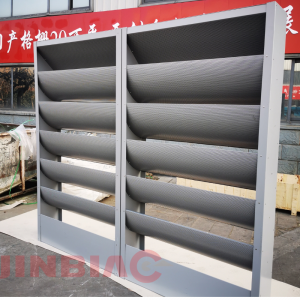
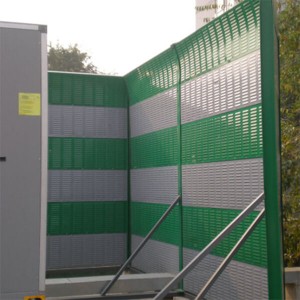
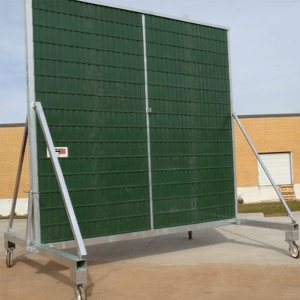
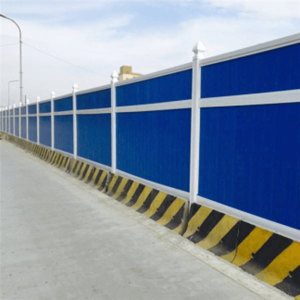
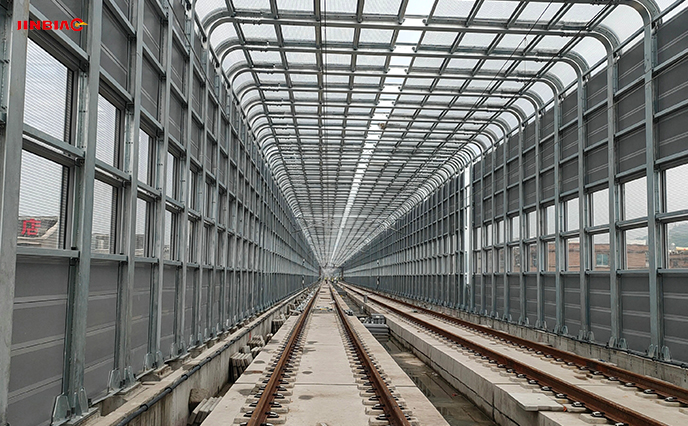
Fully Enclosed Sound Barrier is a high-performance noise control system designed to provide maximum noise reduction for highways, railways, bridges, and urban transportation corridors. Unlike traditional vertical noise barriers, this system adopts a fully enclosed or semi-enclosed structural design that surrounds the noise source, forming a tunnel-like acoustic structure.
By enclosing the road or railway with sound-absorbing and sound-insulating panels, the fully enclosed sound barrier significantly reduces the spread of noise to surrounding residential areas, commercial zones, and public spaces. The internal panels are typically designed with perforated metal sheets combined with sound-absorbing materials such as mineral wool or fiberglass, which effectively absorb and dissipate sound waves.
The supporting structure is usually made from high-strength galvanized steel or aluminum frames to ensure structural stability and long-term durability. Transparent materials such as tempered glass or polycarbonate panels can also be integrated into the design to maintain natural lighting and visibility.
Fully enclosed sound barriers are widely used in densely populated urban areas, elevated highways, rail transit systems, and bridges where strict environmental noise control standards are required.
FAQ
1.What is a fully enclosed noise barrier?
A canopy-style enclosure that covers the road or track on top and both sides to contain noise from all directions – used in dense residential areas.
2.When is a full enclosure needed instead of vertical barriers?
When receptors are close to tall buildings or where vertical barriers cannot reach the noise path, e.g. high-rise residential zones beside viaducts.
3.How are maintenance and fire safety handled in enclosures?
Design includes ventilation, lighting and access provisions; materials are selected with fire-performance requirements in mind.
4.Can enclosures include transparent roofs or panels?
Transparent segments can be incorporated for daylight and driver visibility where design allows.