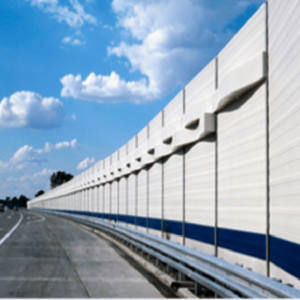
A color steel plate noise barrier is a sound barrier whose panels are formed from pre-painted steel sheet — steel coil coated at the mill, then roll-formed into profiled or perforated panels. The coating is what gives the barrier its colour and much of its weather resistance, and the panel profile is what gives it stiffness. It is one of the most common barrier types on road schemes because it is light, quick to erect, available in a wide colour range, and can be made either reflective or absorptive depending on whether the sheet is solid or perforated.
What a color steel noise barrier is made from
The substrate is a zinc-coated steel sheet, coated on one or both faces with a paint system and cured before forming. Because the coating is applied to flat coil rather than to a finished panel, the finish is uniform and the colour is consistent across a long run — which is the main reason a color steel noise barrier is chosen where the barrier will be seen as a continuous elevation rather than as a functional fence. Sheet thickness for barrier panels is typically in the range of half a millimetre to just over one millimetre, with the profile doing the stiffening work.

Solid or perforated color steel noise barrier panels
A solid color steel noise barrier is a reflective panel. It works as a mass barrier, blocking sound and sending it back into the corridor. That is adequate on a single-sided barrier in open ground, and it is the least expensive way to build height. Where the corridor has walls on both sides, or receivers sit opposite a reflective surface, a solid panel makes the reflections worse and the net result disappoints.
The absorptive version is the same panel with perforations in the face sheet and an acoustic infill behind it, usually mineral wool faced with a protective fleece. The perforations let sound into the cavity, the infill absorbs it, and the panel stops behaving as a mirror. A color steel noise barrier of this type costs more per square metre and is usually specified on the noisy side of a corridor, with plain panels used elsewhere.

Coating systems for a color steel noise barrier
Three systems cover most work. Polyester is the standard choice for inland sites with normal exposure and gives a good colour range at moderate cost. High-durability polyester is specified where the colour has to hold over a longer service life or the site sees more sun. PVDF coatings are the most weather-resistant option and are normally reserved for coastal, industrial or highly visible schemes where repainting is impractical. The distinction matters less on a grey inland road and more on a seafront or a landmark viaduct, where the finish is the visible part of the investment.
Profile and span in a color steel noise barrier
The panel profile is doing structural work, not decoration. A shallow trapezoidal profile with a deeper rib resists wind pressure across a wider post spacing than a flat sheet of the same gauge, and it also affects how the panel sounds when it is struck. Post spacing, panel height and design wind load therefore decide the profile and the gauge together. Where a scheme needs a longer span or a taller barrier, the answer is usually a deeper profile rather than a heavier flat sheet.

Edges, fixings and corrosion
Coated steel fails at its cut edges before it fails anywhere else. Every edge, fixing hole and site cut is a place where the coating no longer protects the substrate, so panels are detailed with folded edges, sealed washers and fixings that do not crush the coating. On a coastal scheme the fixings and the post coating matter as much as the panel: a well-coated panel on a poorly protected post still looks like a failure within a few years. Our notes on barrier maintenance set out what to inspect and how often.
Colour, landscape and glare
Because the colour is set at the coil stage, a color steel noise barrier can be matched to a landscape palette or to adjacent structures across a long run — greens and greys for rural alignments, warmer tones where the barrier passes housing. Two practical points are worth raising early: very dark colours absorb heat and show every mark, and gloss finishes can produce glare for drivers at low sun angles, so matt or low-sheen systems are usually the better specification on a highway.

Typical color steel noise barrier specification
| Item | Typical range |
| Substrate | Zinc-coated steel sheet |
| Sheet thickness | 0.5 mm to 1.2 mm, profile-dependent |
| Panel type | Solid (reflective) or perforated with acoustic infill (absorptive) |
| Coating | Polyester, high-durability polyester, or PVDF |
| Colour | RAL range, matt or low-sheen for highway use |
| Frame | Galvanised steel H-posts, hot-dip galvanised |
| Typical module | 2 m to 4 m post spacing, set by wind load and profile |
What to send for a quotation
Barrier length and height, the design wind load, whether the panels must absorb or may reflect, the colour or RAL reference and the gloss level, the exposure category, and whether the barrier is single-sided or part of a parallel-wall corridor.
FAQ
1.What is a color steel plate noise barrier?
A barrier built from coated (pre-painted) steel sheet panels; the panels can be plain, profiled or perforated depending on whether sound insulation or absorption is required.
2.Is a color steel plate barrier absorptive or reflective?
A solid color steel sheet acts mainly as a reflective/insulating panel; absorbent performance requires perforations or louvers combined with an internal sound-absorbing infill.
3.Which coating systems and colours are available?
Common options include polyester, high-durability polyester and PVDF coatings in a wide RAL colour range, selected according to exposure and the design intent.
4.How is the coating maintained over the service life?
Coating durability depends on the system, environment and exposure; routine inspection of edges and fixings and local touch-up are normally recommended.
5.Why do coated panels corrode at the edges first?
Cutting and drilling expose bare steel, so folded edges, sealed washers and fixings that do not damage the coating are what decide how long the panel lasts.
6.Can the colour be matched to surrounding structures?
Yes. Colour is set at the coil-coating stage, so a run can be produced to a RAL reference. Matt or low-sheen finishes are preferred on highways to avoid glare at low sun angles.