
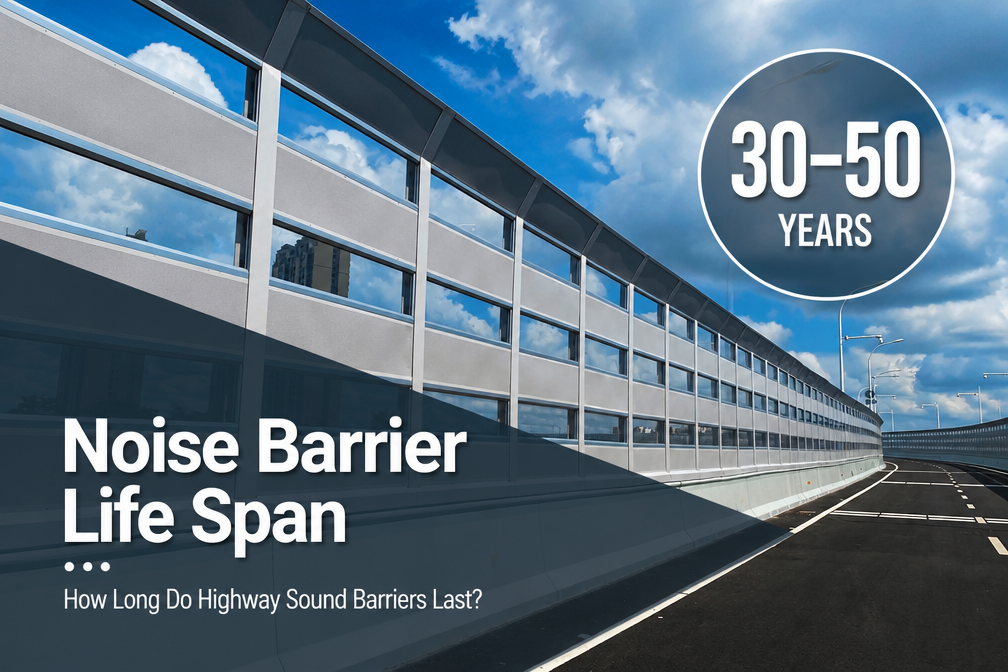
How long does a highway noise barrier last? For projects using metal barriers and transparent panels — the two most widely specified modern systems — the noise barrier life span typically ranges from 15 to 50 years, depending on material, environment, and maintenance. This guide focuses exclusively on these two material categories, explaining what determines their life span, realistic service-life expectations, and the practices that maximize long-term durability.
What Determines Noise Barrier Life Span
Both metal and transparent barrier systems are engineered as long-term assets with a design life of 30 to 50 years, but the noise barrier life span actually achieved depends on several factors:
• Material selection — corrosion resistance and UV stability are the dominant material properties
• Environmental exposure — coastal salt, deicing chemicals, UV radiation, and temperature extremes
• Structural design — wind load capacity, thermal expansion detailing, and foundation quality
• Installation quality — fabrication tolerances and on-site assembly standards
• Maintenance program — inspection frequency and promptness of repairs
A well-designed metal barrier in a moderate inland climate can reach 50 years of service, while a transparent panel system neglected in a high-UV environment may need replacement in under 15. Understanding these variables is the first step toward extending noise barrier life span.
Metal Barrier Life Span: 30 to 50 Years
Galvanized Steel Barriers
Galvanized steel barriers are the workhorse of highway noise control, with a typical service life of 30 to 50 years. The hot-dip zinc coating protects the steel by corroding sacrificially — the zinc wears away first, shielding the steel beneath. The noise barrier life span of a galvanized system depends primarily on coating thickness and environmental severity. In inland climates with moderate rainfall, standard galvanizing to ASTM A123 often delivers 40 years or more. In coastal zones or regions with heavy deicing-salt use, the same coating may be consumed in 20 to 25 years unless a thicker duplex system is specified.
Aluminum Barriers
Aluminum barriers offer the longest noise barrier life span in corrosive environments, commonly exceeding 50 years. Aluminum forms a self-healing oxide layer that requires no protective coating, making it effectively immune to the salt and chemical attack that shortens steel life. The trade-offs are higher initial cost and lower stiffness, which requires thicker panel sections. For coastal highways and bridges where corrosion is the dominant threat, aluminum’s extended life span often makes it the most economical choice over the full service period.
Factors That Shorten Metal Barrier Life
The most common causes of premature metal barrier failure are corrosion at cut edges and fastener holes, where protective coatings are disrupted during fabrication or installation. Field-drilled holes, torch-cut ends, and damaged coatings create entry points for moisture. Once localized rust develops, it can spread beneath the coating if not treated promptly. Galvanic corrosion between dissimilar metals — such as steel posts with aluminum panels — is another risk that must be addressed with proper isolation detailing. Regular inspection and touch-up of damaged coatings are the most effective ways to protect metal noise barrier life span.
Transparent Panel Life Span: 15 to 30 Years
Transparent panels have a shorter life span than metal systems because they are vulnerable to UV degradation and surface wear, but they remain highly valued for preserving sightlines on scenic and urban corridors. The transparent panel life span varies significantly by material.
Acrylic (PMMA) Panels
Acrylic panels typically last 20 to 30 years when manufactured with UV-stabilized formulations. Acrylic maintains excellent optical clarity — transmitting up to 92% of light — but gradually develops surface micro-cracking and haze over decades of sun exposure. Scratches from cleaning and wind-borne debris accelerate clarity loss. Acrylic’s life span is also affected by thermal expansion: poorly detailed edge restraints can induce stress cracking that shortens panel life dramatically. Proper gasketing and expansion allowances are essential to reaching the full 30-year potential.
Polycarbonate Panels
Polycarbonate panels offer exceptional impact resistance — roughly 250 times that of glass — but are the most UV-sensitive transparent material. Unprotected polycarbonate yellows and loses impact strength within 5 to 10 years. With a co-extruded UV-protective cap layer, quality polycarbonate panels reach 15 to 20 years of service. The cap layer is critical: if it is scratched, eroded, or abraded, the underlying material degrades rapidly. Polycarbonate is the best choice where impact resistance outweighs longevity, such as high-vandalism urban locations.
Laminated Glass Panels
Laminated glass delivers the longest transparent panel life span at 25 to 30+ years, with outstanding scratch resistance and zero yellowing over its service life. Tempered or heat-strengthened glass with PVB interlayers retains shattered fragments on impact, providing safety without sacrificing durability. Glass is heavier and more expensive than acrylic or polycarbonate, but its clarity retention and chemical resistance make it the premium long-life option for landmark projects where replacement access is difficult.
Extending the Life Span of Metal and Transparent Barriers
Design for the Environment
The most effective way to maximize noise barrier life span is to specify materials matched to local conditions: aluminum or duplex-coated steel in coastal areas, thicker galvanizing in deicing-salt regions, and UV-stabilized acrylic or glass where sunlight is intense. Thermal expansion detailing and corrosion-resistant stainless steel fasteners are critical for both system types.
Preventive Maintenance
For metal barriers, the maintenance priority is annual inspection of coatings, fasteners, and cut edges, with prompt zinc-rich touch-up of any damage. For transparent panels, the priority is regular cleaning with approved agents and soft tools to avoid scratching, plus inspection of gaskets and edge seals that protect the panel edges. Both systems benefit from drainage maintenance to prevent water pooling at the base.
Plan for Component Replacement
Realistic life-cycle planning treats transparent panels as replaceable components within a longer-lived metal framework. A galvanized steel structure may last 40 years while its transparent panels are replaced once or twice in the same period. Designing for modular panel replacement — accessible fasteners, standard panel sizes, and replaceable gaskets — dramatically reduces replacement cost and keeps the full system functional for its entire intended life span.
Life Cycle Cost and Life Span
Noise barrier life span directly drives ownership cost. A cheap panel replaced twice in 30 years often costs more than a premium panel installed once. Life cycle cost analysis should compare initial purchase, installation, cleaning, inspection, coating touch-up, panel replacement, and disposal across the full analysis period. In many cases, aluminum barriers and UV-stabilized glass panels — despite higher upfront prices — deliver the lowest cost per year of service. Specifying for life span rather than first cost is the single most effective procurement strategy.
Conclusion
The noise barrier life span of metal and transparent systems is an outcome of material choice, environmental reality, and maintenance commitment. Galvanized steel delivers 30 to 50 years, aluminum exceeds 50, and transparent panels range from 15 to 30 years depending on material and UV protection. By choosing materials matched to the environment, installing them correctly, and maintaining them systematically, agencies and contractors ensure that every dollar invested in highway noise mitigation delivers measurable protection for decades — and that the barrier’s life span is maximized, not merely assumed.
FAQ
1.How long do metal noise barriers really last?
With correct surface treatment (hot-dip galvanizing / powder coating) metal systems provide long service; warranty and maintenance guidance available on request.
Post time: Aug-10-2026