
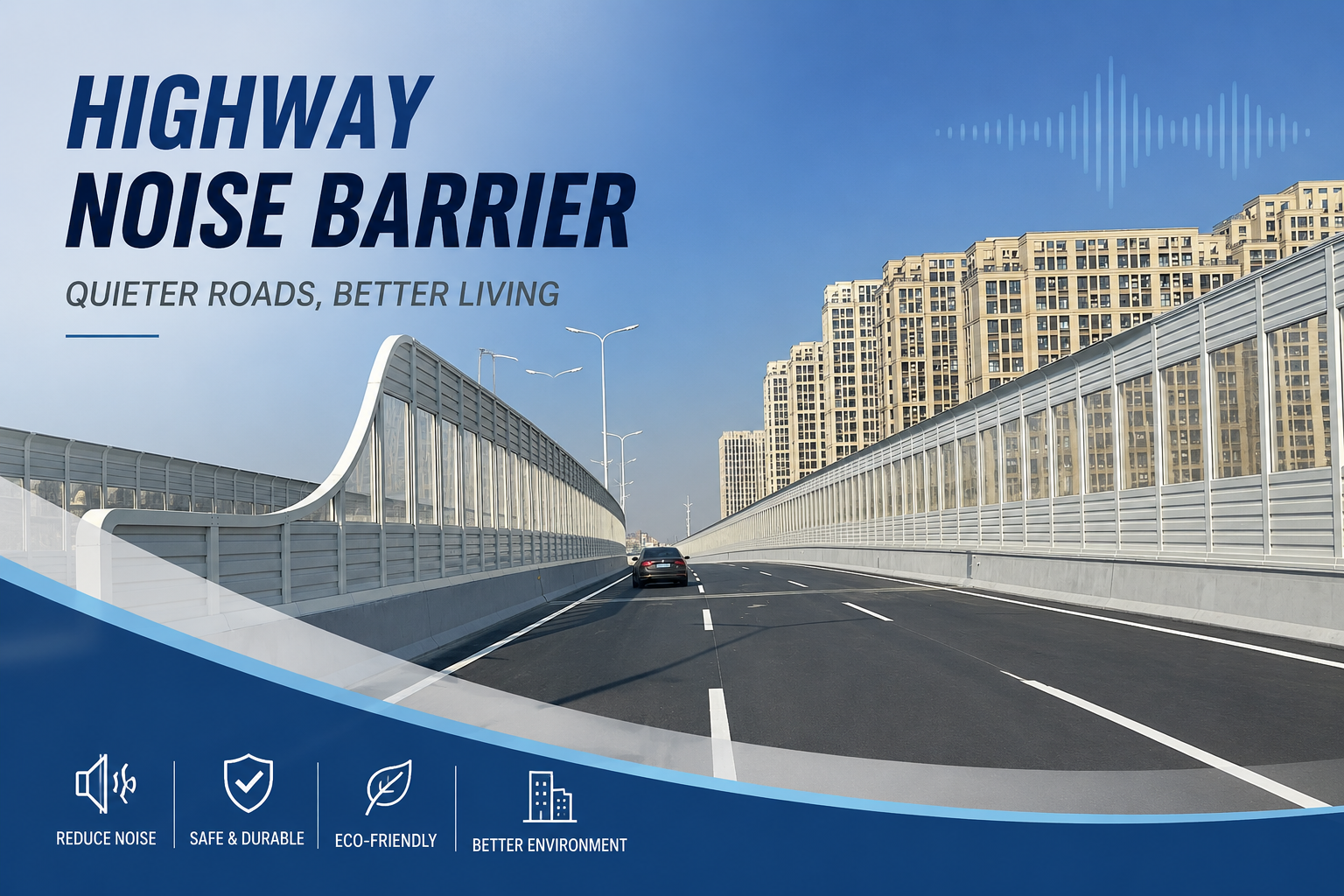
Highways make travel faster and more convenient, but the noise generated by fast-moving vehicles can significantly affect nearby residents. Long-term exposure to traffic noise may not only reduce quality of life but also have negative impacts on health. Highway noise barriers, also known as sound barriers or acoustic barriers, are one of the most effective solutions for controlling road traffic noise.
In this article, we explain in simple terms how highway noise barriers work, what materials are commonly used in noise barrier design.
Why Do Noise Barriers Reduce Traffic Noise?
Sound travels through vibrations in the air. When a noise barrier is installed between a roadway and a residential area, it reduces noise primarily through two mechanisms:
Sound Reflection
Similar to how a mirror reflects light, a noise barrier reflects part of the sound energy back toward the source. Dense and heavy materials provide better sound insulation performance. For example, metal noise barriers are highly effective at blocking sound transmission.
Sound Absorption
Porous materials absorb sound energy much like a sponge absorbs water. Materials such as mineral wool or glass wool allow sound waves to enter tiny pores, where friction converts sound energy into heat, reducing the amount of noise that continues to travel.
Most modern highway noise barriers combine both functions. The road-facing side typically contains sound-absorbing materials, while the rear side uses sound-insulating panels. This combination effectively blocks traffic noise while minimizing unwanted sound reflections.
Common Noise Barrier Materials and How to Choose Them
Selecting the right material requires balancing acoustic performance, durability, cost, and appearance.
Metal Panels (Aluminum or Galvanized Steel)
Metal panels offer excellent strength and long service life. They are often perforated and filled with sound-absorbing insulation, creating a composite sound barrier with both absorption and insulation properties.
Transparent Panels (Polycarbonate or Laminated Glass)
Transparent noise barriers maintain visibility and natural light while reducing noise. They are widely used in scenic areas, urban roads, bridges, and locations where preserving views is important.
In general:
• For superior sound absorption, choose perforated metal panels with acoustic insulation.
• For visibility and aesthetics, choose transparent polycarbonate or glass panels.
Noise Barrier Shapes: Height and Structure Matter
The shape and geometry of a noise barrier directly influence its acoustic performance.
Straight Vertical Noise Barriers
These are the most common and cost-effective designs. Typically 3–5 meters high, they can reduce traffic noise by approximately 10–15 dB.
T-Shaped, Y-Shaped, and Cantilevered Barriers
These designs feature an overhanging top section that blocks sound waves attempting to travel over the barrier. They generally provide better noise reduction than standard vertical walls.
Fully Enclosed Noise Barriers
Resembling a tunnel structure, fully enclosed barriers surround the roadway and provide maximum noise control. They are commonly used near hospitals, schools, and other noise-sensitive areas.
Key Design Principles
• The closer the barrier is to the noise source, the better the performance.
• Increasing barrier height generally improves noise reduction.
• Beyond approximately 5 meters, adding a cantilevered or curved top often provides greater benefits than simply increasing height.
• The total barrier length should ideally be at least five times its height to minimize sound leakage around the ends.
Innovative and Aesthetic Noise Barrier Solutions
Modern highway noise barriers are evolving beyond simple noise control systems.
Solar Noise Barriers
Photovoltaic (PV) panels can be integrated into noise barrier structures, allowing them to generate renewable energy while reducing traffic noise. These systems transform highways into sustainable energy corridors.
Architectural and Landscape Designs
Many cities incorporate artistic elements into noise barriers, including colorful coatings, decorative patterns, cultural artwork, and transparent sections that preserve scenic views. As a result, noise barriers can become attractive features rather than visual obstacles.
Standards and Design Requirements
Noise barrier design must comply with relevant national and international standards covering acoustic performance, structural safety, fire resistance, and weather durability.
Typical requirements include:
• Sound insulation performance of at least 30 dB.
• Specified sound absorption coefficients.
• Structural stability under wind loads and environmental conditions.
• Long-term durability and fire-resistant properties.
Compliance with these standards ensures that the barrier remains safe, effective, and reliable throughout its service life.
Conclusion
A highway noise barrier is much more than a simple wall. It is a comprehensive engineering solution that combines acoustics, materials science, structural design, and aesthetics.
Different environments require different approaches:
• Urban roads often prioritize appearance, transparency, and visual integration.
• Rural highways typically focus on cost-effectiveness and durability.
• Schools, hospitals, and residential areas may require advanced or fully enclosed noise barrier systems.
As technologies such as solar integration, 3D printing, and smart materials continue to develop, future noise barriers will do more than reduce traffic noise. They will contribute to sustainability, enhance infrastructure aesthetics, and improve the quality of life for communities located along transportation corridors.
If you are planning a highway project or looking for an effective traffic noise reduction solution, understanding the fundamentals of noise barrier design is the first step toward achieving both acoustic performance and visual appeal.
The key to a successful highway noise barrier is simple: choose the right materials, adopt the right design, and embrace innovative technologies to achieve both noise reduction and aesthetics.
Post time: Jul-20-2026