
The Rongwu Expressway runs about 1,820 km from Rongcheng on the Shandong coast to Wuhai in Inner Mongolia. It carries the national designation G18 and passes through Weihai, Yantai, Dongying, Huanghua, Tianjin, Bazhou, Laiyuan, Shuozhou and Ordos before reaching its western terminus, which makes it one of the longest continuous east–west arteries in the network and one of the busiest for heavy freight.
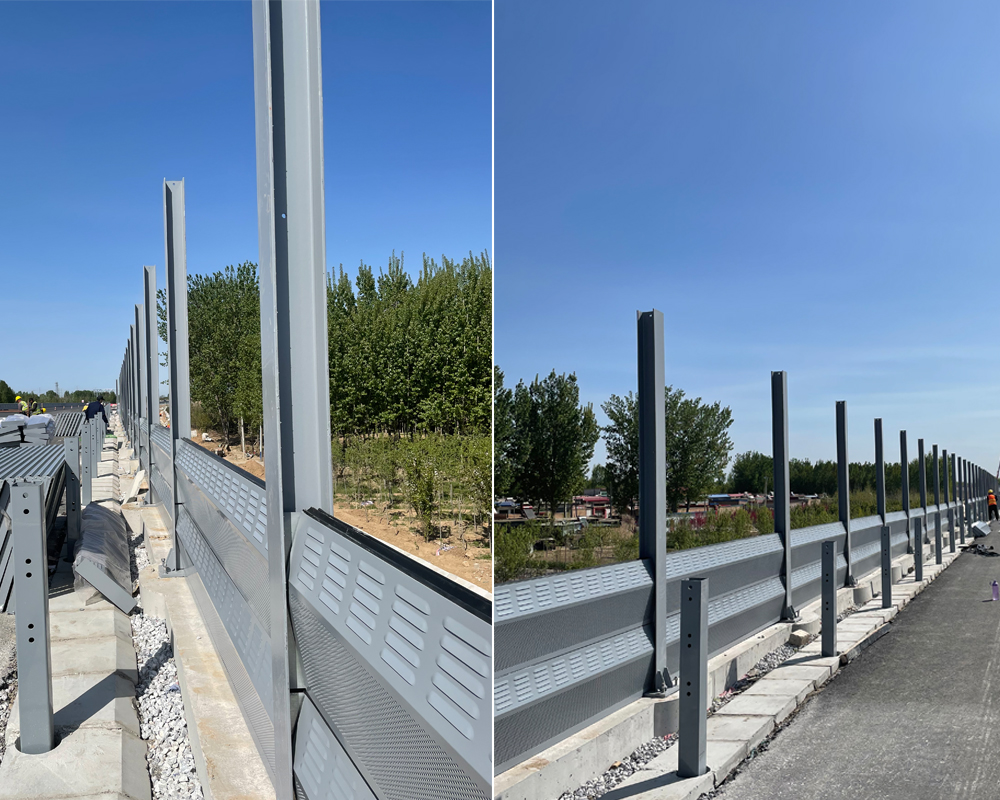
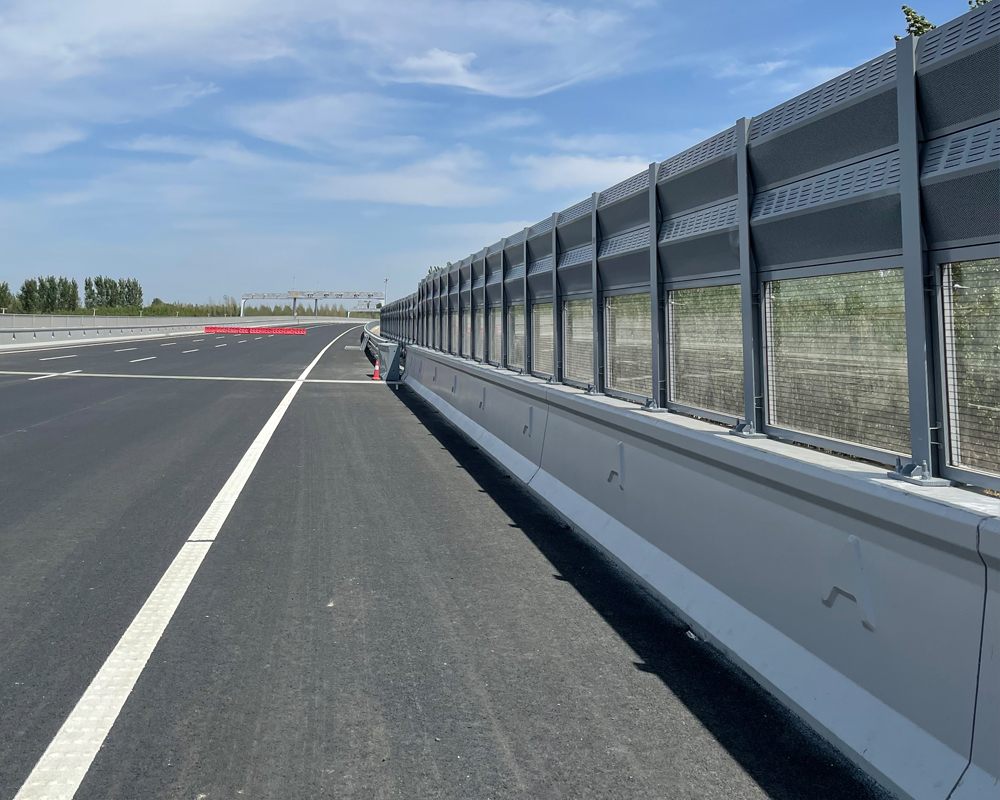
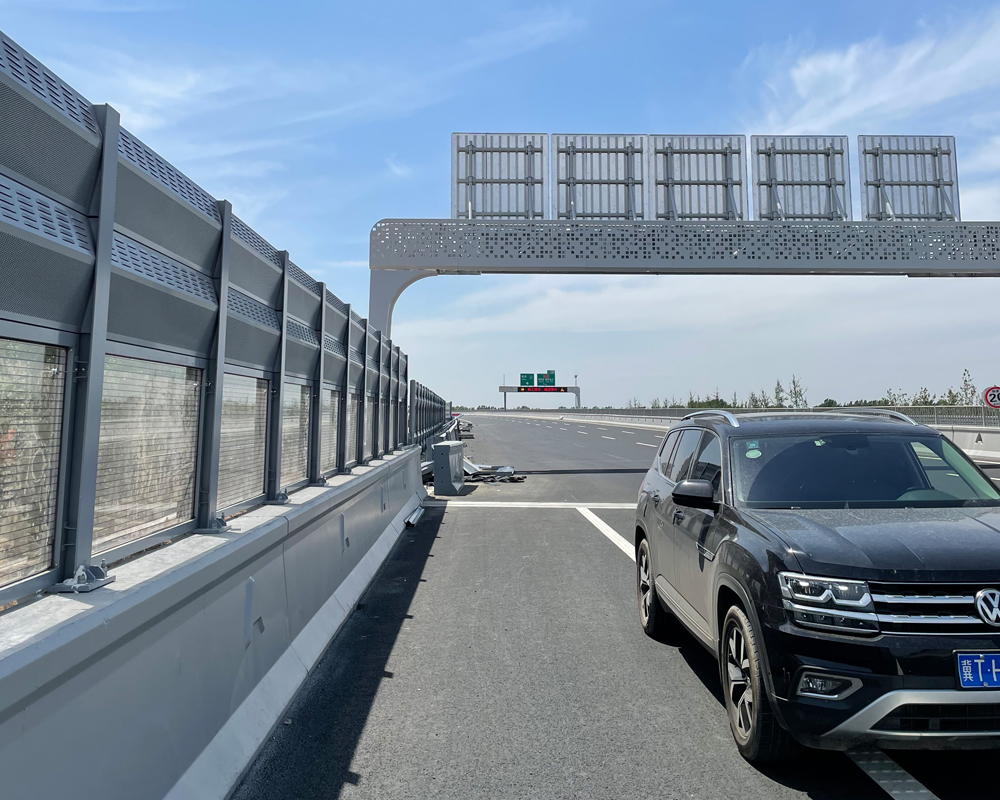
JINBIAO supplied the noise barrier for sections 2, 3 and 4 of that corridor. The installation was completed in the middle of May and passed acceptance with the owner’s approval. What makes the work worth describing is not its length but its repetition: the same noise barrier detail, built and inspected across three sections, at a scale where a small detailing error becomes a very large one.
The project at a glance
| Corridor | Rongwu Expressway (G18), Rongcheng, Shandong to Wuhai, Inner Mongolia |
| Length | Approximately 1,820 km |
| JINBIAO scope | Sound barrier materials for sections 2, 3 and 4 |
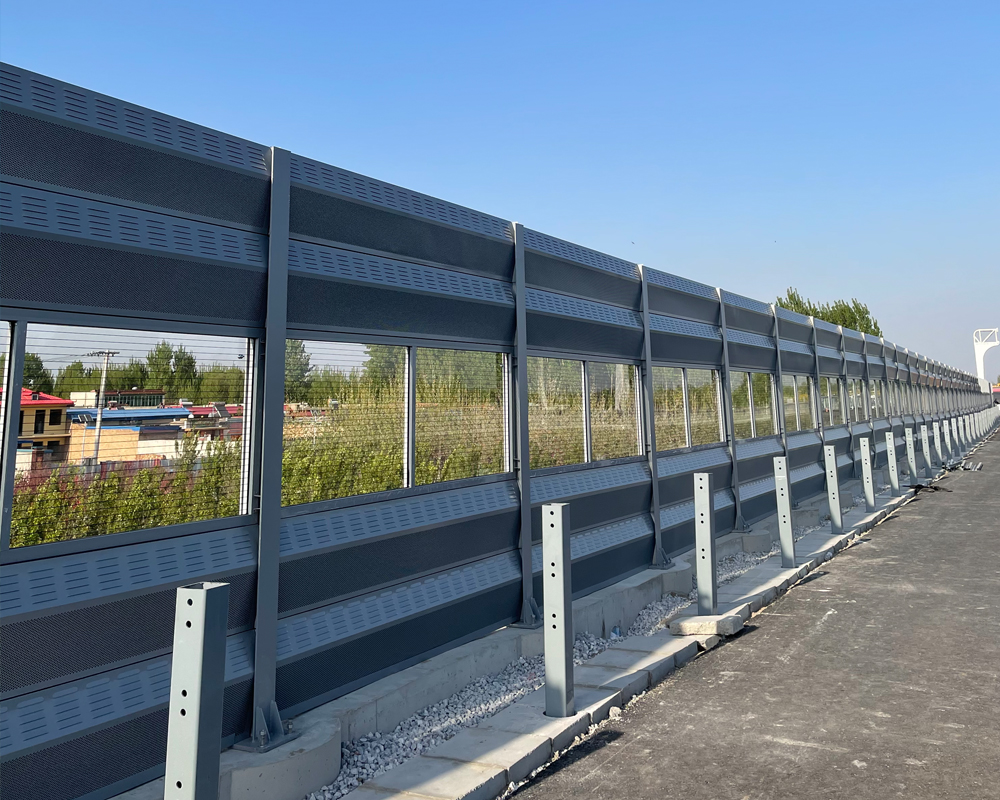
| System | Combined metal screen and transparent screen |
| Completion | Installation completed mid-May, acceptance passed, owner approval obtained |
Why the noise barrier mixed metal and transparent panels
A purely opaque noise barrier is the straightforward answer acoustically and the wrong answer visually over a thousand kilometres of open landscape. Drivers on a long corridor need the horizon, and a continuous wall at window height removes it. The usual resolution is the one specified here: a combined system in which the metal screen carries the acoustic duty and a transparent screen preserves the view and admits daylight.
The two materials in one noise barrier do not perform the same job and should not be treated as interchangeable. A metal panel with absorptive infill reduces the sound that would otherwise reflect back across the carriageway as well as blocking the direct path, which matters where barriers run on both sides. A transparent panel reflects. Where the design mixes them, the proportion and the vertical position of each determine whether you get the benefit of absorption or simply a lighter-looking wall.
There is also a maintenance argument. Transparent panels show dust and road spray, and on an inland corridor with long dry seasons they show it quickly. Putting them where they can be reached for cleaning, rather than in a top tier above a shoulder, is a decision taken at detail stage that nobody revisits afterwards.
What changes when a noise barrier detail repeats for kilometres
On a single site, a two-millimetre tolerance error in the noise barrier is absorbed by adjustment on the day. Across three sections of a national expressway it becomes the difference between panels that seat and panels that do not, because the error accumulates along a line rather than staying local. Three things follow for a noise barrier at this scale.
The module has to be fixed early, so that noise barrier posts, panels and infill are all produced to one geometry and can be installed in any order along the line. The connection detail has to tolerate the settlement and alignment variation that a long embankment and a long viaduct will each deliver differently. And the acceptance criteria have to be written so that an inspector on section 4 applies exactly what an inspector on section 2 applied, otherwise the three sections hand over as three different products.
Repetition also changes the commercial logic. A corridor of this length is a production programme rather than a project: what is being bought is a rate of installed noise barrier metres per week, and the noise barrier supplier’s value lies in holding that rate rather than in producing a distinguished sample panel.
Wind and dust on an inland alignment
The western half of the corridor crosses terrain with little shelter, and a noise barrier is a vertical surface that collects wind load over a long lever arm. Post spacing and foundation design therefore follow from the local wind case rather than from the acoustic calculation, which is the same conclusion reached on the foundation side of barrier design. Dust adds a second, slower problem: it settles into panel joints and onto transparent faces, and a joint that was sealed at installation is a joint that needs to be resealed on a cycle nobody budgets for unless it is written into the maintenance plan.
Acceptance
Noise barrier installation finished in the middle of May and the work passed acceptance with the owner’s approval. On a programme of this size that sentence covers a large amount of unglamorous work: submittals for every component, inspection of galvanising and coating, checking panel alignment against a line that curves and climbs for hundreds of kilometres, and closing out the snag list across three sections at once.
What this project shows
- Fix the noise barrier panel module before production, because repetition amplifies tolerance error rather than averaging it out.
- Decide the metal-to-transparent ratio on acoustic grounds, then place the transparent tier where it can be cleaned.
- Size noise barrier posts and foundations from the wind case, not from the acoustic target.
- Write acceptance criteria once and apply them identically across sections.
- Budget the joint resealing cycle, or the noise barrier loses performance quietly.
Systems used on corridors of this type include the highway acoustic barrier range with transparent acoustic panels, and microporous metal panels where absorption is required on both sides of the carriageway.
Post time: May-27-2021