
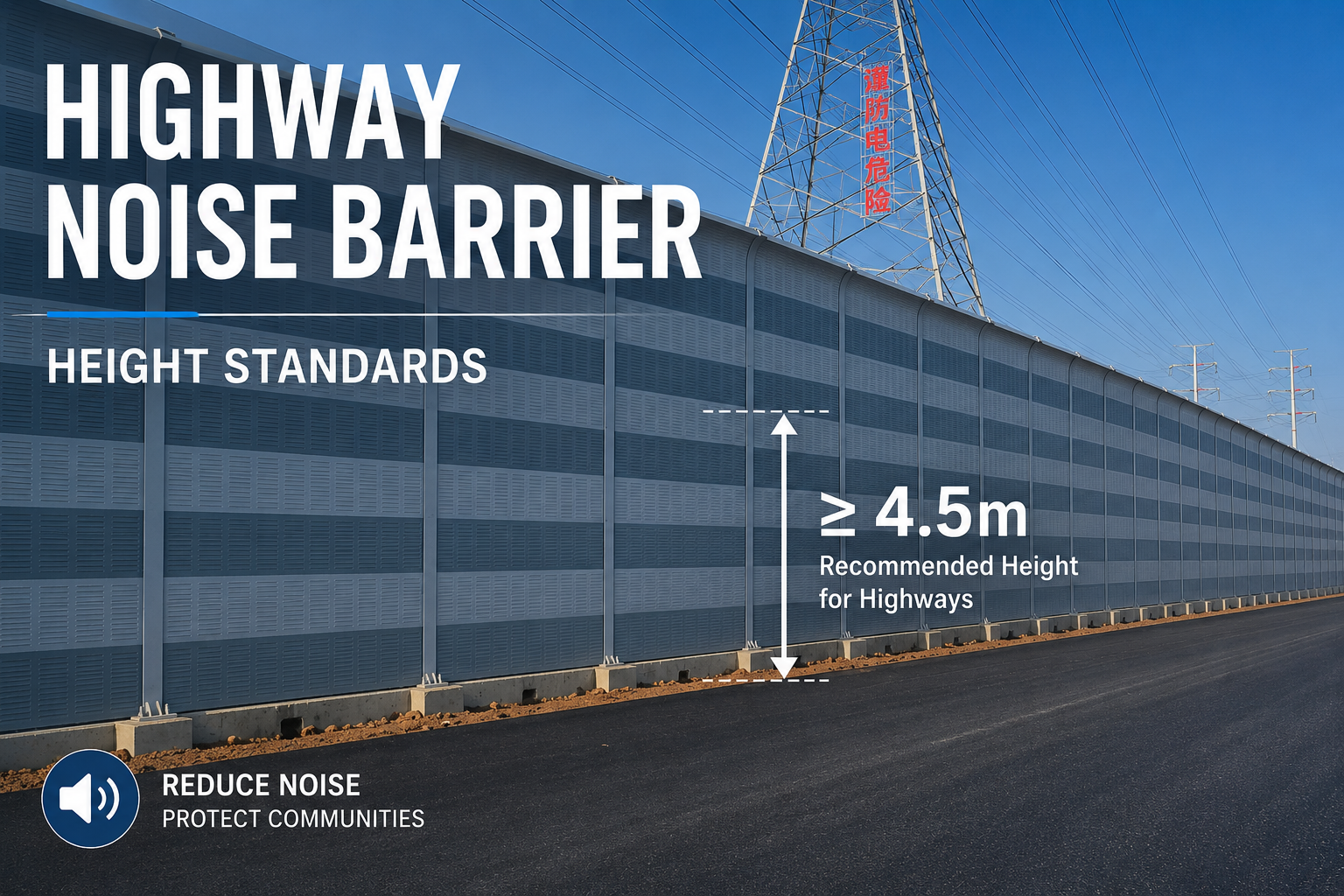
When a highway passes through residential areas, a noise barrier is often one of the most effective solutions for reducing traffic noise. Among all design factors, barrier height is the primary parameter that determines noise reduction performance.
How Tall Does a Highway Noise Barrier Need to Be?
According to research by the Federal Highway Administration (FHWA):
• When a noise barrier just blocks the direct line of sight between the noise source and the receiver, it can reduce noise by approximately 5 dB.
• Once the line of sight is blocked, every additional 1 meter of barrier height can provide roughly 1.5 dB of extra noise reduction.
Example
If the vertical difference between the roadway and a resident’s window is 2 meters:
• A 2-meter-high noise barrier may provide about 5 dB of noise reduction.
• Increasing the barrier height to 4.5 meters can achieve approximately 9–10 dB of noise reduction, which is perceived as nearly cutting the noise level in half.
Highway Noise Barrier Height Standards
Standard Recommended Height Notes
| Standard | Recommended Height | Notes |
| China Standard | ≥ 4.5 m | Based on HJ/T 90—2004 |
| U.S. FHWA | 3–8 m | Evaluated by individual states; no nationwide mandatory standard |
| California (Caltrans) | ≤ 4.3–4.9 m | Minimum height 1.8 m |
| Urban Arterial Roads (China) | ≥ 3.5 m | Traffic noise levels are generally lower than highways |
Key Design Principles
1. Ensure Sufficient Barrier Length
The barrier length should be at least eight times the distance from the receiver to the barrier to minimize sound diffraction around the ends.
2. Maintain Proper Spacing for Dual Barriers
When barriers are installed on both sides of a roadway, the ratio of spacing to barrier height should be at least 10:1 to reduce adverse sound reflections.
3. Avoid Openings and Gaps
Any openings, joints, or unsealed gaps can significantly reduce the barrier’s effectiveness. Proper sealing is essential.
4. High-Rise Buildings Require Additional Measures
Ground-level noise barriers are less effective for buildings above the third floor. In such cases, solutions such as enclosed noise barriers, acoustic enclosures, or soundproof windows may be required.
Conclusion
Three key numbers are worth remembering:
• 5 dB — Typical noise reduction when the barrier first blocks the line of sight.
• 1.5 dB per meter — Additional noise reduction gained from each extra meter of height.
• 4.5 m — Recommended highway noise barrier height in China.
In practice, the optimal highway noise barrier design should be based on detailed noise modeling, site conditions, project budget, and environmental requirements to achieve the best balance between performance and cost.
FAQ
1.What is a standard height for a highway noise barrier?
Typical barriers range from about 2 m to 5 m, with taller barriers used where the source and receptor geometry requires it; there is no single standard height because height follows the acoustic calculation.
2.How is the required barrier height calculated?
The height is derived from the path difference between direct sound and sound diffracting over the barrier top, using the source spectrum, receptor position and terrain.
3.Does a taller barrier always mean more noise reduction?
No – the benefit per additional metre decreases as the barrier gets taller, and practical limits include wind load, aesthetics and sight distance.
4.Are there restrictions on barrier height or position?
Sight distance, access, drainage, lighting and any road authority requirements all constrain what can be built, so the design is coordinated with those conditions.
Post time: Jul-15-2026