
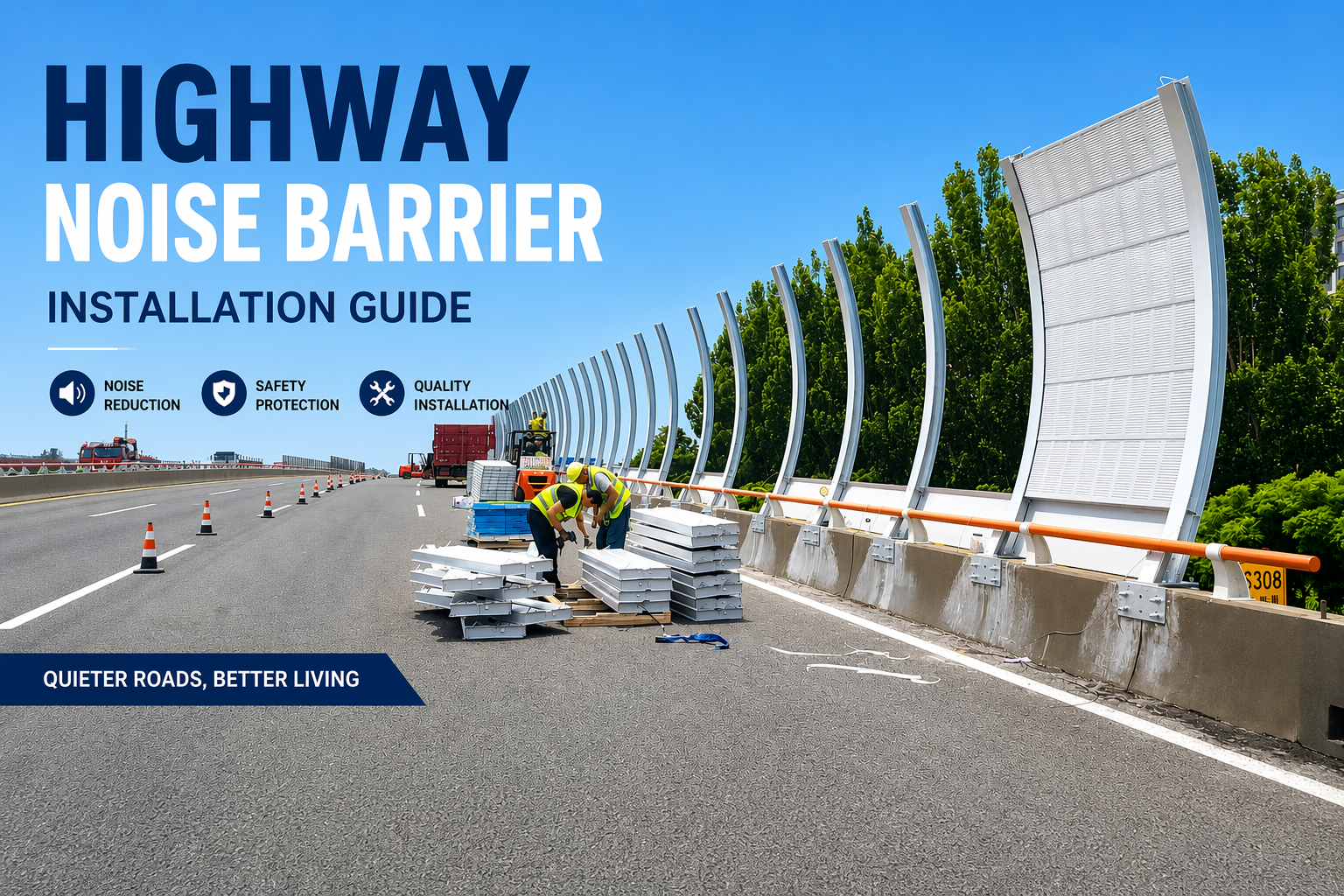
Highway noise barriers are essential facilities for reducing traffic noise and protecting sensitive areas such as residential communities, schools, and hospitals located along roadways. Properly designed and installed barriers can typically achieve noise reductions of 5–10 dB, while absorptive noise barriers may provide sound insulation exceeding 20 dB. As urban expansion and traffic volumes continue to grow, the demand for highway noise barriers is increasing. This article provides an overview of the installation process and key considerations.
1. Pre-Installation Preparation
Site Survey
Clear obstacles from the construction area and install safety warning signs at least 50 meters from the work zone. Conduct measurements and layout marking to determine the barrier centerline and post spacing (typically 2–4 meters), ensuring accurate positioning.
Material Inspection
Inspect posts, panels, fasteners, and other components for deformation, corrosion, or damage. Verify that all specifications and anti-corrosion treatments meet design requirements. Contractors should submit detailed construction drawings for approval at least four weeks before installation.
Equipment Preparation
Prepare the necessary equipment, including cranes, torque wrenches, leveling instruments, and other installation tools.
2. Installation Process
2.1 Foundation Construction
Excavate trenches to the specified depth, generally 1.5–2.5 meters. In cold regions, foundations should extend below the frost line.
Install and compact a crushed stone base layer with a minimum thickness of 100 mm.
Position embedded anchor bolts and align them using leveling instruments. The vertical deviation should not exceed 1°.
Pour concrete with a minimum strength grade of C30. Allow curing for at least 7 days, with thermal protection provided during winter. Subsequent installation work may proceed only after the concrete reaches the required design strength.
2.2 Post Installation
Lift the posts into position using a crane and align them with the anchor bolts.
Adjust vertical alignment to ensure longitudinal deviation does not exceed 3 mm per meter and transverse deviation does not exceed 2 mm per meter. Use shims for fine adjustments when necessary.
Tighten nuts in stages according to the specified torque (typically 30–50 N·m) to ensure uniform load distribution.
2.3 Panel Assembly
Install panels from bottom to top and from left to right, sliding them into the post grooves.
Joint gaps should not exceed 2 mm. Secure panels using self-tapping screws or fastening clips with spacing not exceeding 300 mm.
Seal all gaps, including panel joints and bottom openings, with fire-resistant sealants such as silicone sealant to prevent sound leakage.
If the design includes absorptive materials, install them simultaneously and ensure a smooth, even surface.
2.4 Top Caps and Accessories
Install top caps, rain covers, or decorative edge trims to prevent water ingress and corrosion.
Verify that all fasteners and connections are securely tightened.
3. Design and Safety Considerations
Height Restrictions
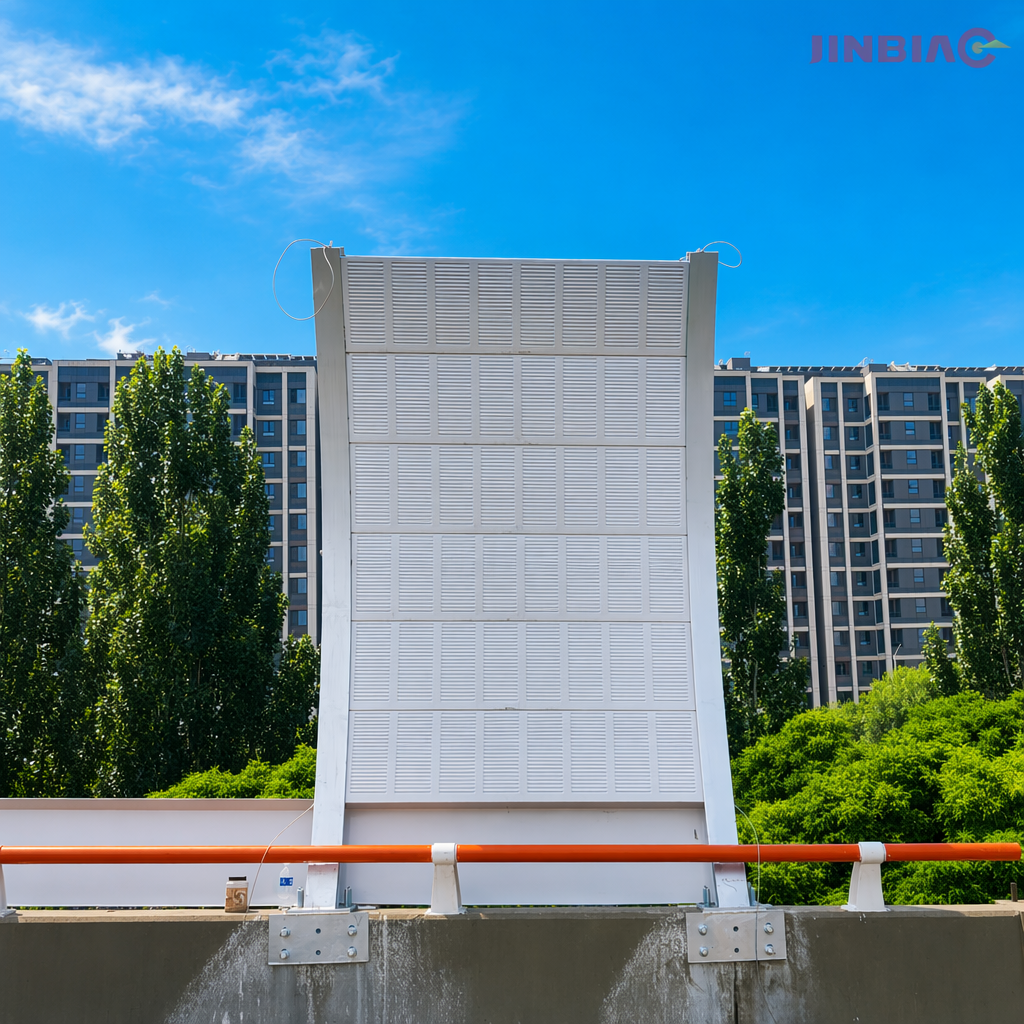
Freestanding noise barriers are generally limited to a maximum height of 6 meters (20 feet), while barriers installed near road shoulders should typically not exceed 3.6 meters (12 feet).
Wind Resistance and Structural Performance
Wind load design should be based on local wind conditions. Deflection limits for panels and posts must comply with relevant standards to ensure structural stability under wind loads.
Traffic Protection
Where barriers are located in areas susceptible to vehicle impact, guardrails or crash protection systems should be installed.
Drainage and Compaction
Backfill should be graded away from the barrier and properly compacted to prevent settlement and the formation of gaps beneath the barrier. Adequate drainage systems should also be provided.
4. Quality Inspection and Acceptance
Visual Inspection
Check for scratches, deformation, uneven joints, inadequate sealing, and improper bolt tightening. Ensure the overall appearance meets project requirements.
Acoustic Testing
Conduct sample noise reduction tests to verify that the barrier achieves the specified acoustic performance, typically a noise reduction target of at least 20 dB.
Wind Load Verification
In high-wind regions, perform wind resistance testing to confirm the stability and safety of the structure.
5. Cost Overview
Project costs typically consist of:
Panels and posts: 45–50%
Foundations: 20–25%
Support systems: 15–20%
Accessories: 5–10%
Typical material costs per linear meter are:
Concrete barriers: USD 20–50
Metal barriers: USD 30–85
Transparent panels: USD 45–120
Composite absorptive panels: USD 50–100
Installation costs generally account for approximately 20–30% of the total project budget. Bulk purchasing and selecting suitable construction seasons can help reduce overall costs.
Conclusion
The installation of highway noise barriers is a comprehensive engineering process that requires strict adherence to design specifications and safety standards throughout every stage, from site surveying and foundation construction to panel installation and final inspection. High-quality noise barriers not only significantly reduce noise pollution and improve the quality of life for nearby residents but also provide long-term structural durability and visual appeal. As technology advances and environmental requirements become more stringent, noise barriers will continue to play an increasingly important role in future transportation infrastructure projects.
FAQ
1.How are noise barrier posts installed?
Posts are set in concrete foundations, driven where ground conditions allow, or fixed to a base plate on an existing structure – the choice follows the structural design.
2.How long does barrier installation take?
Installation rate depends on panel size, access, foundation type and weather; the programme is normally estimated from the linear metres to be erected per shift.
3.What site conditions affect installation?
High winds limit panel lifting, and rain or frost can affect foundations and sealing work, so erection is normally planned around the local weather window.
4.What is inspected during installation?
Post alignment and level, correct panel sequence and sealing, fixing torque and the finished line and height are the usual check points before handover.
Post time: Jul-22-2026