
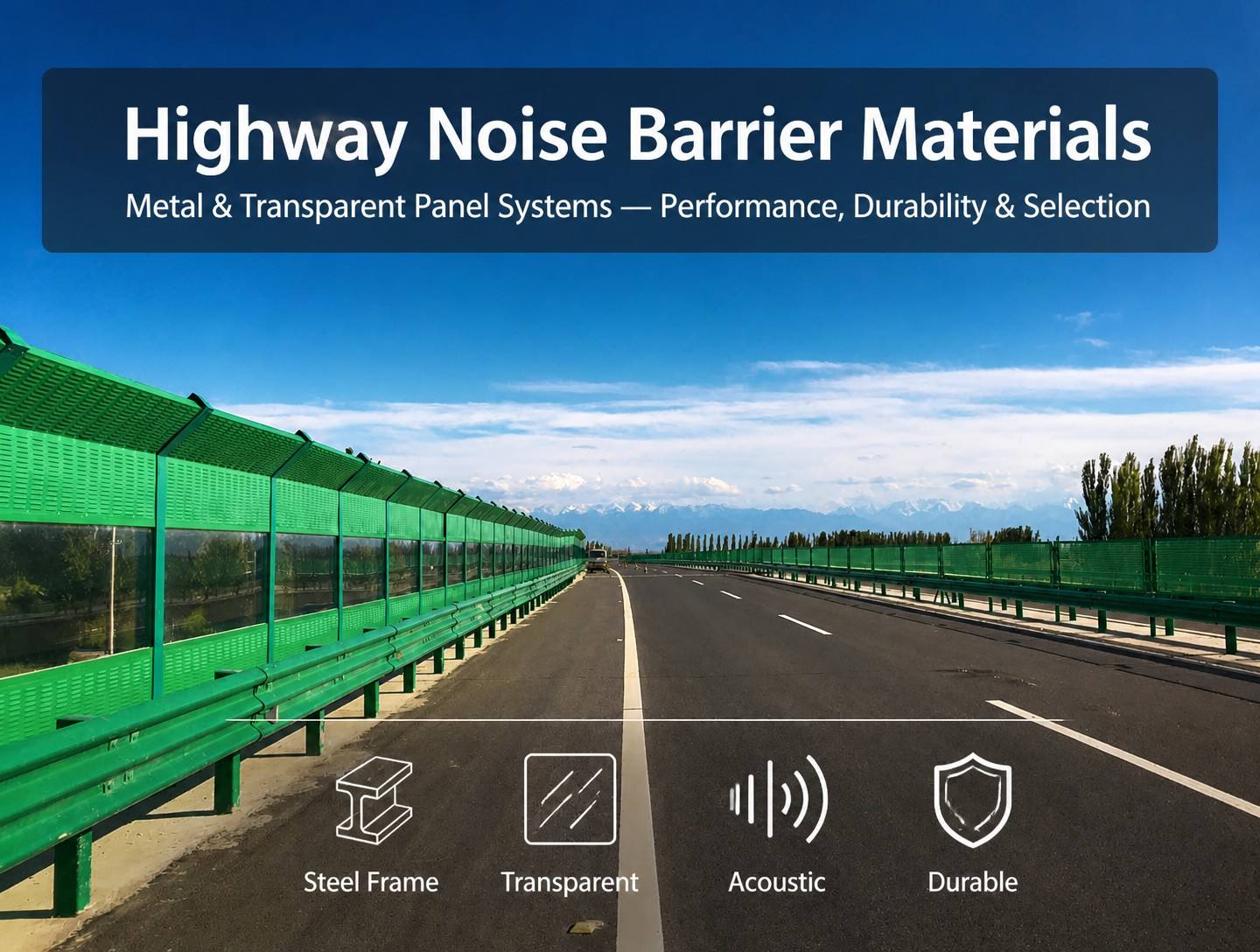
Among the diverse range of materials available for highway noise barriers, metal panel systems and transparent panels stand out as two of the most versatile and widely specified solutions in modern transportation infrastructure. Metal delivers exceptional design flexibility with hybrid reflective-absorptive acoustic performance that monolithic concrete cannot match, while transparent panels preserve sightlines and natural light in corridors where visual openness is non-negotiable. This guide takes an in-depth look at these two high-performance material categories — their properties, advantages, limitations, and ideal applications — to support informed specification decisions.
Why Metal and Transparent Panels Lead Modern Projects
Infrastructure agencies are increasingly moving toward lighter, faster-to-install, and more adaptable systems. Metal and transparent barriers respond to three driving trends: demand for absorptive acoustic performance that solid reflective walls cannot provide, shorter construction timelines with less heavy equipment, and community pressure to maintain visual connectivity along highways through urban and scenic corridors. Both material types also integrate seamlessly with standard steel post-and-beam frameworks, simplifying procurement.
Metal Noise Barrier Systems
Materials and Construction
Metal noise barriers are built primarily from galvanized steel and, to a lesser extent, aluminum. Steel panels are roll-formed from 18 to 14 gauge sheet metal with corrugated, ribbed, or trapezoidal profiles that maximize bending stiffness while minimizing material weight. Standard corrosion protection is hot-dip galvanizing to ASTM A123; for coastal highways or regions with heavy deicing-salt use, enhanced coatings such as Galfan (zinc-5% aluminum) and Galvalume (zinc-55% aluminum) offer two to four times the service life of conventional galvanizing. Powder coating and PVDF architectural finishes add further corrosion barriers and enable color coordination with surrounding structures.
Aluminum panels — typically 5052-H32 or 6061-T6 alloy — eliminate corrosion risk in non-industrial environments and weigh roughly one-third of steel, reducing foundation loads. However, aluminum’s lower modulus of elasticity demands thicker sections, and material cost is roughly double that of galvanized steel. Aluminum is most often specified for highly corrosive coastal sites and architecturally demanding urban projects.
Acoustic Performance: The Hybrid Advantage
Metal’s defining acoustic strength is its compatibility with sound-absorptive fills. Panels with perforated faces (25% to 40% open area) backed by mineral wool, fiberglass, or polyester fiber blankets achieve NRC values of 0.70 to 0.95, creating a hybrid reflective-absorptive barrier in a single panel. This is critical for highways with barriers on both sides, where purely reflective systems create a sound canyon effect from multiple reflections between parallel walls. Solid non-perforated panels with a minimum surface mass of 20 kg/m² achieve STC ratings of 30 to 40 for reflection-only applications. The ability to mix perforated and solid panels within the same framework gives designers precise acoustic control without switching structural systems.
Maintenance and Durability
The primary long-term concern is corrosion at field-cut edges, fastener holes, and coating damage. Zinc coatings provide cathodic protection, but once the zinc layer is consumed locally, red rust appears and must be addressed. Annual visual checks of post bases (where moisture and deicing chemicals accumulate), panel connections, and coating damage are essential. Touch-up with zinc-rich coatings is effective when performed early. Properly galvanized steel barriers in moderate climates routinely achieve 40 to 50 years before major refurbishment; aluminum barriers can exceed 60 years with essentially no corrosion maintenance.
Transparent Noise Barrier Systems
Material Options and Optical Properties
Acrylic (PMMA) is the most widely used transparent barrier material in Europe and Asia, transmitting up to 92% of visible light with good UV stability and a service life exceeding 20 years with proper UV-stabilized formulations. It is approximately half the weight of glass and can be cut, drilled, and fabricated on-site with standard tools. Key limitations include susceptibility to scratching during cleaning or from wind-borne debris, and a high coefficient of thermal expansion that demands carefully detailed edge restraints to prevent stress cracking from temperature-driven dimensional changes.
Polycarbonate offers roughly 250 times the impact resistance of glass and 30 times that of acrylic — making it the preferred choice for high-vandalism areas, locations with potential vehicle impact, or industrial zones with flying debris risk. It is also lighter than acrylic. However, unprotected polycarbonate yellows and loses impact strength significantly within 5 to 10 years; co-extruded UV cap layers are mandatory and must remain intact and scratch-free throughout service life. Multi-wall polycarbonate sheets provide better thermal insulation at the cost of reduced optical clarity.
Laminated glass provides unmatched scratch resistance, chemical resistance, and fire performance with zero aging discoloration. Tempered or heat-strengthened panels with PVB interlayers retain shattered fragments rather than releasing them. Glass is roughly twice as dense as acrylic and demands robust framing with neoprene or EPDM gaskets at all contact points. It is most common in prestige urban projects, landmark corridors, and tunnels where long-term optical quality is paramount.
Structural Considerations
All transparent materials share a key structural challenge: they are lightweight relative to surface area, making wind load the dominant design case. Posts adequate for heavy concrete panels may be undersized — wind moment at the base remains comparable, regardless of panel weight. Thermal expansion is another design driver. Acrylic expands approximately 0.07 mm per meter per degree Celsius; a 3-meter panel across a 50°C swing undergoes about 10.5 mm of movement. Aluminum framing offers a closer thermal match than steel, reducing differential stress at panel edges.
Comparing Metal and Transparent Systems
Acoustic Performance
Metal systems with absorptive fills deliver superior noise reduction in multi-barrier and parallel-wall scenarios. Transparent panels are inherently reflective — blocking sound through surface mass — and acoustically equivalent to solid metal panels of similar weight. For corridors requiring absorption, transparent panels can be combined with absorptive metal sections in alternating or stacked configurations.
Lifecycle Cost
Metal systems offer lower procurement cost but higher maintenance burden due to coating inspection requirements. Transparent panels carry higher material and installation costs but lower routine maintenance — periodic cleaning is the primary need — plus unique amenity value from preserved sightlines. Laminated glass may have the highest upfront cost but the lowest 50-year total cost of ownership when optical quality is valued.
Selection Guidance
Choose metal when: absorptive acoustic performance is required, barriers line both highway sides, color customization is needed, and moderate maintenance budgets exist for coating inspection. Choose transparent panels when: preserving sightlines or views is a project requirement, the corridor passes through scenic or urban areas, and the budget accommodates higher material and framing costs in exchange for long-term visual performance.
Conclusion
Metal and transparent noise barrier systems represent the most adaptable material categories in modern highway infrastructure. Metal delivers hybrid reflective-absorptive acoustic versatility with competitive installed costs and proven durability. Transparent panels provide visual openness that solid walls cannot — preserving sightlines and natural light where communities expect it. The right decision — and increasingly, the decision to combine both — should be driven by acoustic requirements, site context, and a lifecycle cost analysis that accounts for the full 30-to-50-year maintenance outlook.
Post time: Aug-03-2026