
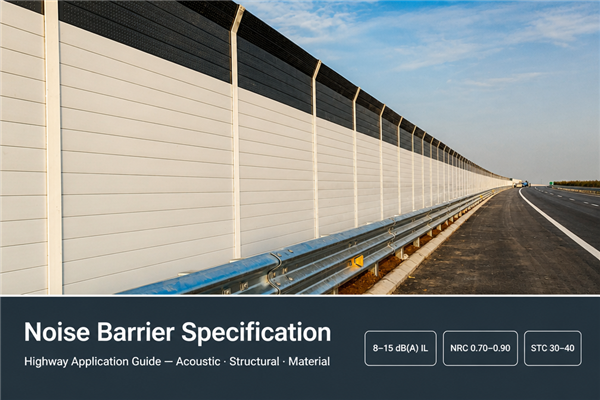
A well-written noise barrier specification is the foundation of every successful highway noise mitigation project. It translates noise reduction goals into measurable engineering requirements — covering acoustic performance, structural design, material selection, installation quality, and acceptance testing. On highways, where traffic volumes are high, vehicle speeds are fast, and sound levels can reach 85 to 90 dB(A) at the roadside, a precise specification determines whether a barrier delivers its intended protection or becomes an expensive disappointment. This guide outlines the essential elements of a highway noise barrier specification and explains how each requirement contributes to long-term performance.
Why a Detailed Specification Matters on Highways
Highway noise is dominated by tire-road interaction and engine noise, producing a broadband sound spectrum concentrated in the 250 Hz to 4,000 Hz range — exactly the frequencies the human ear is most sensitive to. Unlike urban roads with slow, stop-and-go traffic, highways generate continuous, high-level noise from high-speed vehicles, making effective barrier design more demanding. A comprehensive specification protects the owner by establishing clear performance expectations, quality standards, and acceptance criteria that can be objectively verified. It also prevents costly disputes between contractors, manufacturers, and agencies by defining exactly what must be delivered.
Acoustic Performance Requirements
Insertion Loss and Design Targets
The single most important acoustic parameter in a highway noise barrier specification is insertion loss (IL) — the reduction in sound level at a receiver location achieved by the barrier. Highway projects typically specify IL values of 8 to 15 dB(A) depending on the distance to sensitive receptors and the required noise reduction. The specification should state the design methodology, traffic data assumptions, and the noise prediction model to be used, ensuring that all bidders calculate performance on the same basis.
Sound Absorption Coefficient
For highways with barriers on both sides, or where reflected noise could reach receivers on the opposite carriageway, the specification must require a minimum noise reduction coefficient (NRC) or sound absorption coefficient (α). Typical highway specifications call for absorptive panels with an NRC of 0.70 to 0.90, measured in accordance with ASTM C423 or ISO 354. This requirement prevents a “sound canyon” effect where noise bounces repeatedly between parallel barriers.
Sound Transmission Class
To ensure the barrier itself does not transmit noise through its structure, the specification should set a minimum Sound Transmission Class (STC) rating. Highway noise barriers commonly require an STC of 30 to 40 for panel systems, with solid concrete barriers achieving higher values through sheer mass. The STC requirement guarantees that sound reduction occurs around and over the barrier, not through it.
Structural Design Requirements
Wind Load Resistance
Wind load is often the governing design case for highway noise barriers, particularly for tall barriers (3 to 6 meters) on exposed elevated sections. The specification must reference the applicable design code (such as ASCE 7 or local equivalents), define the basic wind speed, and require structural calculations for both ultimate and serviceability limit states. For coastal highways, the specification should also address wind-borne debris loading and the risk of panel detachment at high wind speeds.
Foundation and Post Design
Highway barriers must withstand not only wind loads but also vehicle impact loads, vibration from passing traffic, and thermal expansion. The specification should define foundation types (spread footings, drilled shafts, or precast bases), minimum embedment depths, and post spacing limits based on panel spanning capability. It should also require design checks for post plumbness tolerance and anchor bolt capacity, with maximum deflection limits typically set at H/75 to H/100 of the barrier height under design wind loads.
Vehicle Containment and Safety
Noise barriers installed near travel lanes must not become a hazard in a collision. The specification should define the minimum setback from the travel lane edge, the crash-testing requirements for barrier systems within the clear zone, and the performance of the barrier under vehicle impact per standards such as MASH (Manual for Assessing Safety Hardware). Where barriers sit behind existing guardrails, the specification must confirm that the combined system meets safety requirements.
Material and Durability Specifications
Metal Components
For metal noise barrier systems, the specification should require hot-dip galvanized steel to ASTM A123 with a minimum average coating thickness — typically 85 µm for the service environment of highway corridors. In coastal or deicing-salt environments, zinc-aluminum alloy coatings (Galfan or Galvalume) or duplex coating systems should be specified. Panel profiles, steel grades, and corrosion protection requirements for all fasteners, brackets, and connectors must be explicitly defined, including requirements for stainless steel fasteners in aggressive environments.
Transparent Panels
Where transparent noise barrier panels are specified — typically for bridges, scenic corridors, and locations requiring sightline preservation — the specification should define the material (acrylic, polycarbonate, or laminated glass), minimum optical clarity, UV stabilization requirements, and impact resistance ratings. Acrylic panels should meet UV-stabilized grades with a documented service life; polycarbonate must include a co-extruded UV cap layer; laminated glass must comply with relevant safety glazing standards and use PVB interlayers.
Absorptive Fill Materials
For hybrid metal panels with absorptive cores, the specification should define the fill material (mineral wool, fiberglass, or polyester), minimum density, and water repellency requirements. Highway absorptive fills must be non-combustible or fire-retardant, resistant to moisture absorption, and protected from bird and vermin intrusion by appropriate facing materials. The specification should also require the fill to maintain its acoustic performance throughout the design life, with performance retention testing where applicable.
Environmental and Aesthetic Requirements
Appearance and Finish
Because highway corridors are highly visible, the specification should address color, texture, and finish requirements. This includes color matching to architectural samples, minimum paint system specifications for metal panels (typically including primer and topcoat with a total DFT of 100 to 140 µm), and resistance to UV fading, chalking, and graffiti. Anti-graffiti coatings may be specified for urban corridors where vandalism is anticipated.
Drainage and Foundation Protection
Proper drainage is essential to prevent water accumulation at barrier foundations, which accelerates corrosion and causes freeze-thaw damage. The specification should require drainage provisions at the barrier base, weep holes at panel bases, and positive slope away from foundations. For absorptive panels, drainage requirements must prevent water ingress into the fill material.
Installation and Quality Assurance
Installation Tolerances
The specification must define acceptable installation tolerances: vertical alignment (typically ±10 mm over 3 meters), panel-to-panel joint gaps, post plumbness, and the sealing of all acoustic joints to prevent sound leakage. Photos and inspection records should be required at each stage of installation.
Acceptance Testing
Before acceptance, the completed barrier should undergo verification that installed panels match the approved design, joints are properly sealed, and the system is structurally sound. Where feasible, field acoustic testing can confirm the achieved insertion loss. The specification should define the testing methodology, measurement positions, and acceptance criteria — for example, meeting or exceeding the design IL at specified receiver locations within defined tolerances.
Conclusion
A complete highway noise barrier specification integrates acoustic targets, structural safety, material durability, environmental performance, and verifiable quality standards into a single enforceable document. It is the difference between a barrier that merely exists and a barrier that performs — delivering the designed noise reduction for 30 to 50 years while withstanding wind, weather, salt, and time. For agencies, engineers, and contractors, investing the effort to specify highway noise barriers correctly is the most cost-effective step in the entire mitigation process: it ensures that every dollar spent on construction delivers measurable, lasting noise reduction for the communities the highway serves.
Post time: Aug-07-2026