
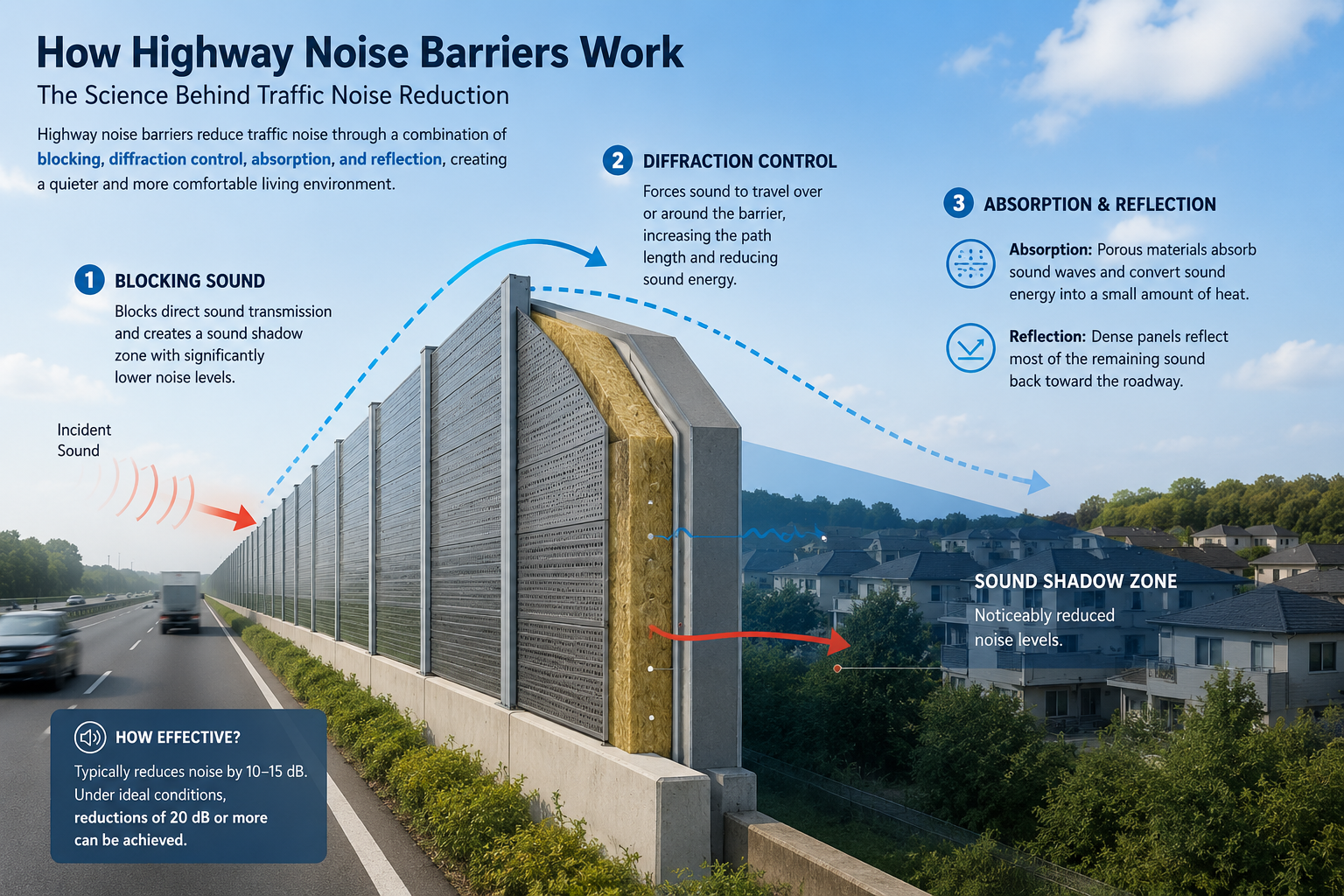
The working principle of a highway noise barrier can be easily understood as building a “wall” between the noise source (the highway) and the area that needs protection, such as residential communities. By creating a physical obstacle, the barrier blocks or weakens the path through which sound travels.
Specifically, highway noise barriers utilize several acoustic principles:
1. Blocking Sound: Creating a “Sound Shadow Zone”
This is the core function of a noise barrier. Just as a wall blocks light and creates a shadow behind it, a sound barrier blocks noise and creates a quieter area on the other side.
Blocking Direct Sound Transmission
The primary purpose of a highway noise barrier is to interrupt the shortest and most direct path between traffic noise and nearby receivers. If the barrier blocks the line of sight between the road and the residential area, it effectively reduces direct sound transmission.
Creating a Sound Shadow Zone
Behind the barrier, a zone with significantly reduced noise levels is formed. This area is known as the sound shadow zone, where residents experience a noticeable reduction in traffic noise.
Frequency-Dependent Performance
High-frequency sounds, such as tire-road interaction noise, have shorter wavelengths and are easier to block. As a result, sound barrier walls are particularly effective at reducing medium- and high-frequency noise. Low-frequency sounds, such as engine rumble, have longer wavelengths and can more easily bend over the top of the barrier, making them more difficult to control.
2. Diffraction Control: Forcing Sound to Take a Longer Path
Sound waves naturally exhibit a phenomenon called diffraction, which allows them to bend around obstacles, much like water flowing around a rock.
A highway noise barrier cannot completely stop sound waves. Instead, it forces most of the sound to travel around the top or ends of the barrier. This significantly increases the distance sound must travel before reaching the protected area.
Because sound energy decreases as it travels through the air, the longer path results in greater attenuation. By the time the sound reaches nearby homes or buildings, its volume is noticeably lower.
3. Absorption and Reflection: Managing Sound Energy
Modern acoustic barriers are more than simple walls. They are often designed as composite structures that combine sound absorption and sound insulation.
Sound Absorption
The side of the barrier facing the highway is typically covered with porous sound-absorbing materials such as glass wool, rock wool, or acoustic fiber panels.
When sound waves enter these tiny pores, they cause air particles to vibrate and create friction within the material. This process converts a portion of the sound energy into a small amount of heat, effectively reducing noise levels. Absorptive surfaces are particularly effective at controlling medium- and high-frequency traffic noise.
Sound Reflection and Insulation
The main structure of the barrier is usually made from dense materials such as steel panels, aluminum panels, concrete, or composite boards. These materials prevent sound from passing through and reflect much of the remaining sound energy back toward the roadway.
Generally, the greater the surface mass of the barrier, the better its sound insulation performance.
How Effective Are Highway Noise Barriers?
A properly designed and installed highway noise barrier can typically reduce noise levels by 10–15 decibels (dB). Under favorable conditions, reductions of 20 dB or more can be achieved.
To the human ear, this often translates into a perceived reduction in noise of approximately half or more. However, it is important to understand that noise barriers do not eliminate all traffic noise. Some sound can still reach the protected area through diffraction, reflections, or other transmission paths.
Conclusion
In summary, highway noise barriers work through a combination of blocking, diffraction control, sound absorption, and sound reflection.
• Blocking interrupts direct sound transmission.
• Diffraction control forces sound to travel a longer path and lose energy.
• Absorption converts sound energy into heat within porous materials.
• Reflection redirects sound back toward the roadway.
By combining these acoustic mechanisms, highway noise barriers provide an effective solution for reducing traffic noise and improving the quality of life for communities located near busy roads and highways.
FAQ
1.How does a highway noise barrier actually reduce noise?
It works in three ways: it blocks the direct sound path so energy must diffract over the top, it absorbs or reflects energy at the panel face, and it limits transmission through the panel itself.
2.What is insertion loss?
Insertion loss is the difference between the noise level at a receptor with the barrier in place and the level without it, measured or calculated at the same position.
3.Does a barrier need to absorb sound on both sides?
Where barriers face each other or a receptor sits opposite, an absorptive facing reduces the reflected energy that would otherwise reach that receptor.
4.How far along the road does a barrier protect?
Benefit is greatest close to the barrier and decreases with distance and with the height of the receptor; acoustic modelling is used to establish the effective extent.
Post time: Jul-08-2026