
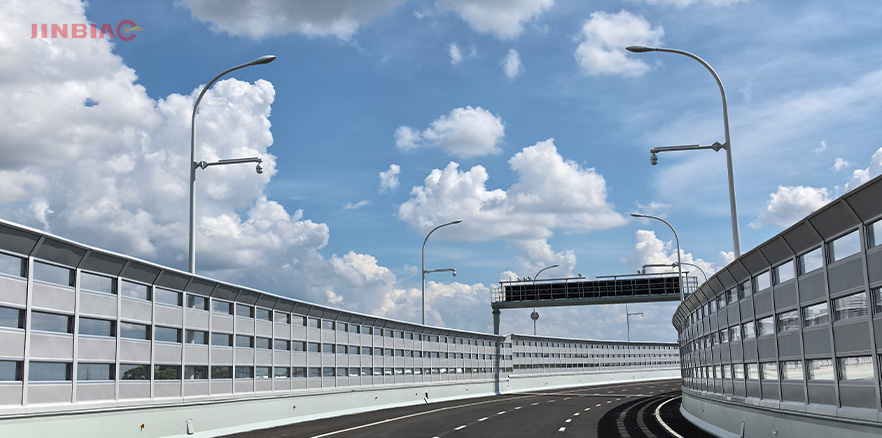
When purchasing noise barriers for highways, railways, industrial facilities, or residential areas, one of the most common questions buyers ask is: “How much does a noise barrier cost per meter?”
The answer varies significantly depending on the material, height, acoustic performance, and installation conditions. In the international market, prices can range from USD 30 to USD 800 per linear meter. This guide summarizes the key factors that influence pricing and helps you estimate your project budget more accurately.
1. Reference Price per Linear Meter (By Material Type)
The following table shows typical factory prices for common noise barrier materials (based on a standard height of approximately 2–3 meters):
| Material Type | Reference Price (USD/Linear Meter) | Features |
| Concrete Noise Barrier | $20 – $50 | Durable and long-lasting, but heavy in weight |
| Metal Noise Barrier (Galvanized Steel/Aluminum) | $30 – $85 | Lightweight, strong, and highly cost-effective |
| Transparent PC/Acrylic Barrier | $45 – $120 | Excellent visibility and aesthetics, ideal for landscape-sensitive areas |
| Composite Sound-Absorbing Barrier | $50 – $100 | Combines sound absorption and sound insulation performance |
Note: The above prices are factory reference prices and do not include transportation or installation costs.
2. Five Key Factors That Affect Noise Barrier Costs
Material Selection
Metal barriers are the most widely used due to their balance of performance and cost. Transparent panels are generally more expensive, while composite materials fall somewhere in between.
Height and Thickness
For every additional meter in height, the overall cost typically increases by 15%–20%.
Structure and Surface Treatment
Curved or angled designs can cost 20%–50% more than standard straight panels. Higher-grade anti-corrosion treatments, such as fluorocarbon coating, also increase the price.
Installation Conditions
Projects located in mountainous areas or on soft ground often require special foundations, making installation costs account for 20%–30% of the total project budget.
Customization Requirements
Custom colors, decorative patterns, or specially shaped components may require additional tooling and manufacturing costs.
3. Typical Cost Breakdown of a Noise Barrier Project
For a standard noise barrier project including installation, the cost distribution is generally as follows:
Panels and posts: 45%–50%
Foundation and ground treatment: 20%–25%
Structural support system: 15%–20%
Accessories and miscellaneous costs: 5%–10%
4. Practical Ways to Reduce Costs
Optimize the Design
In many applications, a barrier height of 2–2.5 meters is sufficient to achieve effective noise reduction, eliminating the need for unnecessarily tall structures.
Purchase in Larger Quantities
The longer the total project length, the lower the unit price manufacturers can typically offer.
Source from Chinese Manufacturers
China is one of the world’s largest noise barrier manufacturing hubs. For products of comparable quality, prices are often 30%–50% lower than those offered by suppliers in Europe or North America. For example, metal noise barriers manufactured in China typically cost around USD 50–80 per square meter, offering excellent value for money.
Schedule Installation Strategically
Construction during off-peak periods can help reduce labor, safety management, and traffic control costs.
5. Frequently Asked Questions
Q: What is the difference between pricing per meter and pricing per square meter?
A: Linear meter pricing is commonly used for infrastructure projects such as highways and railways, while square meter pricing is often used for standalone sound walls or fencing systems. To compare quotations accurately, confirm the barrier height first and convert linear meters into total square meters using:
Area = Height × Length
Q: Why is the actual quotation often much higher than online reference prices?
A: Online prices are usually based on EXW (Ex Works) factory pricing and typically exclude shipping, customs duties, installation, and special foundation work. Projects requiring barriers taller than 3 meters or customized designs can also significantly increase costs.
Q: Which is more cost-effective: Polycarbonate (PC) panels or Acrylic panels?
A: Polycarbonate (PC) panels offer excellent impact resistance and are generally more affordable. Acrylic panels provide higher light transmission and a more premium appearance but come at a higher cost. For most projects, PC panels are the more economical choice.
Q: How much does a noise barrier cost per square metre?
A: Cost is quoted per project rather than from a single rate, because it depends on the panel type, the height, the post design, the foundation and the transport distance. A budget figure is only meaningful once the specification and the location are known – two schemes with the same wall area can differ considerably.
Q: Which factors change the price the most?
A: Panel material and build-up, barrier height, foundation type, site access and transport distance are the main drivers. Finish and any non-standard shape or colour follow behind them; height tends to have the largest single effect, because it changes the panel, the post and the foundation together.
Q: Does the price include installation?
A: Quotations normally distinguish between supply only and supply with supervision or installation, so the scope should be fixed before offers are compared. A supply-only figure and an installed figure are not comparable, and the difference is often wider than the spread between suppliers.
Q: Can you give a budget estimate from a drawing?
A: Yes. A section drawing showing the height and the length, together with the location and the intended panel type, is enough for a preliminary budget estimate. The figure is refined once the acoustic target and the structural requirements are confirmed.
6. Get an Accurate Noise Barrier Quotation
The actual cost per meter depends on your project’s specific requirements, including:
Total barrier length
Required height
Application scenario (highway, railway, factory, residential area, etc.)
Sound absorption requirements
Transparent panel requirements
Site and foundation conditions
Anti-corrosion specifications
As a professional noise barrier manufacturer, we provide free design consultation and cost optimization services to help you achieve the best balance between acoustic performance and budget.
Before Requesting a Quote, Please Prepare:
✔ Total barrier length and design height
✔ Application scenario (highway, railway, factory, residential area, etc.)
✔ Whether sound-absorbing panels are required
✔ Whether transparent panels are needed
We will provide a cost-effective solution that complies with international standards and helps ensure the successful implementation of your noise control project.
Post time: Jun-03-2026