
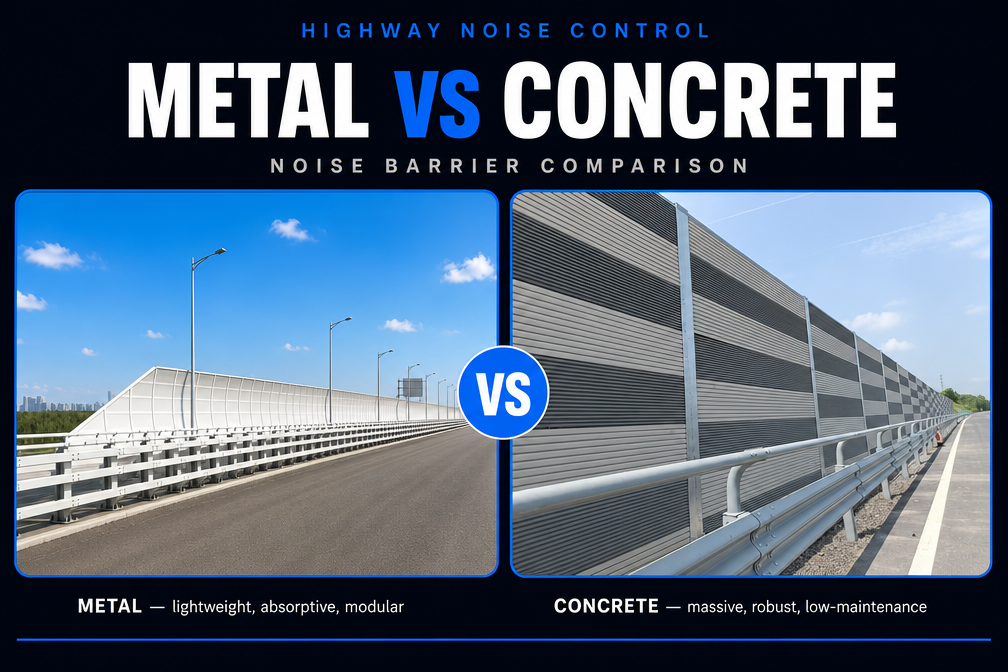
When a highway authority or contractor evaluates roadside noise control, the metal vs concrete noise barrier decision is often the initial fork in the road. Both systems have decades of service history, and both can meet insertion-loss targets when correctly specified. But they behave very differently in weight, foundation demand, acoustic flexibility, installation speed, and long-term maintenance. This guide compares metal noise barrier and concrete noise barrier systems across the criteria that matter in real highway projects, so engineers and procurement teams can select the right solution with confidence.
Metal vs Concrete Noise Barrier: Understanding the Two Systems
A concrete noise barrier is typically built from cast-in-place walls or precast concrete panels mounted on a continuous footing. It is massive, inherently reflective, and extremely rigid. A metal noise barrier, by contrast, is an engineered assembly: aluminum or galvanized steel panels supported by steel H-section posts, with the option of perforated or louvered facings, sound-absorbing infill, and transparent inserts. The phrase “metal vs concrete noise barrier” is therefore not simply a material debate — it is a debate between a monolithic wall and a modular acoustic system, and each has a distinct cost and performance profile.
Why Engineers Choose a Metal Noise Barrier
On modern highway corridors, the metal noise barrier has become the default specification in many regions, and for reasons that are easy to quantify.
Lighter Weight, Lighter Foundation
Metal panels typically weigh a fraction of precast concrete equivalents. On bridges, viaducts, and elevated structures, where every tonne of dead load must be justified to the structural engineer, a metal noise barrier can be mounted directly on parapets or light footings without major strengthening work. This alone often decides the metal vs concrete noise barrier question on elevated alignments.
Absorptive Performance on Demand
Concrete is reflective. Where receptors exist on both sides of a corridor — or where parallel barriers create multiple reflections — an absorptive metal noise barrier with perforated facing and mineral-wool or polyester infill dissipates sound energy instead of bouncing it back across the carriageway. Specifiers routinely require noise reduction coefficient (NRC) values of 0.70 to 0.90, a level that concrete cannot provide without expensive added treatments. When a project specification demands absorption, the metal vs concrete noise barrier comparison effectively ends before it begins.
Transparent Sections and Visual Integration
Unlike concrete, metal systems accept transparent polycarbonate or laminated glass inserts above solid lower panels. On scenic highways, near residential viewpoints, or where drivers need sight lines around curves, a metal noise barrier preserves the view while still attenuating noise. Metal systems also integrate more easily with curved profiles, arched tops, and color-matched facings, giving architects freedom that a concrete noise barrier rarely offers.
Faster Installation and Easier Replacement
Metal panels are prefabricated, delivered in modular units, and installed with mechanical fixings. A contractor can erect several hundred metres of metal noise barrier in a fraction of the time required to pour or place concrete, reducing traffic management windows and associated costs. If a vehicle strike or fire damages one section, individual panels are unbolted and replaced without demolishing the wall — a significant whole-life advantage over concrete, where repairs are slow and conspicuous.
Where a Concrete Noise Barrier Still Earns Its Place
The concrete noise barrier remains a legitimate choice in specific situations, and fair comparison should acknowledge them.
Extreme Robustness and Impact Resistance
Precast or cast-in-place concrete offers impact resistance and vandal resistance that lightweight panels cannot match. In high-risk zones, along industrial corridors, or where debris and vehicle impacts are a real possibility, the mass and rigidity of a concrete noise barrier provide durability that is difficult to argue with.
Low Maintenance Surface
Well-made concrete requires little routine maintenance over a long service life. There is no coating system to re-apply every decade, and the structure does not suffer the corrosion mechanisms that metal systems must be designed against. For owners who prioritize minimal intervention and who do not require absorption, a concrete noise barrier can offer an attractive total cost of ownership.
Mature Specification and Familiar Procurement
Concrete barriers have been specified for decades, and many national highway agencies have standard drawings, qualified precasters, and established acceptance testing for them. Where the design office already holds proven concrete noise barrier details, the engineering risk of re-specification is low.
Side-by-Side: Metal vs Concrete Noise Barrier in Key Criteria
The following comparison summarizes how the two systems perform across the criteria that typically appear in tender documents:
- Weight and foundation: a metal noise barrier is light and suits bridges and parapets; a concrete noise barrier is heavy and demands substantial footings and geotechnical review.
- Acoustic absorption: metal panels can deliver NRC 0.70–0.90 with perforated or louvered facings and infill; concrete is essentially reflective unless specially treated.
- Transparent and aesthetic options: metal systems integrate transparent inserts, curved tops, and custom colors; concrete is limited in form and cannot provide transparency.
- Installation speed: modular metal panels install quickly with fewer traffic disruptions; concrete pours and curing extend program schedules.
- Repair and replacement: damaged metal panels are swapped individually; damaged concrete sections typically require partial demolition and recasting.
- Maintenance: metal relies on hot-dip galvanizing or coated finishes, which need periodic inspection and touch-up; concrete needs little surface maintenance but can develop cracks and staining.
- First cost and whole-life cost: metal is often competitive on first cost and favorable on whole-life cost when absorption, transparency, or elevated installation is required; concrete can be economical on simple embankment lines where only reflection is acceptable.
How to Choose Between a Metal and Concrete Noise Barrier
There is no universal winner in the metal vs concrete noise barrier debate — there is a correct answer for each site. A practical decision sequence looks like this:
- Check the alignment. If the barrier runs on a bridge, viaduct, or retained structure, the weight advantage of a metal noise barrier usually controls the decision.
- Check the acoustic brief. If absorption is required to protect receptors on both sides, or if the specification cites NRC values, choose an absorptive metal system; a reflective concrete noise barrier will not meet the brief.
- Check the program. If night-time lane closures are scarce and the schedule is tight, modular metal installation shortens on-site work versus concrete placement and curing.
- Check the environment. In coastal or industrial atmospheres, specify hot-dip galvanized or coated metal with appropriate corrosion protection; in high-impact zones, consider concrete or a hybrid of concrete base and metal upper panels.
- Check the budget model. Compare first cost and whole-life cost together, including foundations, traffic management, maintenance cycles, and future replacement scenarios, rather than comparing panel prices alone.
Conclusion: Making the Metal vs Concrete Noise Barrier Decision
Choosing between a metal noise barrier and a concrete noise barrier comes down to project-specific engineering. Where weight, absorption, transparency, speed, and modular replacement matter — the conditions of many modern urban and elevated highways — the metal noise barrier offers measurable advantages. Where mass, impact resistance, and minimal maintenance dominate, and reflection is acceptable, concrete remains a defensible choice. By comparing the two systems against the criteria above, project teams can specify the solution that meets acoustic targets, structural limits, and budgets, and avoid paying for capability they do not need or missing performance they do.
FAQ
1.Which is better: a metal or concrete noise barrier for a highway?
Metal suits bridges and elevated sections (lighter, absorptive options, modular); concrete suits high-impact zones with minimal maintenance needs. Site-specific engineering decides.
2.Does a metal noise barrier absorb more noise than concrete?
Absorptive metal systems can reach NRC 0.70-0.90 while concrete is mainly reflective, which matters where receptors exist on both sides.
Post time: Sep-07-2026