
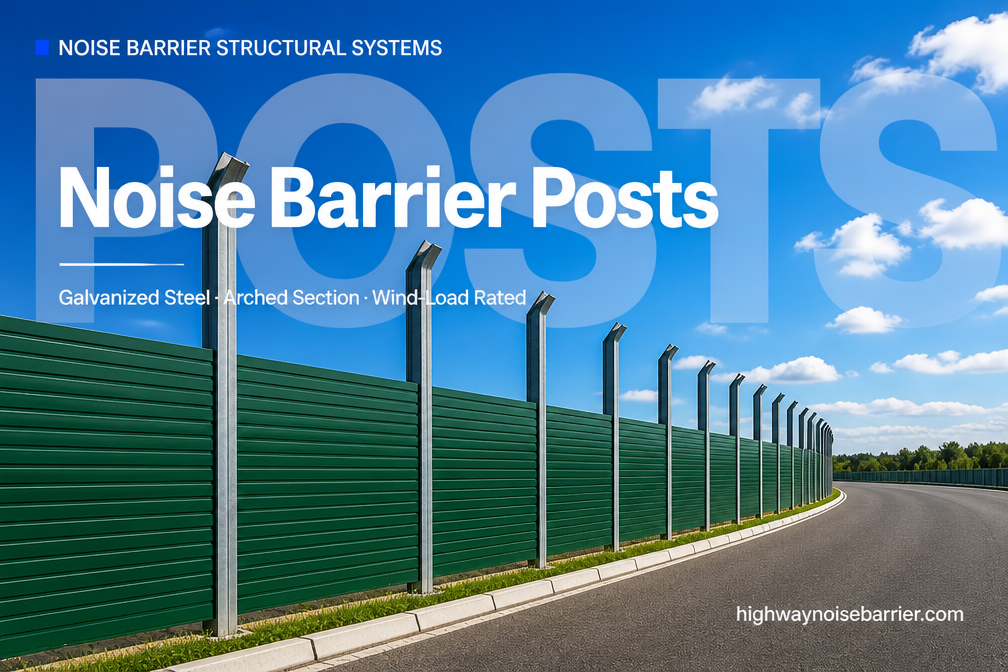
Among all materials used for highway noise barrier posts, hot-dip galvanized steel is the clear industry standard — and for good reason. Galvanized steel noise barrier posts deliver the structural strength, corrosion resistance, and service life that highway projects demand, at a cost that no alternative material can match over a 30-to-50-year project horizon. This guide covers everything highway engineers, contractors, and procurement teams need to know about specifying, designing, and installing galvanized steel noise barrier posts.
Why Galvanized Steel Dominates the Noise Barrier Post Market
Highway noise barrier posts must resist wind loads, support the weight of acoustic panels, and remain structurally sound in some of the most demanding environments in civil infrastructure — exposed to deicing salts, vehicle exhaust, moisture cycling, and ultraviolet radiation. Hot-dip galvanized steel noise barrier posts meet these demands through a combination of inherent structural properties and sacrificial corrosion protection that no uncoated or painted alternative provides.
The zinc coating applied during hot-dip galvanizing works through two mechanisms: it forms a physical barrier between the steel and the environment, and it acts as a sacrificial anode — corroding preferentially in place of the steel underneath. This dual protection means that even where the zinc layer is scratched or cut, the surrounding zinc continues to protect the exposed steel through cathodic action. The result is a noise barrier post material that is self-protecting, low-maintenance, and predictably durable across the full range of highway environments.
Steel Section Profiles for Noise Barrier Posts
H-Beam Posts
H-beam posts (wide-flange sections) are the most widely used profile for highway noise barrier posts. Their symmetrical cross-section provides equal bending resistance in both axes, which simplifies panel connection details and allows standardized bracket designs to be used across a project. H-beams are available in a wide range of section sizes, from lightweight W100×19 sections for low barriers with short spans to heavy W200×100 sections for tall barriers in high-wind zones. For most standard highway noise barrier applications, W150 to W200 series sections provide the right balance of stiffness, weight, and economy.
I-Beam Posts
I-beam posts (standard or S-series sections) have a narrower flange relative to their depth compared to H-beams, giving them higher bending efficiency in the primary load direction — perpendicular to the barrier face. This makes them slightly more material-efficient than H-beams for barriers where wind load is the dominant design action and panel connection details can be adapted to the narrower flange. I-beams are commonly used in European markets and in projects where section weight is a key procurement criterion.
C-Section and Custom Profiles
For aesthetic installations and landscape noise barrier applications, C-section (channel) and proprietary curved or arched profiles are increasingly specified. These profiles are roll-formed or press-braked from galvanized sheet steel, providing an elegant curved appearance while meeting structural requirements. Arched-top posts in particular are used in residential and urban corridors where the visual character of the barrier is as important as its acoustic performance. Regardless of the profile, hot-dip galvanizing remains the corrosion protection standard for all steel section types used as noise barrier posts.
Hot-Dip Galvanizing: Standards and Coating Performance
The galvanizing process for noise barrier posts is governed by ASTM A123 (North America) and ISO 1461 (international markets). These standards specify minimum average zinc coating thicknesses based on the steel section thickness:
- Structural steel ≥ 6 mm thick: minimum 85 µm average coating thickness (equivalent to approximately 610 g/m²)
- Steel 3 to 6 mm thick: minimum 75 µm average coating thickness
- Spot readings: minimum 70 µm at any individual measurement point for structural sections
At the standard ASTM A123 coating thickness of 85 µm, the expected zinc consumption rate in a typical inland highway environment is approximately 1 to 2 µm per year, giving a theoretical first-maintenance threshold of 40 to 60 years. In coastal environments or heavy deicing-salt corridors, the rate increases to 3 to 5 µm per year, reducing the maintenance-free period to 20 to 30 years — still far exceeding the performance of painted or thermally sprayed alternatives without periodic recoating.
Structural Design of Galvanized Steel Noise Barrier Posts
Wind Load Design
The primary lateral load on a noise barrier post is wind pressure. Design wind loads are calculated per ASCE 7 (US) or EN 1991-1-4 (Europe), with site-specific exposure factors applied based on terrain category and barrier height. A 4-meter-high galvanized steel noise barrier post on an exposed highway section may experience design wind pressures of 1.2 to 1.8 kN/m², requiring posts with section moduli of 80 to 200 cm³ per meter of barrier width — depending on post spacing.
The critical design check for noise barrier posts is bending at the base, where the full wind moment is transferred to the foundation. Engineers must verify that the post section provides adequate elastic section modulus and that the base connection — whether through anchor bolts or direct embedment — can resist the resulting moment without yielding or connection failure.
Post Spacing
Optimizing post spacing is one of the most impactful cost-control decisions in a noise barrier project. Wider spacing reduces the number of posts and foundations, lowering material and installation cost; but it increases the structural demand on each post and the unsupported span of each panel. Standard spacing ranges for galvanized steel noise barrier posts are:
- 2.0 to 2.5 m: high-wind zones, heavy concrete or composite panel systems, or barriers over 5 m high
- 3.0 to 4.0 m: standard metal panel systems in normal wind exposure
- 4.0 to 6.0 m: lightweight transparent or thin metal panel systems with intermediate horizontal rails
Base Plate and Anchor Bolt Design
Most galvanized steel noise barrier posts are connected to their foundations through a welded base plate and anchor bolt assembly. The base plate distributes the post moment over the anchor bolt pattern; the bolts resist the tensile force from the overturning moment and the shear force from the wind. Anchor bolts for noise barrier posts are typically ASTM F1554 Grade 55 or Grade 105, hot-dip galvanized to match the post. Base plate grouting after final alignment eliminates bearing eccentricity and locks the post position.
Foundation Options for Galvanized Steel Posts
The choice of foundation system significantly affects project schedule, cost, and long-term performance of galvanized steel noise barrier posts.
Cast-in-place concrete footings — individual footings at each post location, typically 1.0 to 1.5 m square and 0.8 to 1.5 m deep — are the most common choice. They provide reliable moment resistance and are compatible with standard anchor bolt templates. Driven H-pile or tube-pile foundations are preferred where soil conditions are poor, excavation is restricted, or installation speed is critical. The post base plate is welded directly to the pile top, eliminating the need for anchor bolt positioning. Continuous reinforced concrete plinths serve both as foundation and as the acoustic ground seal, reducing the number of individual excavations for long barrier runs.
Installation and Quality Control
Proper installation of galvanized steel noise barrier posts requires attention to alignment tolerances, anchor bolt torquing, and protection of the galvanized coating. Key quality control requirements include:
- Vertical alignment: ±10 mm over any 3-meter height, checked with a digital level before grouting
- Horizontal position: ±5 mm from the design alignment string line
- Anchor bolt torque: per structural drawings, typically 70 to 80% of proof load for galvanized bolts
- Coating protection: any zinc coating damaged during fabrication, welding, or installation must be repaired immediately with zinc-rich paint per ASTM A780 — minimum two coats to achieve 100 µm dry film thickness over the repair area
Maintenance of Galvanized Steel Noise Barrier Posts
One of the greatest advantages of galvanized steel noise barrier posts is their low maintenance requirement. Under normal highway conditions, the recommended maintenance program is:
- Annual visual inspection: check for physical damage, coating condition at ground level and anchor bolt areas, and any signs of base plate corrosion or concrete cracking
- Zinc thickness survey: every 10 years, using a magnetic induction gauge, to verify remaining coating life and plan future maintenance
- Touch-up repair: immediately after any observed coating damage, using zinc-rich paint or zinc-spray repair per ASTM A780
- Drainage maintenance: keep drainage clear at the base of each post to prevent water and salt accumulation against the steel and foundation
When the zinc coating approaches minimum serviceable thickness — typically below 20 to 25 µm — a thermal spray zinc or zinc-rich paint overcoat system can restore protection, extending service life by a further 20 to 30 years without replacement.
Conclusion
Hot-dip galvanized steel noise barrier posts are the proven, cost-effective, and technically superior choice for highway noise barrier structural systems. With service lives of 30 to 50 years under standard conditions, self-protecting sacrificial zinc corrosion protection, a wide range of section profiles — from H-beams to arched custom sections — and straightforward maintenance requirements, galvanized steel noise barrier posts deliver reliable structural performance across the full lifecycle of any highway noise barrier project. For engineers and contractors specifying noise barrier posts, galvanized steel represents not just the industry standard, but the rational first choice for every project context.
Post time: Aug-19-2026