
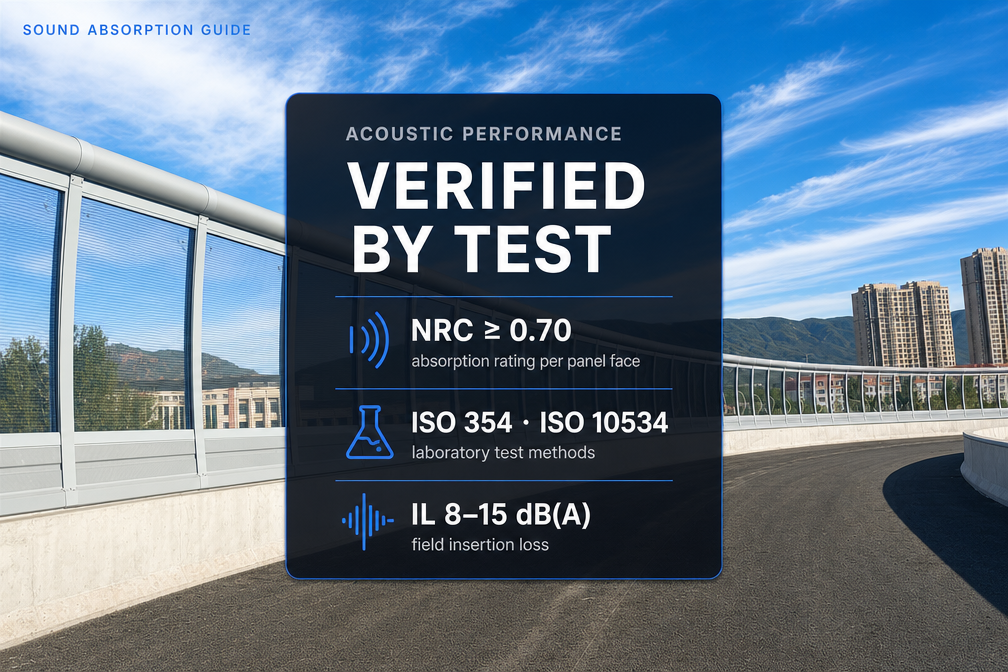
Noise barrier sound absorption is the property that determines whether a highway sound barrier simply blocks noise or actually manages it. A non-absorptive barrier reflects sound energy back across the roadway, where it bounces between opposing walls or escapes to sensitive receptors on the opposite side. An absorptive barrier, by contrast, converts a large share of that energy into heat inside the panel. This guide explains how noise barrier sound absorption is measured in the laboratory, how acoustic ratings are calculated, and how performance is verified on real highway projects.
Why Sound Absorption Matters on Highways
On a typical highway, traffic noise reaches a barrier from a line of moving sources — engines, tires, and aerodynamic flow. When a reflective barrier stands alongside the road, incident sound energy is redirected: some passes over the top, some diffracts around the ends, and much is reflected back toward the roadway or toward buildings on the opposite side. On dual-carriageway and elevated sections, reflections between two parallel barriers can measurably increase noise levels on both sides — an effect known as multiple reflection.
Sound-absorbing panels break this cycle. By dissipating rather than reflecting acoustic energy, an absorptive barrier reduces the total sound field around the corridor and improves performance for receptors on the far side of the road — which is why the specified noise barrier sound absorption class directly shapes panel selection and project budget. This is why highway noise barrier sound absorption is specified not as an option, but as a core acoustic requirement on most modern projects — typically with a Noise Reduction Coefficient (NRC) of 0.70 to 0.90 for the panel face.
How Sound Absorption Is Measured in the Laboratory
The fundamental quantity behind every absorptive rating is the sound absorption coefficient (α) — the fraction of incident sound energy absorbed by a material, measured on a scale from 0 (perfect reflection) to 1 (perfect absorption). Two laboratory methods are internationally recognized:
- Reverberation room method (ISO 354 / ASTM C423) — a sample panel is placed in a calibrated reverberation room and the decay time of a diffuse sound field is measured with and without the sample. The absorption coefficient is derived from the difference. This method produces the ratings used in most highway specifications.
- Impedance tube method (ISO 10534-2 / ASTM E1050) — a small sample is mounted at the end of a tube and a transfer-function analysis of incident and reflected waves yields the normal-incidence absorption coefficient, typically over a frequency range of 100 Hz to 6,300 Hz. This method is fast and repeatable, and is widely used for material development and quality control.
Both methods test the panel face under controlled conditions. For highway panels, absorption coefficients are reported in one-third-octave bands, usually from 100 Hz to 5,000 Hz, because traffic noise spans exactly this range: tire noise dominates above 1 kHz, engine and exhaust noise below 500 Hz.
Key Acoustic Ratings Explained
Specifiers encounter several single-number ratings derived from the absorption spectrum when they define noise barrier sound absorption requirements. Knowing what each one means prevents costly specification errors:
- NRC (Noise Reduction Coefficient) — the arithmetic average of the absorption coefficients at 250, 500, 1,000 and 2,000 Hz, rounded to the nearest 0.05. Highway panel specs commonly require NRC ≥ 0.70; high-performance panels reach 0.85–0.90.
- SAA (Sound Absorption Average) — a 12-band average from 200 to 2,500 Hz that gives a more complete picture than NRC for broadband noise sources.
- αw (weighted absorption coefficient) — the European single-number rating per ISO 11654, used in EU projects alongside sound absorption classes A–E.
- STC (Sound Transmission Class) — measures sound *insulation* (blocking), not absorption. Both matter: the panel must absorb on its road-side face and block on its overall structure.
For highway absorptive noise barriers, the specification package usually demands both an NRC (absorption) and an STC (insulation) value, plus a minimum insertion loss measured on site.
From Lab to Road: On-Site Verification
Laboratory coefficients do not automatically guarantee field performance, because the real sound field arrives at oblique angles, from moving sources, and under varying weather. Highway projects therefore verify noise barrier sound absorption performance on site:
- Insertion loss (IL) measurement — sound levels are measured at receptor points with and without the barrier (or predicted vs. measured after construction), typically in accordance with methods such as the U.S. FHWA Traffic Noise Model validation protocol or EN 1793-6 for field testing of sound barriers.
- Sound absorption field test (EN 1793-5) — for a panel facing the road, the in-situ absorption coefficient can be assessed with a portable measurement system using the pressure-pressure method.
- Acceptance criteria — contracts commonly specify a minimum field insertion loss, e.g., 8–15 dB(A) at reference receptor points, measured under controlled traffic and weather conditions.
Measured results on completed highway projects typically confirm that a well-specified absorptive barrier with NRC ≥ 0.80 panels achieves its design attenuation, while reflective barriers on the same alignment underperform by several decibels at receptors on the far side of the carriageway.
Choosing an Absorptive Panel for Highway Projects
Panel technology determines both the absorption spectrum and the long-term durability of the system. Common highway options include:
- Micro-perforated aluminum panels — corrosion-resistant, fully recyclable, and acoustically tunable; a strong choice for long service life in humid or coastal corridors.
- Metal louver panels — louvered profiles that diffuse and absorb sound; easy to install and maintain, widely used on expressways.
- Perforated metal with mineral-wool or polyester core — high broadband absorption at low cost; the core must be protected against moisture ingress and fire risk.
- Composite and transparent systems — absorptive lower sections combined with transparent upper glazing to preserve views while meeting absorption targets.
Selection factors include the dominant traffic-noise frequencies at the site, the required NRC class, environmental conditions, fire classification, and whole-life maintenance cost. A manufacturer with certified laboratory data and completed project references — supported by on-site verification results — provides the evidence base that specifiers need.
Conclusion
Noise barrier sound absorption is a measurable, verifiable engineering property, not a marketing claim. From ISO 354 reverberation-room coefficients and NRC ratings to on-site insertion-loss measurements per EN 1793-6, the performance of an absorptive highway barrier can be specified with precision and confirmed after installation. For engineers and contractors, understanding how noise barrier sound absorption is tested and rated — and demanding certified data plus field verification — is the difference between a barrier that looks right and one that actually delivers the quiet it was designed to provide.
FAQ
1.How is sound absorption performance tested?
Laboratory absorption is measured per ISO 354 / ASTM C423 (reverberation room) or ISO 10534-2 / ASTM E1050 (impedance tube); on-site insertion loss follows methods such as EN 1793-6.
2.What does NRC mean for my noise barrier specification?
NRC is the average absorption coefficient at 250-2000 Hz rounded to 0.05; highway panels are commonly specified at NRC 0.70 or higher.
Post time: Aug-31-2026