
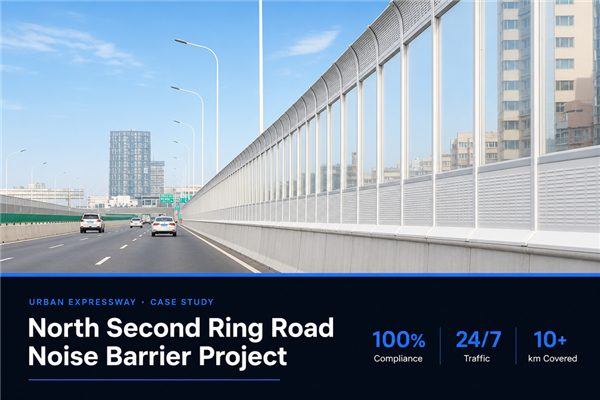
The Shijiazhuang North Second Ring Road noise barrier project demonstrates how responsive municipal action combined with proven noise barrier technology can resolve real community concerns. When residents living near the elevated section of the North Second Ring Road reported that traffic noise was disrupting daily life, the Shijiazhuang municipal government launched a dedicated mitigation program. Hebei Jinbiao supplied the noise barrier systems for this project, which was completed successfully with noise reduction performance verified to meet national standards. This case study examines the project background, the solution delivered, and the outcomes achieved.
Project Background
The Community Noise Concern
The North Second Ring Road is one of Shijiazhuang’s busiest urban expressways, carrying continuous, high-volume traffic through densely populated residential areas. The elevated viaduct section, which passes close to residential buildings, generated significant traffic noise that affected the daily lives of nearby residents. Community members formally raised their concerns with the municipal government, highlighting the impact of round-the-clock traffic noise on sleep quality, home comfort, and overall quality of life in the neighborhoods adjacent to the elevated road.
Elevated expressways present a particular acoustic challenge in urban settings. Unlike at-grade roads, where terrain and distance provide some natural attenuation, elevated viaducts expose adjacent buildings to noise from multiple directions — engine noise and tire-road interaction radiate laterally from the deck, while structure-borne vibration transmits through the supports. For buildings whose upper floors sit at or near the elevation of the roadway, the acoustic exposure can be especially severe, with noise levels at residential facades frequently exceeding daytime and nighttime limits recommended for living environments.
Government Response and Project Initiation
In response to the residents’ reports, the Shijiazhuang municipal government promptly initiated a noise mitigation program for the North Second Ring Road elevated section. The city’s municipal engineering department was tasked with designing and implementing noise barrier installation along the affected corridor, with the clear objective of reducing traffic noise at nearby residential receptors to levels compliant with national acoustic environmental standards. The project reflected the city’s commitment to addressing residents’ environmental concerns through concrete infrastructure improvements.
The Solution: Noise Barrier Installation on the Elevated Expressway
The mitigation program centered on the installation of noise barriers along the elevated section of the North Second Ring Road. Hebei Jinbiao, a specialist noise barrier manufacturer, supplied the noise barrier products for the project, providing a system engineered to meet the acoustic requirements of an urban elevated highway environment.
System Design and Configuration
The noise barriers were designed to address the specific acoustic challenges of an elevated urban expressway, where noise radiates both laterally and downward toward adjacent residential areas. The barrier system incorporated:
- Effective noise blocking — barrier panels sized and positioned to interrupt the direct sound path between the traffic source and nearby residential receivers
- Durable construction — materials selected for long-term performance in an urban environment with continuous traffic exposure
- Safe integration with elevated structure — mounting designed to work with the viaduct structure without compromising road safety or structural integrity
- Low maintenance design — components engineered for minimal routine upkeep over the barrier’s service life
Because the corridor passes through a densely built urban area, the barrier height and placement were carefully configured to maximize noise reduction at the nearest residential buildings while maintaining sightlines where appropriate. The result was a tailored installation that balanced acoustic performance with the practical constraints of an existing urban elevated roadway.
Implementation
The installation of the noise barriers proceeded under the coordination of the municipal engineering department, with Hebei Jinbiao supplying the barrier products. Working on an elevated urban expressway requires careful planning: installation had to be carried out while maintaining traffic operations on the road below and ensuring the safety of both workers and motorists. The project team managed these logistics effectively, completing the noise barrier installation across the affected sections of the corridor.
Project Outcomes
Noise Reduction Compliant with National Standards
The completed noise barrier project achieved its primary objective: noise reduction performance that complies with national standards. Following installation, traffic noise levels at the residential receptors adjacent to the elevated section were reduced to acceptable levels, directly addressing the concerns raised by the community. The successful outcome was verified through the completion of the project, which confirmed the barriers delivered the required acoustic performance.
Improved Quality of Life for Residents
For the residents living near the North Second Ring Road elevated section, the barriers brought a measurable improvement in daily living conditions. The reduction in traffic noise restored quieter, more comfortable homes in the neighborhoods that had raised the original concerns — demonstrating how targeted infrastructure investment can translate directly into community wellbeing.
A Model for Responsive Urban Noise Mitigation
The Shijiazhuang project offers a compelling template for other cities facing similar challenges. Its key elements — listening to community concerns, responding with a structured mitigation program, engaging an experienced noise barrier supplier, and verifying results against national standards — form a repeatable process for urban elevated highway noise control. For municipal authorities, the project shows that community-reported noise problems can be resolved efficiently with well-specified barrier systems and professional execution.
Lessons for Urban Noise Barrier Projects
Several transferable lessons emerge from the Shijiazhuang North Second Ring Road project. First, community input should drive project prioritization — the program originated directly from residents’ reports, ensuring public resources were directed to the locations where noise problems were most acutely felt. Second, early engagement of an experienced barrier supplier helped align product selection with the specific constraints of an elevated urban corridor, avoiding the delays and performance shortfalls that can arise when specifications are finalized without manufacturing input. Third, verification against national standards provided objective confirmation that public investment delivered the promised acoustic outcome — an important element of accountability for municipal projects.
For other cities evaluating elevated expressway noise mitigation, the project also demonstrates the value of a phased, corridor-specific approach: rather than attempting blanket coverage, the barriers were installed on the sections where residential exposure was greatest, concentrating acoustic benefit where it was needed most while keeping project scope — and budget — proportionate to the problem.
Conclusion
The Shijiazhuang North Second Ring Road noise barrier project illustrates the effective resolution of a genuine community concern through responsive governance and reliable noise barrier technology. By acting on residents’ reports, commissioning a structured mitigation program, and deploying noise barriers supplied by Hebei Jinbiao, the city delivered noise reduction that complies with national standards and improved the quality of life for affected communities. The project stands as a practical reference for urban elevated expressway noise control — proof that when municipal authorities, engineering teams, and experienced manufacturers work together, community noise concerns can be turned into successful, standards-compliant infrastructure outcomes.
Post time: Aug-12-2026