
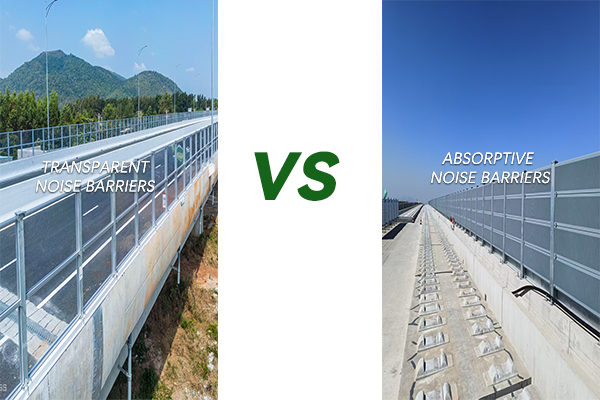
As traffic volumes increase, bridge noise has become a major concern in urban areas. Installing noise barriers is one of the most effective ways to reduce traffic noise. The two most common types are transparent noise barriers and absorptive noise barriers. Each offers unique advantages depending on project requirements.
Transparent Noise Barriers
Transparent noise barriers are typically made from polycarbonate, acrylic, or laminated glass.
Advantages
Maintain clear visibility and preserve bridge aesthetics.
Allow natural light to pass through.
Lightweight, reducing structural load on the bridge.
Easy to install and clean.
Limitations
Primarily block noise rather than absorb it.
Smooth surfaces can reflect sound, causing secondary noise.
Some materials may yellow or deteriorate after long-term exposure to weather.
Absorptive Noise Barriers
Absorptive barriers use materials such as rock wool, glass wool, or aluminum foam, protected by perforated metal panels.
Advantages
Absorb and block noise simultaneously.
Reduce sound reflection and secondary noise.
Excellent performance against traffic noise frequencies.
Strong and durable, suitable for bridges with high wind loads.
Limitations
Usually opaque, affecting visibility and natural lighting.
Heavier than transparent barriers.
Require periodic maintenance to maintain acoustic performance.
Higher initial investment.
Performance Comparison
Recommended Applications
| Feature | Transparent Barrier | Absorptive Barrier |
| Noise Reduction | 8–15 dB | 10–25 dB |
| Sound Reflection | Higher | Lower |
| Visibility | Excellent | Limited |
| Weight | Lightweight | Heavier |
| Service Life | 5–15 Years | 15–25 Years |
| Maintenance Cost | Low | Medium |
| Initial Cost | Lower | Higher |
Choose Transparent Noise Barriers If:
• Visual appearance is important.
• The bridge is located in scenic or urban landmark areas.
• Structural load capacity is limited.
• Budget is a key consideration.
Choose Absorptive Noise Barriers If:
• Nearby residential areas, schools, or hospitals require better noise control.
• Noise reduction performance is the top priority.
• Sound reflection must be minimized.
• The bridge structure can support additional weight.
• Hybrid Solutions: The Best of Both Worlds
Many modern bridge projects use a hybrid design, combining an absorptive lower section with a transparent upper section. This solution provides effective noise reduction while maintaining visibility and natural light, making it a popular choice for new bridge construction.
Both transparent and absorptive bridge noise barriers have their advantages. Transparent barriers excel in aesthetics and visibility, while absorptive barriers provide superior acoustic performance. For many projects, a hybrid system offers the best balance between noise control, appearance, and long-term value.
Before selecting a solution, it is recommended to conduct professional noise assessments and structural evaluations to ensure the most suitable design for your project.
Post time: Jun-15-2026