
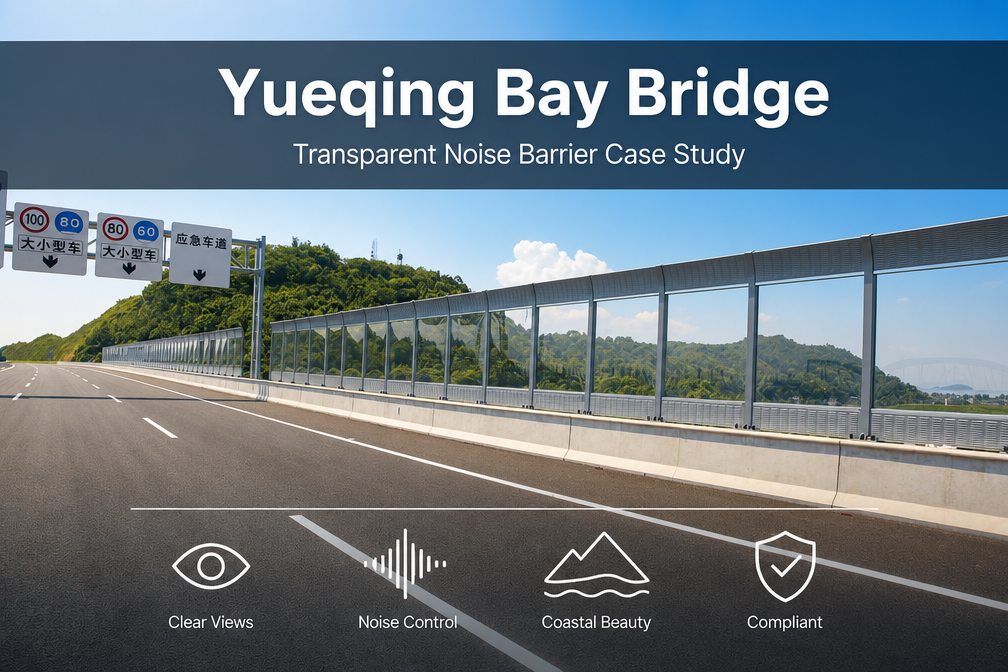
The Yueqing Bay Bridge project stands as a landmark example of how transparent noise barrier systems can protect communities while preserving the natural beauty of coastal landscapes. As a critical section of the Yongtaiwen Expressway auxiliary line, this 38.147-kilometer bridge-and-approach project required an innovative approach to noise control — one that could shield nearby residential areas from traffic noise without sacrificing the panoramic views that make the route one of the most scenic drives in Zhejiang Province. This case study examines the project challenges, the transparent noise barrier solution, and the outcomes delivered.
Project Overview
The Yueqing Bay Bridge and its approach roads form a key component of the Ningbo–Taizhou–Wenzhou Expressway auxiliary line, one of the most important transportation arteries on China’s eastern seaboard. The full project spans 38.147 kilometers, comprising 47 bridges of varying scale — including four major bridges crossing the bay itself — and three tunnels. With a total investment of approximately RMB 10.39 billion, the project was among the largest highway construction undertakings in Taizhou during the “12th Five-Year Plan” period.
The main bridge structure extends 13.1 kilometers, connecting Yuhuan City in the south to Yueqing City in the north. Construction began in December 2011, and after years of intensive engineering work, the bridge was officially opened to traffic on October 1, 2018 — a milestone that significantly reduced travel time between the coastal cities of eastern Zhejiang and strengthened the region’s position within the national expressway network.
Project Challenges
Noise Impact on Coastal Communities
Unlike many highway projects that pass through open countryside, sections of the Yueqing Bay Bridge corridor run close to residential communities and villages located at the foot of surrounding hills. With the bridge carrying high volumes of expressway traffic, noise levels at these locations posed a genuine threat to residents’ quality of life. The challenge was to implement effective noise mitigation that would meet national acoustic standards while minimizing disruption to the area’s natural character.
Scenic Landscape Preservation
The corridor is blessed with exceptional natural scenery — rolling green hills, the open waters of the bay, and panoramic coastal vistas. Conventional solid noise barriers would have blocked these views entirely, degrading the travel experience on a route celebrated for its beauty and reducing the visual connection between the highway and the surrounding landscape. The project team needed a noise barrier solution that could deliver real acoustic performance without turning the corridor into a walled tunnel.
The Solution: Transparent Noise Barrier Systems
To balance acoustic protection with scenic preservation, the project specified a combination of fully transparent and mid-transparent noise barrier sections across the most sensitive portions of the route. The noise barriers were designed, manufactured, and installed by Hebei Jinbiao, a specialist sound barrier manufacturer, with installation concentrated in the areas nearest to residential communities.
Technical Design
The barrier system combines transparent acrylic panels with lightweight metal support frames mounted on concrete foundation walls. This hybrid structure delivers two critical functions simultaneously:
- Acoustic performance — the panel mass and sealed mounting system effectively block and absorb traffic noise, ensuring sound levels at residential receptors comply with national standards
- Visual transparency — drivers and nearby residents retain unobstructed views of the bay, hills, and coastline through the clear panels
Perforated metal sections integrated into the upper and lower zones of the barrier provide additional sound absorption, preventing reflected noise from degrading overall performance. The combination of transparent and absorptive elements allows the barrier to perform as a hybrid reflective-absorptive acoustic system rather than a simple reflective wall.
Why Transparent Panels Were Selected
The selection of transparent panels was driven primarily by the project’s scenic context. Along the most picturesque sections of the route, fully transparent barriers were specified to preserve the panorama; in other locations, mid-height transparent inserts were combined with solid lower sections where additional acoustic mass was needed. This tailored approach ensured that every barrier section was optimized for its specific location — maximizing noise reduction where communities were closest while maximizing views where the landscape was most valuable.
Implementation and Engineering Highlights
The installation of the noise barrier systems required careful coordination with the bridge and approach road construction schedule. Because large portions of the corridor are elevated or located in coastal wind zones, the barrier mounting systems had to be engineered to withstand significant wind loads while maintaining a sealed acoustic envelope. The lightweight nature of the transparent panel system simplified installation on the bridge structures, avoiding the heavy lifting requirements that solid concrete barriers would have imposed.
All noise barrier sections along the route were completed in advance of the October 2018 opening, allowing final acoustic verification testing to be carried out before traffic commenced. The completed systems met the required noise reduction standards, confirming that the transparent barrier approach could achieve the same acoustic compliance as conventional solid systems while delivering far superior visual outcomes.
From a maintenance perspective, the transparent panel system offers practical long-term advantages in the coastal environment. The acrylic panels are treated with UV-stabilized formulations that resist yellowing under intense seaside sunlight, while the galvanized metal framing provides corrosion resistance against salt-laden sea air. The modular panel design allows individual sections to be replaced quickly if damaged, minimizing disruption to traffic and keeping lifecycle maintenance costs predictable.
Project Outcomes
Community Noise Protection
The primary objective — protecting nearby residents from traffic noise — was fully achieved. With the barrier systems operational, noise levels at sensitive residential receptors along the corridor comply with national acoustic environmental standards, delivering a measurable improvement in living conditions for the communities adjacent to the route.
Scenic Experience Preserved
Equally important, the project preserved the scenic character of one of eastern Zhejiang’s most beautiful coastal corridors. Travelers on the bridge continue to enjoy unobstructed views of the bay and surrounding hills through the transparent panels, while residents retain their sightlines to the water and landscape. The project demonstrates that noise mitigation and scenic preservation are not mutually exclusive — when the right barrier technology is specified, both objectives can be achieved simultaneously.
A Replicable Model for Scenic Corridors
The Yueqing Bay Bridge project has become a reference case for noise barrier specification on scenic highways and coastal corridors. Its success proves that transparent acoustic panel systems can deliver national-standard noise reduction in demanding coastal environments while preserving the visual amenity that defines a region’s character. For agencies and contractors planning noise mitigation along similarly scenic routes, the project offers a proven, cost-effective alternative to conventional solid barrier walls.
Conclusion
The Yueqing Bay Bridge noise barrier project exemplifies the evolution of highway noise control from purely functional infrastructure toward integrated solutions that respect both acoustic performance and environmental quality. By combining transparent panels with absorptive metal elements in a lightweight, wind-resistant system, Hebei Jinbiao delivered a barrier that protects coastal communities from traffic noise while keeping the region’s celebrated landscapes open to view. The project stands as a compelling demonstration that well-designed transparent noise barriers can meet the highest acoustic standards — and that scenic preservation and effective noise control belong together in modern highway design.
Post time: Aug-06-2026