
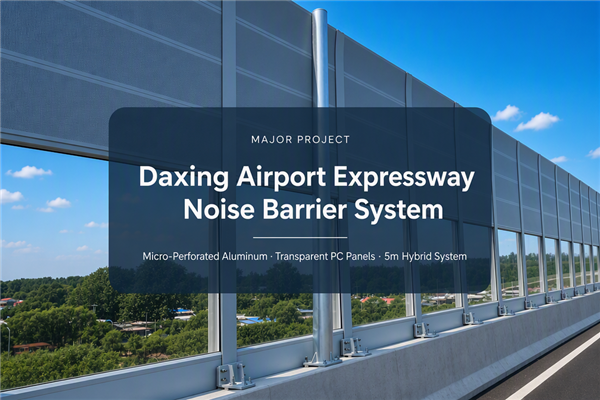
The Beijing Daxing International Airport North Line Expressway stands as a flagship project in the Beijing–Tianjin–Hebei regional integration initiative, serving as the vital express link between the capital and the Xiong’an New Area. As part of this national priority infrastructure, the project demanded noise barrier systems that could meet the highest standards of acoustic performance, structural quality, and visual excellence. This case study examines how a 5-meter hybrid noise barrier system — combining micro-perforated aluminum panels with transparent polycarbonate lower sections — was delivered along both sides of this landmark corridor.
Project Background
A Gateway of National Significance
The Daxing Airport North Line Expressway is one of the “five vertical and two horizontal” corridors forming the comprehensive transport network serving Beijing Daxing International Airport. More than a simple airport access road, the expressway is a high-speed corridor connecting the airport to the capital’s core urban area and providing a direct express route from the Xiong’an New Area — a major national development zone — into Beijing. As the first expressway linking the capital with Xiong’an, the project marked a significant step forward in Beijing’s support for the new area’s development and in the deeper integration of the Beijing–Tianjin–Hebei region.
The expressway’s strategic position meant that every element of its construction — from pavement quality to roadside infrastructure — was held to the highest national standards. Noise barriers, as a highly visible component running the full length of both carriageways, were no exception. They had to perform acoustically, endure for decades, and present a polished appearance worthy of the corridor’s role as a gateway to China’s newest international aviation hub.
The Noise Mitigation Challenge
Because the expressway carries airport-bound traffic at high speeds and passes through areas designated for future urban development, effective noise control was a core design requirement from the outset. The corridor needed noise barriers that would protect potential residential and commercial development along the route while maintaining the visual openness expected of a modern gateway expressway. The specification called for a barrier system that combined robust acoustic performance with an attractive, high-quality appearance befitting a national showcase project.
The Solution: Hybrid Metal and Transparent Barrier System
Hebei Jinbiao supplied and installed noise barrier systems along both sides of the expressway, delivering a tailored solution engineered specifically for the project’s requirements. The barrier system stands 5 meters tall and employs a sophisticated two-part hybrid design that optimizes both acoustic and visual performance.
Upper Section: Micro-Perforated Aluminum Panels
The upper portion of the barrier features micro-perforated aluminum panels — a high-performance material chosen for its exceptional acoustic properties. The precisely engineered micro-perforations allow the panels to absorb sound energy across a broad frequency range, effectively damping the traffic noise that would otherwise propagate over the barrier top. Aluminum construction provides several advantages in this application:
- Superior corrosion resistance — critical for a corridor exposed to varying weather conditions year-round
- Lightweight strength — reducing structural load on foundations and supporting posts
- Long service life — with minimal maintenance required over decades of operation
- Clean aesthetic finish — complementing the modern architectural character of the airport corridor
The micro-perforation pattern is carefully calculated to maximize the sound absorption coefficient while maintaining the panel’s structural integrity, delivering effective noise reduction where it matters most.
Lower Section: Transparent Polycarbonate Panels
The lower portion of the barrier incorporates transparent polycarbonate (PC) panels, adding a critical visual dimension to the noise control system. The transparent lower section offers multiple benefits:
- Preserved sightlines — drivers retain views of the surrounding landscape and approaching traffic, enhancing road safety and travel experience
- Natural light transmission — preventing the “tunnel effect” of fully opaque barriers and keeping the corridor open and airy
- Impact resistance — polycarbonate’s exceptional toughness protects against debris and vandalism
- Weight reduction — the lightweight material reduces loads on the supporting structure
This combination of absorptive metal above and transparent material below creates a barrier that performs acoustically at the highest level while maintaining the visual openness expected of a modern gateway expressway.
Design and Engineering Highlights
Integrated Acoustic Design
The hybrid configuration delivers what engineers call a reflective-absorptive composite barrier. The micro-perforated aluminum upper panels absorb incident sound energy, while the mass of the system blocks sound transmission. This integrated approach provides more effective noise reduction than a simple reflective wall, particularly for the higher-frequency components of traffic noise that most affect nearby communities.
Structural Performance
At 5 meters in height, the barrier system required careful structural engineering to withstand wind loads and dynamic traffic effects. The lightweight nature of both aluminum and polycarbonate reduced the structural burden on foundations and support posts, while the corrosion-resistant materials ensured long-term durability with minimal maintenance. The system was engineered to meet the demanding quality standards of a national gateway project.
Implementation and Quality Assurance
Installation of the 5-meter barrier system along both sides of the expressway required precise coordination with the overall highway construction schedule. Each barrier section was delivered as a fully fabricated unit, with the micro-perforated aluminum upper panels and transparent polycarbonate lower panels pre-assembled to factory tolerances. This modular approach minimized on-site work, accelerated installation, and ensured consistent quality across the entire corridor length.
During installation, rigorous quality checks were performed on panel alignment, joint sealing, and structural connections. The transparent lower sections required particular care to ensure edge restraints accommodated thermal expansion while maintaining an acoustically sealed envelope. The completed system was verified against the project’s acoustic specification before the corridor opened to traffic.
Project Outcomes
National Standard Acoustic Performance
The completed noise barrier system delivers effective noise reduction in compliance with national acoustic standards, protecting the corridor’s surroundings from traffic noise while meeting the exacting requirements of this landmark infrastructure project.
Visual Quality and Aesthetic Excellence
Beyond acoustic performance, the barrier contributes to the modern, high-quality visual identity of the airport corridor. The clean lines of the aluminum upper section, combined with the transparent lower panels, create an attractive structure that complements the architectural character of China’s newest international gateway.
A Model for Gateway Infrastructure
The Daxing Airport North Line Expressway project demonstrates how hybrid noise barrier systems can satisfy the most demanding requirements of national showcase infrastructure. The combination of acoustic performance, structural reliability, corrosion resistance, and visual quality established a benchmark for similar corridors serving major transport hubs across China.
Conclusion
The Daxing Airport North Line Expressway noise barrier project exemplifies the delivery of world-class noise control for national flagship infrastructure. By combining 5-meter-tall micro-perforated aluminum panels with transparent polycarbonate lower sections, Hebei Jinbiao delivered a system that achieves superior acoustic performance while preserving the openness and visual quality expected of China’s premier airport gateway corridor. The project stands as a compelling reference for hybrid metal-transparent noise barrier design — demonstrating that the most demanding infrastructure projects can achieve both exceptional noise reduction and outstanding visual outcomes.
Post time: Aug-07-2026