
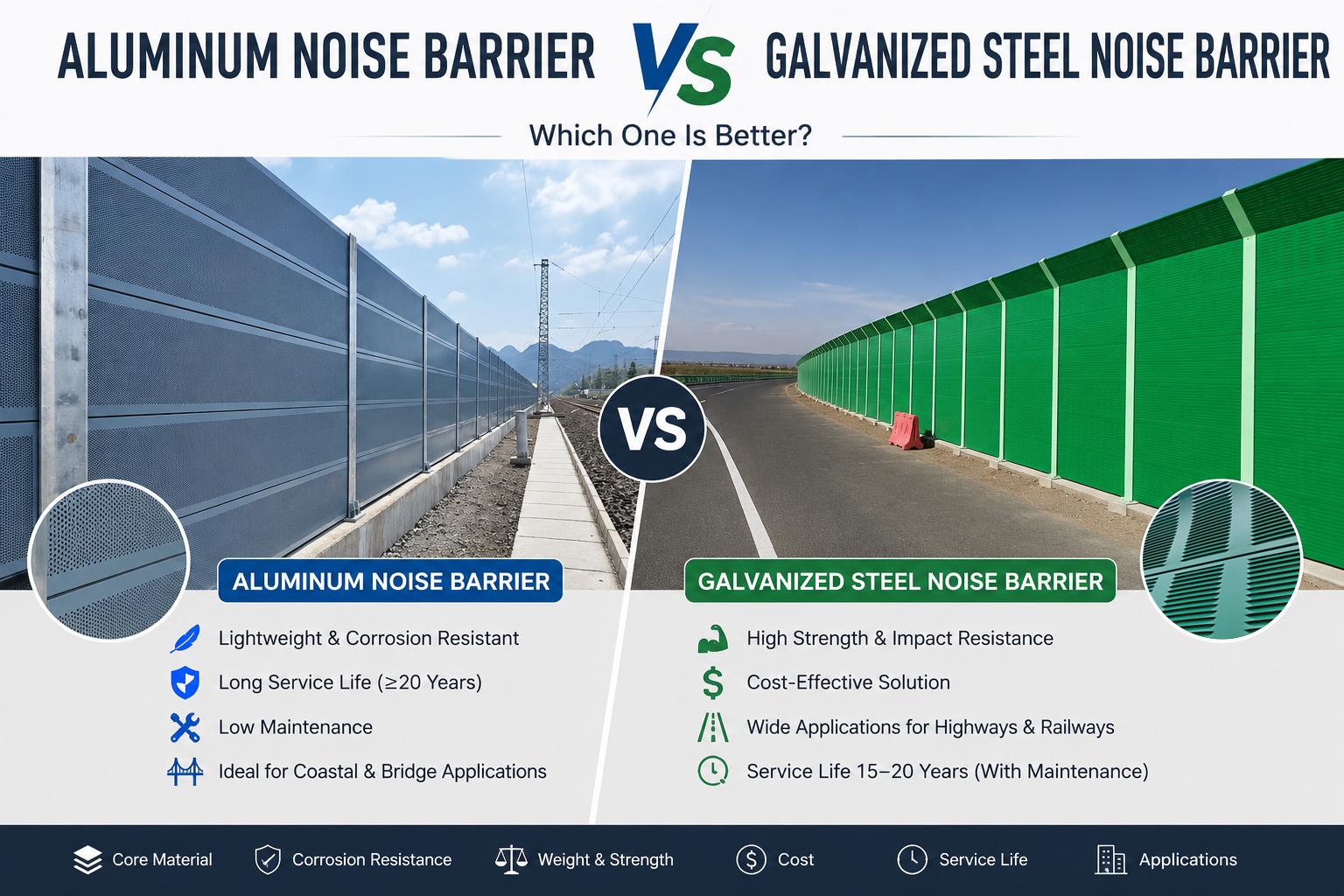
Aluminum noise barriers and galvanized steel noise barriers are two mainstream types of metal sound barriers. They differ significantly in performance, cost, and application scenarios. The key difference is that aluminum panels focus on lightweight construction and corrosion resistance, while galvanized steel panels emphasize high strength and cost-effectiveness.
Detailed Comparison
| Comparison Item | Aluminum Noise Barrier | Galvanized Steel Noise Barrier |
| Core Material | Aluminum alloy panels | Galvanized steel panels |
| Corrosion Resistance | Excellent. Natural oxide layer provides superior corrosion resistance. | Good. Zinc coating protects against rust, but performance decreases if the coating is damaged. |
| Weight & Strength | Lightweight with relatively high strength. | Heavier, but offers higher strength |
| Cost | Higher | More economical |
| Service Life | Long, typically ≥20 years with excellent weather resistance. | Generally 15–20 years, requiring periodic maintenance. |
| Fabrication & Installation | Easy to process and shape, but very thin sheets may be susceptible to transport damage. | Easy to form and assemble. |
| Typical Thickness | Recommended: 0.9–4.0 mm | Commonly used: 0.6–3.0 mm |
Material Characteristics and Performance
Corrosion Resistance and Durability
- Aluminum panels naturally resist corrosion and are ideal for humid, rainy, or coastal environments.
- Galvanized steel panels rely on the zinc coating for protection. When the coating remains intact, they provide a long service life, but damaged coatings may lead to rust.
Weight and Strength
- Aluminum panels are lightweight, making them suitable for bridges and structures where reducing load is important.
- Galvanized steel panels provide higher strength and better resistance to impact and wind pressure.
Acoustic Performance
Both types use perforated panels combined with sound-absorbing materials such as centrifugal glass wool to achieve noise reduction. Aluminum panels offer greater flexibility in acoustic design, while steel panels have higher rigidity and may experience resonance at certain frequencies.
Cost and Economic Benefits
Initial Cost
Galvanized steel noise barriers are more affordable and are commonly chosen for projects with limited budgets.
Long-Term Cost
Although aluminum noise barriers require a higher initial investment, they have lower maintenance costs. Galvanized steel barriers, on the other hand, require periodic maintenance over their service life.
Recommended Applications
Choose Aluminum Noise Barriers If:
- The project is located in coastal areas with high salt content and severe corrosion.
- Weight limitations are critical, such as on bridges or rooftop installations.
- Long-term, low-maintenance performance and aesthetic appearance are priorities.
Choose Galvanized Steel Noise Barriers If:
- Cost efficiency is a major concern for large-scale projects.
- High structural strength is required, such as for highways and railways.
- The installation environment is inland with normal atmospheric conditions.
Conclusion
In simple terms, choosing between aluminum and galvanized steel noise barriers is a trade-off between initial investment and long-term value:
- If the project budget is limited and the environment is not highly corrosive, galvanized steel noise barriers offer an economical and efficient solution.
- If durability, lightweight design, and low maintenance are priorities, and the budget allows, aluminum noise barriers are a better long-term investment.
Is your project intended for a highway, railway, or urban roadway? Different applications have different requirements for corrosion resistance, structural strength, and load-bearing capacity. If you can share the specific application, I can help recommend the most suitable solution.
Post time: Jun-23-2026