
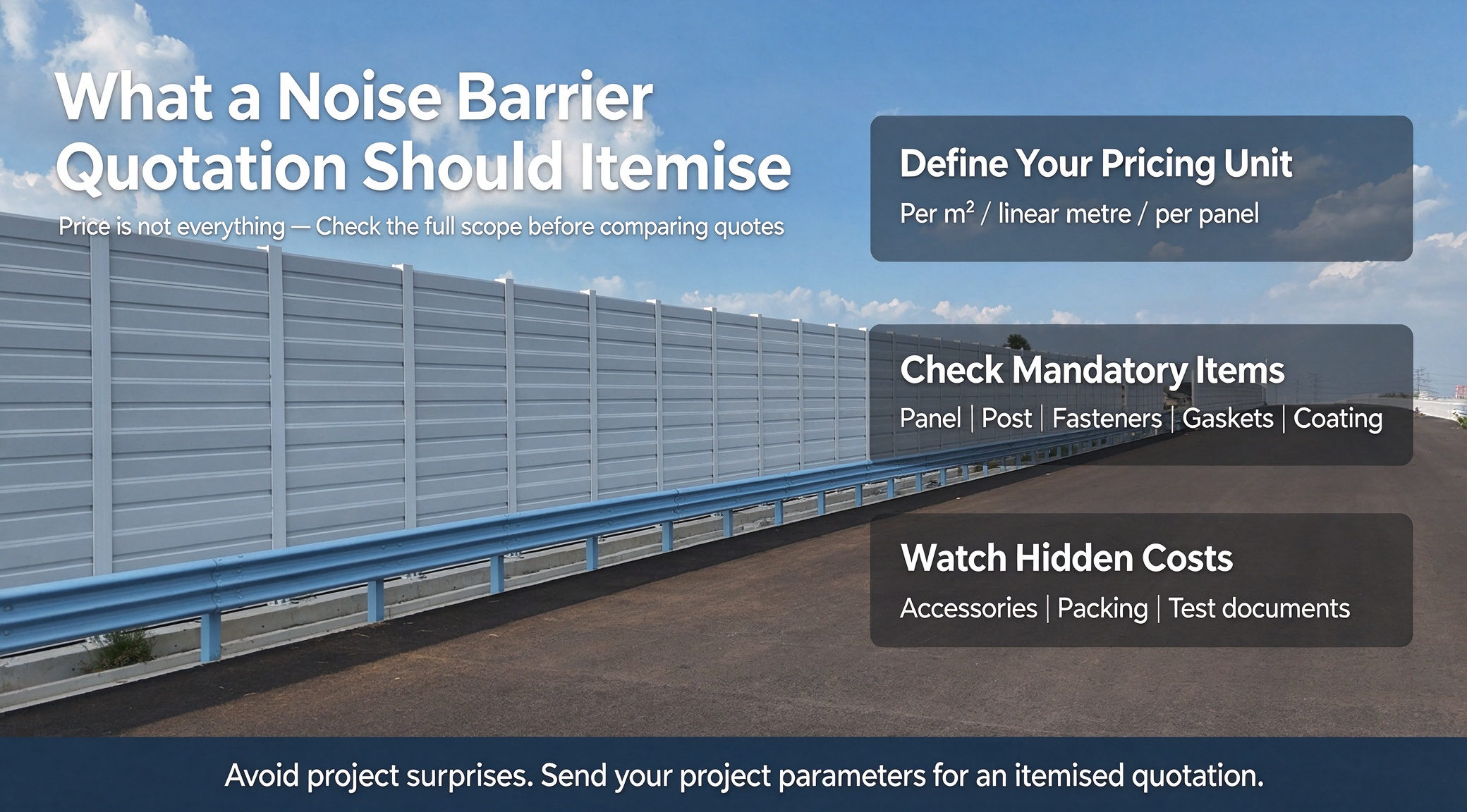
A quotation is a scope, not a price
Most buyers compare the number at the bottom of the page. That number is the least useful part of the document. Two quotes for what sounds like the same barrier can sit far apart and neither is dishonest, because they are not quoting the same thing.
A usable noise barrier quotation tells you exactly where the supplier’s responsibility stops. If you cannot find that line in the document, the price is not comparable to anything.
The gap usually surfaces at the worst moment. Panels arrive, the site team opens the container, and there are no clips. Or the panels are there but the posts were never in the price. By then the delivery date is fixed and the leverage is gone. A noise barrier quotation that lists its scope takes a little longer to write and removes that conversation completely.
Fix the unit before you compare
Three units get used interchangeably in this trade and they are not the same. Per square metre of barrier face. Per linear metre of barrier line. Per panel. A noise barrier quotation priced without posts will look competitive against one that includes them, and the gap only shows up when you add the steel back in.
So the opening question about any noise barrier quotation is what the unit covers. Face area only, or face area plus posts, fixings and base plates. Linear metre at what height, since a metre of 3 m barrier and a metre of 5 m barrier are different products. Panel price at what panel width.
Ask each supplier to restate the unit in their own words. Where two suppliers describe it differently, you have found the reason the prices differ before anyone starts arguing about money.
The lines a usable quotation carries
Ten items do most of the work. If a noise barrier quotation is missing several of them, it is a price indication rather than an offer.
- Scope statement. What is included and what is not. Panels only, or panels with posts, clips, gaskets and base plates. Installation almost never is.
- Unit basis. m² of face, linear metre, or panel count, and whether posts sit inside that unit.
- Panel build. Type, thickness, material, absorptive facing and weight per square metre. Weight drives freight, and it tells you whether the post was sized for this panel.
- Post and base. Section, spacing, coating and base plate size. Without post spacing the price has no fixed meaning.
- Fasteners and accessories. Clips, gaskets, bolts, cap profiles. Cheap per piece, considerable over a kilometre, which is why they are the classic omission.
- Coating system. Not “galvanized”. The standard, the coating class, the dry film thickness and the colour reference.
- Packing. How panels are protected, bundle size, and whether packing is inside the price or billed as an extra.
- Loading. Container type, how much goes into one, and whether loading supervision is included.
- Price term. EXW, FOB or CIF, the named port, and how long the figure holds.
- Documents. Test reports, mill certificates, inspection reports, and who pays for third-party inspection if the project calls for it.
Where the money hides
Four lines do most of the damage when they are absent from a noise barrier quotation.
- Fasteners counted in pieces, not sets. Listing clips without a quantity per panel leaves the total open.
- Packing treated as free. Panels need edge protection and separation. That is material and labour, and someone pays for it.
- Unloading left to the buyer. CIF gets the container to the port, not the panels off the truck at site.
- No spare allowance. Site damage happens. Zero spares means one broken panel becomes a new order with new freight.
Lead time and payment sit inside the price
Two commercial lines in a noise barrier quotation change what the price is worth, and both are routinely left out. One is the production lead time, stated as days from deposit or from drawing approval. “Six to eight weeks” sounds like a commitment until you notice it does not say from when.
The second is payment structure. Deposit percentage, balance trigger, currency, and what happens to the price if the exchange rate moves during a long validity period. A noise barrier quotation with an open-ended validity invites a revision at order stage, which is not a negotiation you can win once the schedule depends on it.
Warranty is part of a noise barrier quotation too. What is covered, for how long, and what voids it. Installation by others is the usual exclusion, and it is worth reading before you assume the warranty travels with the panels.
Four phrases that hide a gap
“As per standard” says nothing until you ask which standard. “Coating: galvanized” is a process name, not a specification. “Price subject to final design” means the figure you are comparing is provisional and may move once the wind load case settles. “Packing included” deserves a follow-up about what the packing actually is.
None of these is dishonest alone. Together they turn a noise barrier quotation into a document that cannot be checked, and a document that cannot be checked cannot be compared with anything.
Reading two quotations side by side
| Line | What to compare | Typical gap |
|---|---|---|
| Unit basis | Both per m² of face, posts in or out | Quotes look close, scopes are not |
| Post spacing | Same spacing and same section | Wider spacing offered as the same product |
| Coating class | Named standard and dry film thickness | Process named, class omitted |
| Fasteners | Quantity per panel and per kilometre | Listed but never counted |
| Validity | Days or months, and the basis behind it | Open-ended, then revised at order |
What to send with the enquiry
Suppliers quote what they are given. A vague enquiry produces a vague noise barrier quotation in exactly the same places, and the vagueness surfaces later as a claim.
Six details keep a noise barrier quotation clean. Barrier height and total length, or the face area if you already have it. Post spacing, if your design fixes it. Coating class and colour reference. Destination port. Whether posts, fixings and installation are in or out of scope. And the documents the project will ask for at submittal.
Send those six and a supplier can commit. Leave them out and you will get a range, a footnote, and a request to confirm later.
Our own quotations are built on this structure: scope, then units, then the lines above, then price. If you want to see what it looks like for your project, send the six details through our contact page and we will reply with the itemised version rather than a single figure. For the technical side of the same document, the wind load article covers what a structural submittal has to contain, and the product pages list the panel builds those lines refer to.
Post time: Nov-23-2026