
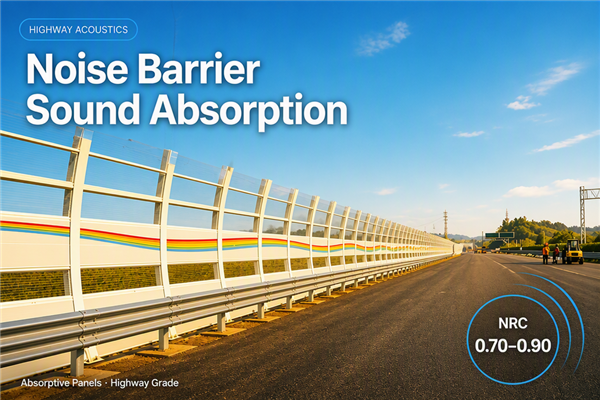
On modern highways, noise barrier sound absorption is no longer optional — it is an acoustic necessity. When sound barriers line both sides of a carriageway, reflected noise can bounce repeatedly between parallel walls, creating a “sound canyon” that erodes the noise reduction each barrier was designed to provide. Noise barrier sound absorption solves this problem by trapping and dissipating sound energy at the barrier surface instead of reflecting it back. This guide explains why sound absorption matters for highway barriers, how absorptive panels work, and what to specify for highway projects.
Why Noise Barrier Sound Absorption Matters on Highways
Highways present a unique acoustic environment: high traffic volumes, sustained speeds, and — critically — barriers on both sides of the roadway. When two reflective barriers face each other, sound waves reflect back and forth between them, and the noise level at the receiver can actually increase as reflected energy accumulates. Noise barrier sound absorption prevents this by converting incident sound energy into heat within the panel’s absorptive core, breaking the reflection cycle. Field studies consistently show that absorptive barriers outperform reflective barriers by 3 to 5 dB(A) in parallel-wall highway configurations — a difference residents notice immediately.
Absorption also matters where barriers must be placed close to residences on elevated or constrained corridors. In these situations, reflected noise can be directed toward upper-story windows on the opposite side of the road, creating complaints even where the primary barrier appears to perform. Specifying noise barrier sound absorption on both sides of the highway eliminates these reflection paths and delivers more predictable, uniform noise reduction across the corridor. For this reason, sound absorption has become a standard criterion in highway acoustic design guides and environmental impact assessments worldwide.
How Sound Absorption Works in Barrier Panels
The acoustic principle behind noise barrier sound absorption is simple: when sound waves strike a porous material, the air particles inside the material’s pores vibrate and lose energy to friction, converting acoustic energy into heat. The effectiveness of this process is measured by the sound absorption coefficient (α), which ranges from 0 (perfectly reflective) to 1 (perfectly absorptive), and by the Noise Reduction Coefficient (NRC), an average of absorption coefficients across speech and traffic frequencies.
For highway barriers, the target is an NRC of 0.70 to 0.90, meaning the panel absorbs 70% to 90% of incident sound energy. Achieving this level of sound absorption requires a carefully engineered panel construction:
- Perforated or micro-perforated facing — the panel surface is perforated with holes typically 2 to 5 mm in diameter, with open areas of 15% to 40%
- Absorptive core — behind the perforated face sits a layer of mineral wool, fiberglass, or polyester fiber blanket, typically 50 to 100 mm thick
- Back panel — a solid rear face contains the core and provides structural stiffness
The perforation size, open area, core density, and core thickness are all tuned to the specific frequency range of highway traffic noise — predominantly the 250 Hz to 4,000 Hz band. Well-tuned panels achieve high absorption exactly where it is needed most. This frequency-matched design is what separates effective noise barrier sound absorption from generic acoustic treatment — highway panels are engineered for the noise signature of road traffic, not for speech or industrial noise.
Absorptive Materials for Highway Noise Barriers
Mineral Wool and Rock Wool
Mineral wool and rock wool cores are the most widely used absorptive materials in highway barrier panels. They offer excellent broadband absorption, are non-combustible (fire rating A1 or A2), and resist moisture and biological attack. Density typically ranges from 60 to 120 kg/m³, and the material maintains its acoustic performance for decades when properly sealed within the panel. Mineral wool is the default choice for most highway noise barrier sound absorption specifications, and its proven track record makes it the benchmark against which other sound absorption materials are measured.
Fiberglass
Fiberglass blanket cores provide comparable absorption to mineral wool with slightly lower density, making panels lighter and easier to handle. Fiberglass is non-combustible and dimensionally stable, but must be protected from water ingress — absorbed moisture degrades both acoustic performance and panel integrity. Encapsulation within sealed panel construction is essential.
Micro-Perforated Aluminum
Micro-perforated aluminum panels offer sound absorption without any fibrous core, using precisely sized and spaced sub-millimeter perforations to dissipate sound energy. This “clean” absorption is prized in architectural and premium highway applications because it eliminates loose-fill materials entirely, reduces long-term maintenance, and provides a durable, corrosion-resistant surface. Micro-perforated systems typically achieve NRC values of 0.50 to 0.80 depending on design, with zero maintenance of the absorptive mechanism.
Polyester and Recycled Fiber Composites
Emerging polyester fiber and recycled composite cores are gaining traction in sustainable highway projects. These materials are lightweight, moisture-resistant, and increasingly available with recycled content. While their sound absorption coefficients can match mineral wool, polyester cores are combustible and require fire-retardant treatment plus careful specification where fire codes apply. For projects prioritizing environmental certification, these cores offer a viable path to sustainable noise barrier sound absorption without compromising acoustic targets.
Absorptive vs Reflective Barriers: What to Choose
Both barrier types block sound; the difference lies in what happens to the sound energy that reaches the barrier face. Reflective barriers (solid concrete, non-perforated metal, and glass) bounce nearly all incident energy back toward the source. They are appropriate when the barrier faces open land or water with no receivers on the opposite side. Absorptive barriers — panels with perforated faces and absorptive cores — dissipate the incident energy, preventing reflections. They are the correct choice whenever:
- Barriers are installed on both sides of the highway
- Residences or sensitive receivers exist on both sides of the corridor
- The corridor has parallel elevated structures that could reflect noise
- Communities require predictable, documented noise reduction
In practice, most major highway programs specify noise barrier sound absorption on at least the traffic-facing side of every barrier section, reserving purely reflective systems for isolated, single-sided locations. Sound absorption performance is now a standard line item in highway barrier procurement documents, with contractors required to demonstrate compliance through certified acoustic testing.
Specifying Absorptive Barriers for Highway Projects
A highway specification for noise barrier sound absorption should include four core requirements:
- Minimum NRC of 0.70, tested in accordance with ASTM C423 or ISO 354 using the same mounting method as field installation
- Sound absorption coefficient verification at the critical traffic frequencies (250 Hz, 500 Hz, 1 kHz, 2 kHz)
- Non-combustible core materials meeting A2 fire classification, with documented test reports
- Durability requirements — absorption performance retention after weathering, moisture, and UV exposure, verified by accelerated aging tests
Specifiers should also require the manufacturer to provide third-party laboratory test reports rather than self-declared values, and should verify that the tested panel construction — perforation pattern, core density, core thickness — matches the production panels exactly. Performance claims based on different constructions are a common source of specification failure.
Maintenance Considerations for Absorptive Panels
Noise barrier sound absorption systems require modest but specific maintenance. The absorptive core must be protected from moisture ingress — failed edge seals and damaged perforated faces allow water into the core, reducing absorption and accelerating degradation. Annual inspection should focus on seal condition, perforated-face integrity, and drainage clearances. In coastal areas, the perforated face should be inspected for salt buildup that can clog perforations; in industrial corridors, exhaust soot accumulation should be monitored. Absorptive panels are typically replaceable modules — designing for panel-level replacement keeps the system’s acoustic performance at specification throughout its service life.
Conclusion
Noise barrier sound absorption is a defining feature of effective modern highway noise mitigation. By converting reflected sound energy into heat within absorptive panels, highway agencies eliminate the sound-canyon effect of parallel barriers, deliver predictable 3-to-5 dB(A) improvements in dual-barrier corridors, and protect communities on both sides of the roadway. With NRC targets of 0.70 to 0.90, mineral wool and fiberglass cores, micro-perforated aluminum alternatives, and verified third-party test data, the technology for high-performance highway sound absorption is mature, proven, and ready to specify. For any project evaluating noise barrier sound absorption, the message is clear: absorptive panels are not an optional upgrade but an essential component of compliant, community-responsive highway design — ensuring that every barrier dollar delivers the full noise reduction communities expect.
Post time: Aug-17-2026