
 What “temporary” actually means
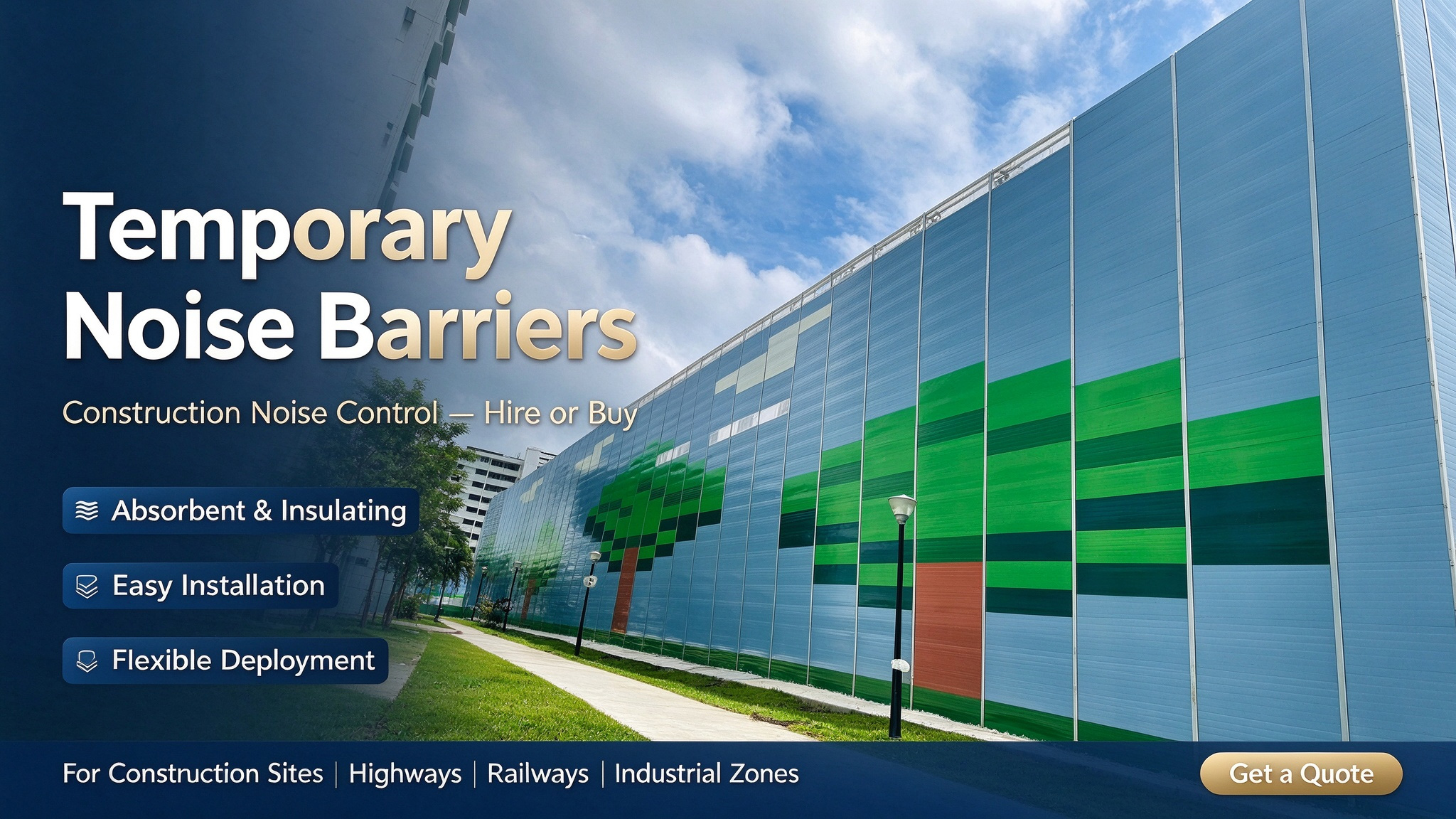
A temporary noise barrier is not a cheap permanent one. It is a different engineering problem. A permanent barrier is designed around a service life measured in decades, a fixed foundation and a structural calculation for the site’s design wind speed. A temporary noise barrier is designed around being moved: it has to stand up without a concrete foundation, come apart into pieces one or two people can handle, survive being loaded onto a truck, and still work when it is reassembled somewhere else.
Those constraints push the design in a specific direction. Free-standing frames, ballast instead of foundations, bolted or socketed joints instead of welded ones, and a panel light enough to crane by hand. The trade-off is real: everything that makes a temporary noise barrier relocatable also makes it easier to get wrong on site.
Three ways sites solve it
A temporary noise barrier on a construction site usually takes one of three forms.
- Modular absorptive panel systems. Steel or aluminium frames carrying an absorptive cassette, typically two to four metres high, held down with water ballast, concrete kentledge or ground pins. The heaviest option, the strongest acoustic result, and the one that can be reused across a project pipeline.
- Acoustic curtains on frames. Quilted absorptive blankets hung between posts. Fast to erect and light to transport, with less transmission loss than a rigid cassette, so they suit situations where the problem is reflected noise inside a site rather than noise escaping it.
- Integrated hoarding. The site’s perimeter fence is built with an absorptive lining on the inside face. Efficient where the hoarding already exists for security and the barrier only has to add acoustics, but the fence line then has to carry a duty it was never designed for.
Most sites end up combining two or three temporary noise barrier formats: rigid panels along the boundary facing residents, curtains around the noisiest plant inside the site, and a lined hoarding where access is tight.
Hire or buy: the decision is a duration, not a preference
The economics turn on one variable — how many times the set will be used. A temporary noise barrier carries three costs: the acquisition, the mobilisation each time it moves, and the repair bill at the end of each cycle. Hiring removes the capital cost but keeps the other two, and adds a hire rate that is charged whether the barrier is standing or sitting in the compound.
For a single short programme, hiring a temporary noise barrier is usually right, because mobilisation is someone else’s problem and the set leaves when the job ends. For a contractor with a pipeline of site work across several years, buying wins on arithmetic, but only if the panels are specified for reuse: hot-dip galvanised frames rather than painted ones, absorptive cassettes that can be replaced individually, and a stackable bundle design that survives loading without edge damage.
The mistake in both cases is the same. Sites compare hire rate against unit price and leave it there, then discover the real cost is the third and fourth mobilisation, when damaged panels have to be replaced and the set no longer closes the perimeter it was bought for.
Wind is the failure mode, not noise
Ask what has actually gone wrong with temporary noise barriers on site, and it is rarely an acoustic shortfall. It is a run of panels on the ground after a squall. A free-standing temporary noise barrier is a sail: the taller it is, the more of the load it collects, and the only thing resisting that is ballast and base width.
Three checks decide whether a temporary noise barrier will stay upright:
- What wind speed the temporary noise barrier is rated for, stated as a number rather than “suitable for site conditions”.
- Whether the layout allows any tie-back to an existing structure, which can cut the ballast requirement substantially.
- What happens at the ends of a run and at corners, where the wind load path changes and a plain panel line is weakest.
A supplier who cannot state a rated wind speed and the corresponding ballast per panel has not designed a temporary barrier, only assembled one. This is also where hiring fails quietly: the hire set arrives with the ballast the depot had, not the ballast your site needs.
Gaps and edges decide the result
The acoustic rating of a temporary noise barrier panel is measured on a sealed specimen in a laboratory. On site the barrier is a line of panels with joints, a base that does not sit flush on the ground, and an upper edge that sound diffracts over. Each of those paths carries sound the panel’s own rating does not describe.
The base gap is the usual culprit, because ground is never flat and nobody levels a temporary noise barrier line to millimetre tolerance. A skirt or a flexible bottom seal costs very little at the specification stage and is almost impossible to retrofit once the set is in use. The second culprit is the corner: a run that stops square instead of returning back on itself leaves a clear path around the end, and the receiver behind that corner hears almost the untreated level.
Height has the same logic. What matters is effective height against the line of sight to the receiver — the top floor of a nearby block is not shielded by a three-metre barrier directly below it, no matter how good the panel is.
What a specification should pin down
| Item | What to write into the specification | Why it matters |
|---|---|---|
| Acoustic duty | Insertion loss or transmission loss to a named standard, not an adjective | “Acoustic” panels without a rated figure cannot be checked |
| Absorptive facing | State whether the inward face is absorptive and to what rating | Reflective panels raise noise inside the site |
| Wind rating | Design wind speed and ballast mass per panel at that speed | The most common on-site failure is overturning |
| Base detail | Skirt or flexible seal, allowed gap at ground | The largest single acoustic leak on site |
| Reuse cycles | Number of moves the frame and cassette must survive | Drives galvanising and cassette fixings |
Some jurisdictions now go further and make site perimeter barriers a condition of the works, with a minimum height, a required absorptive facing and a mandatory test standard. Where that applies, the specification is fixed and the only remaining question is which temporary noise barrier can document compliance — and the documentation question is the one that decides the tender.
Where temporary barriers underperform
Four patterns account for most disappointing results. The temporary noise barrier is specified by height alone, with no acoustic figure, so nobody can tell whether it does anything. It is installed with a base gap that nobody notices until a complaint arrives. It is bought as a set sized for one site and then split across two, leaving neither perimeter closed. Or it is treated as a purchase decision when the actual cost driver was mobilisation, and the set sits in the yard for most of its life.
The fix is unglamorous: specify a rated figure, specify the wind case, detail the base and the corners, and count how many times the set will move before choosing between hire and purchase.
A sequence that avoids rework
Establish the receiver before anything else — which facades are affected, how far away, and at what height. That sets the barrier height and the run length, and it usually shows that only part of the perimeter is doing acoustic work. Then fix the wind case, because it drives ballast and therefore transport weight and crane time, which is where temporary schemes blow their budget. Only then choose between panel systems, and only then between hire and buy.
If the site also needs a security perimeter, decide early whether the hoarding and the acoustic barrier are one structure or two. Combining them is cheaper on paper and harder to get right, because the fence then has to resist wind load it was not designed for.
Our louvred absorber panels and noise barrier systems can be supplied in relocatable frame configurations for site work. For projects where the barrier will eventually become permanent, the foundation notes explain what changes when the frame has to be anchored rather than ballasted. If the problem is noise inside the site rather than at the boundary, acoustic blankets are often the more economical answer.
Tell us the affected facades, the run length and the wind case, and we will tell you which configuration fits — including when a temporary set is the wrong answer and a permanent barrier is cheaper over the life of the works. Send the site details through and we will size it.
Post time: Nov-09-2026