
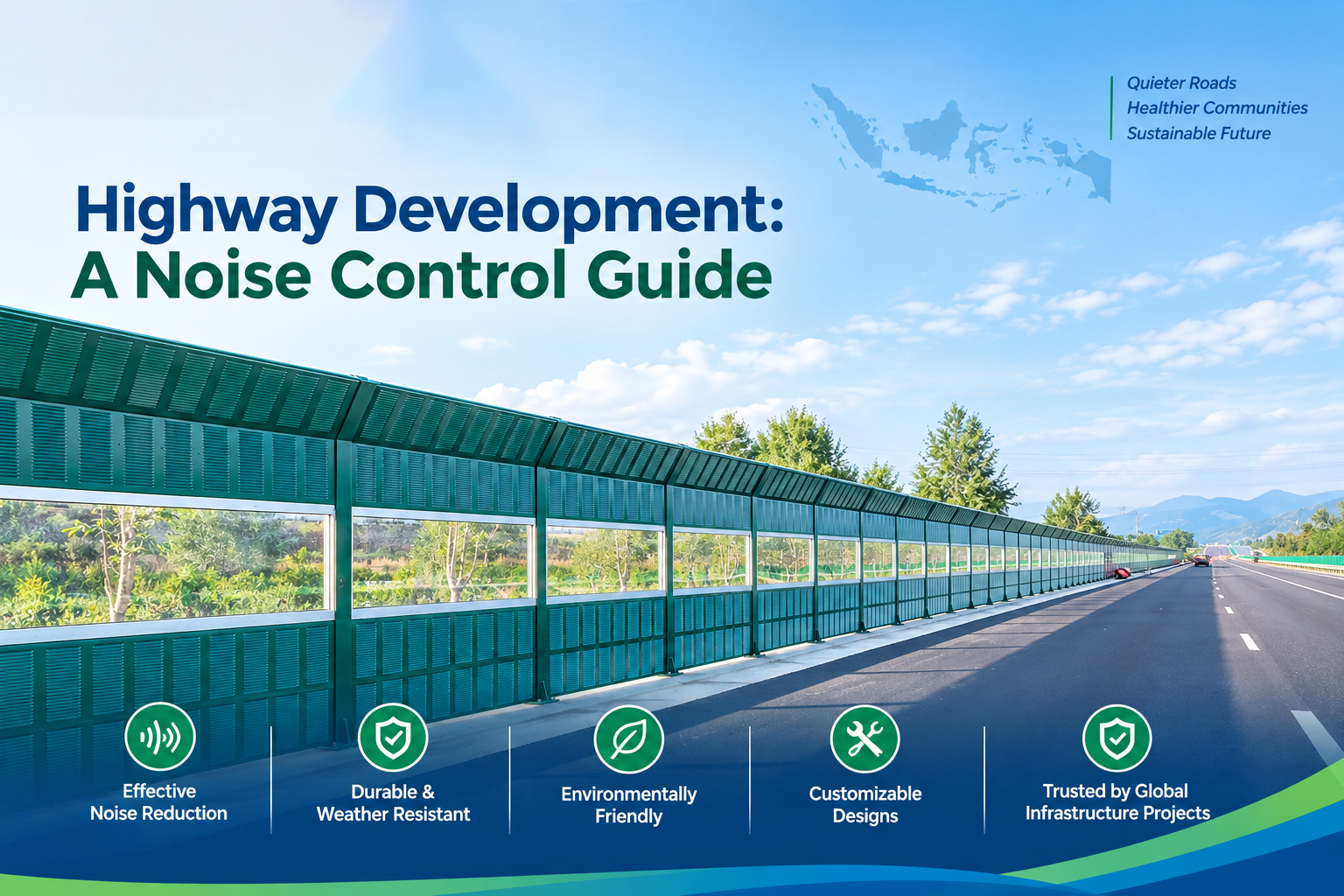
 Indonesia Highway Development: A Noise Control Guide
Indonesia highway construction has become one of the largest infrastructure programmes in Southeast Asia, and it is now entering the phase where building the road is only half the job. Once a toll road opens, the sections that pass close to houses, schools and commercial districts start to attract complaints — and solving that after the fact costs far more than designing it in. This guide sets out what Indonesia highway projects typically need in noise control, which systems suit the climate, and what to prepare before the acoustic scope is tendered.
The Scale of the Indonesia Highway Programme
That scale explains why noise control reaches so many agendas at once. As of August 2026, Indonesia had around 3,100 km of operational toll roads across roughly 76 sections managed by 54 toll road business entities (BUJT), with total investment in the operating network reported at about Rp779 trillion (US$43.9 billion). The Ministry of Public Works also reported around Rp36 trillion (about US$2 billion) of foreign direct investment for the toll road sector, and the Trans-Sumatra corridor, Trans-Java links and the access roads serving the new capital continue to extend the Indonesia highway network.
Two things follow from that growth across the Indonesia highway network. More of it is being built through areas that were previously quiet, pushing sensitive receivers closer to the carriageway. And corridors that already exist are retrofit candidates, because land use along them has changed since they opened.
Why Noise Control Arrives Late — and What It Costs
On most Indonesia highway schemes, acoustic treatment is not the first scope to be defined. Land acquisition, alignment, pavement design and drainage lead the programme, and the noise question tends to surface through the environmental process or through community complaints after opening. The consequence is predictable:
- Retrofit is more disruptive — working live lanes, closing shoulders and handling traffic management add cost and programme risk that a design-stage package would not carry.
- Foundations are harder — an alignment that has already been finished puts services, drainage and finished pavement in the way of post foundations.
- The receiver has usually moved in first — where housing predates the road, the expectation of mitigation is higher and tolerance for delay lower.
The practical answer is to define the acoustic scope while the alignment is still flexible, even if the barrier line is only an allowance in the bill of quantities.
What Indonesia Highway Projects Typically Need
The scope is rarely a single product. Most Indonesia highway packages combine several elements, and buying them from one qualified manufacturer shortens the interface list:
- Absorptive metal noise barriers — perforated aluminium or galvanised steel panels with a mineral wool core, used on the mainline sections where reflected sound would otherwise reach the opposite side. The trade-offs between panel types are set out in our highway noise barrier material comparison.
- Transparent panels — polycarbonate or acrylic upper sections, used where residents must keep daylight or where drivers need the sightline through a curve. Which transparent material suits a given Indonesia highway section is covered in our acrylic vs polycarbonate vs glass guide.
- Structural posts and foundations — hot-dip galvanised H-beams with driven or cast-in footings, sized for the local wind load. See our noise barrier foundation guide and the post design guide.
- Perimeter fencing — chain link, welded mesh and anti-climb systems for right-of-way control, substations and depot boundaries.
- Geosynthetics — geogrid and drainage products for embankments and retaining structures, often tendered in the same civil package.
Standards and Requirements to Expect
Indonesian environmental guidance sets noise limits for receiving areas, with residential limits in the region of 55 dB(A) under KepmenLH No. 48/1996, and individual projects then fix their own binding figures through the AMDAL or UKL-UPL environmental process. In practice this means the Indonesia highway acoustic requirement is project-specific and must be read from the environmental approval, not from a generic table.
On the technical side, specifications on Indonesia highway work frequently reference international test frameworks rather than purely local ones — the full list of clauses to expect sits in our highway noise barrier specification guide. The ones that come up most often are:
- Sound absorption — rated under EN ISO 11654 or measured to EN ISO 354, reported as a weighted absorption coefficient and an absorption class.
- Airborne sound insulation — rated to EN 1793-2 or EN ISO 717-1, which is what determines how much sound passes through the panel itself.
- Structural design — wind load per the project’s own criteria, with supporting calculations for posts, connections and footings.
- Corrosion protection — coating mass or thickness requirements, typically expressed against ISO 1461 for hot-dip galvanizing.
Design Priorities Specific to Indonesia
The tropical and coastal conditions of the archipelago change what should be specified. These are the points worth settling early on an Indonesia highway package:
- Corrosion, not just rain — high humidity, monsoon rainfall and salt spray on coastal corridors make galvanizing thickness and coating system selection the first durability question. Inland sections still see aggressive wet-dry cycling.
- UV exposure for transparent panels — long-term clarity and impact behaviour under strong tropical ultraviolet levels differ between polycarbonate and acrylic, and the choice should follow the maintenance regime the operator can sustain.
- Drainage and monsoon runoff — a continuous barrier line changes where water goes. Post bases that trap water are the most common cause of early corrosion, so the detail matters as much as the coating.
- Seismic and wind interaction — foundations and post connections in seismically active regions need to be designed for the combination the project specifies, which usually means a heavier anchorage than a wind-only check would suggest.
- Maintenance access — barrier runs should be broken into maintainable bays so that a damaged panel can be replaced from the verge without closing a lane on an operating Indonesia highway.
Delivery, Documentation and Installation
For an Indonesia highway contractor or BUJT, the logistics half of the order often decides the schedule. Panels and posts are bulky, so on Indonesia highway orders the design should be modular enough to load efficiently into standard containers and light enough to handle at the roadside. Three things are worth confirming before award:
- Documentation for customs and acceptance — packing lists that match the panel schedule, mill certificates, coating thickness records and test reports issued in the buyer’s name.
- Installation support — setting-out drawings, torque and tolerance requirements, and, where needed, a supervisor on site for the first section.
- Spares and repetition — identical panel and post sections across phases, so later extensions or replacements do not require a new tooling order.
Frequently Asked Questions
1. Does a highway noise barrier need a foundation in Indonesia?
Yes — every Indonesia highway barrier needs a foundation in some form, and the type depends on ground conditions. Driven posts suit competent, obstruction-free verges, while cast-in concrete footings are used where soils vary along the line or where the wind and seismic criteria are demanding. The choice should follow a geotechnical assessment rather than a default detail.
2. Which panel materials suit Indonesian conditions?
Absorptive aluminium and galvanised steel systems are widely used on Indonesia highway work because their corrosion protection can be specified directly. Transparent polycarbonate is common where daylight must be preserved. The decisive factors are the coating system, the exposure, and the maintenance regime the operator will follow.
3. How is the noise requirement set on an Indonesia highway project?
Through the environmental process. On an Indonesia highway scheme, national guidance sets limits by land use, and the project’s AMDAL or UKL-UPL then fixes the binding figure for each sensitive receiver. The acoustic design target should be taken from that document, together with the receiver positions it defines.
4. Can a barrier be added after the road is open?
It can, but it is more expensive and more disruptive. Indonesia highway retrofit work has to be carried out with live traffic, and finished pavement and drainage constrain the foundation options. Where treatment is likely, defining an allowance at design stage is the lower-risk route.
5. What information is needed to quote a barrier package?
For an Indonesia highway barrier package: the barrier line and heights, the acoustic target and the standard it is measured against, the panel type or desired transparency ratio, the ground conditions, the governing wind and seismic criteria, and the delivery point. With those, a manufacturer can price the panels, posts and foundations against the same basis.
Planning the Acoustic Scope Early
The Indonesia highway programme will keep adding kilometres for years, and the sections that generate complaints are usually the ones where the acoustic scope was left until after opening. Settling the barrier line, the acoustic target and the foundation approach while the design is still open is the difference between a planned package and an emergency retrofit.
JINBIAO GROUP manufactures absorptive and transparent noise barrier systems, structural posts, highway fencing and geosynthetic products, with export experience across Southeast Asia. For early-stage Indonesia highway projects, our engineering team can review an alignment, propose panel and foundation options, and prepare tender documentation. Send us the barrier line and the acoustic target, and we will come back with a system proposal.
Post time: Oct-06-2026