
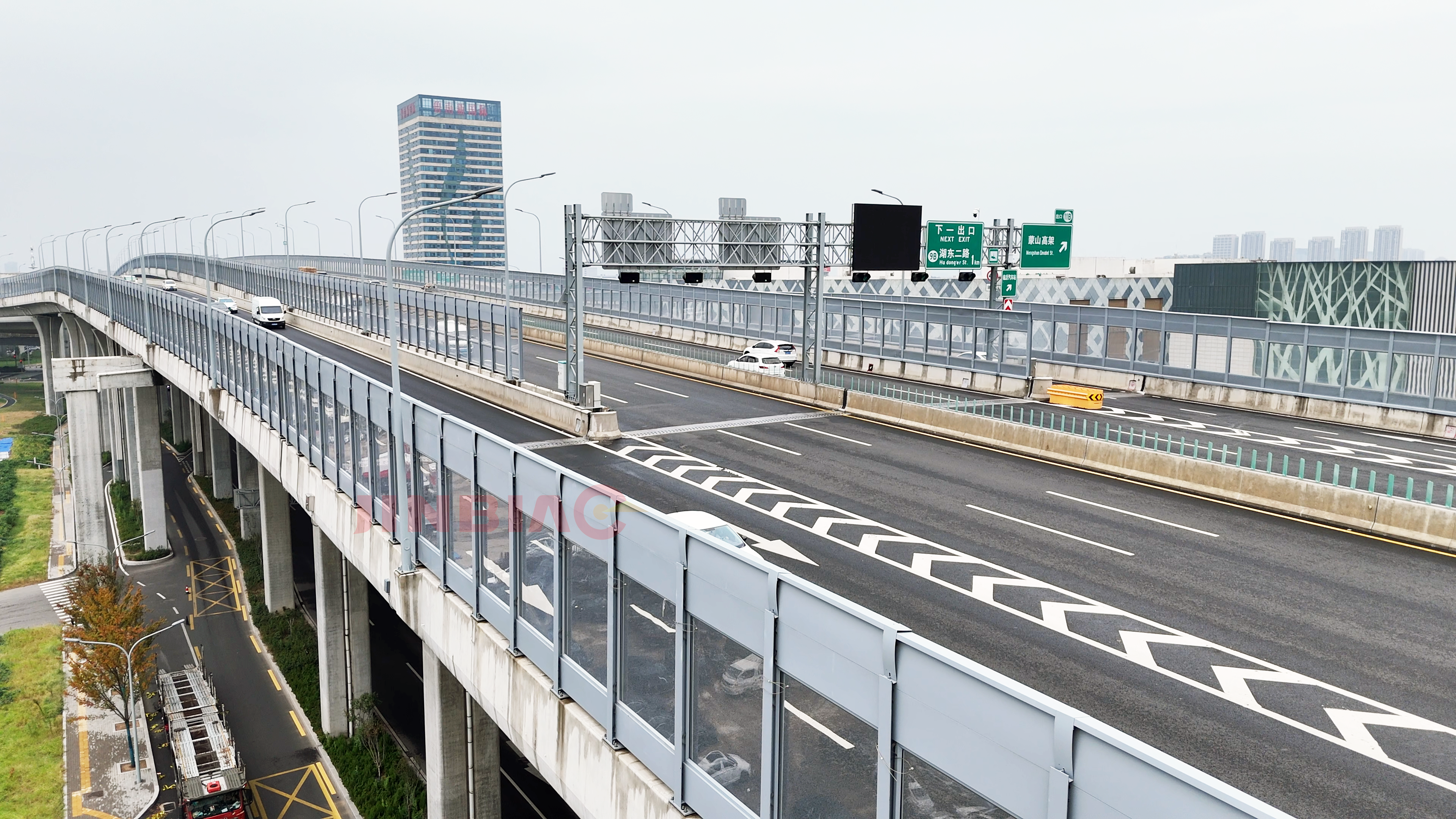
When a highway, viaduct or rail project has to reduce noise without walling off the view, a transparent noise barrier is usually what the community and the authority ask for. The harder question comes next: which transparent material should be specified? Acrylic, polycarbonate and glass all deliver see-through acoustic performance, yet they behave differently under impact, sunlight, thermal movement and budget pressure — and those differences shape how a barrier looks and performs after ten years in service.
This guide compares the three options on the factors that decide the outcome: acoustic class, light transmission, impact resistance, weathering, weight and lifetime cost.
What a Transparent Noise Barrier Does — and What It Does Not
A transparent panel reduces noise mainly by blocking sound rather than absorbing it. Performance follows the mass law: the heavier and stiffer the panel, the more airborne sound energy it reflects back toward the source. That is why a transparent noise barrier is often effective for receivers behind the wall, but can underperform on a corridor with sensitive buildings on both sides, where reflected energy bounces between parallel walls and erodes the net benefit.
The usual answer on such corridors is a hybrid configuration — an absorptive metal lower section facing the traffic, with transparent panels above it. That design logic is covered in our guide to transparent vs absorptive bridge noise barriers, so the rest of this article deals with the transparent noise barrier material itself.
The Three Main Transparent Panel Materials
Acrylic (PMMA)
Acrylic — polymethyl methacrylate, often sold as Plexiglas or Perspex — is the traditional acrylic noise barrier material on European highway projects. It offers the clearest optical result of the three options, with typical visible light transmission around 92%, and it resists yellowing well under long-term UV exposure. Acrylic is also rigid, which keeps panels optically flat and avoids the waviness that large thin sheets can show.
Its limitation is brittleness under hard impact: acrylic handles everyday loading but can crack under a heavy strike, and is the material most exposed to vandalism risk.
Polycarbonate (PC)
Polycarbonate is the impact-led choice. A solid PC panel offers far higher impact resistance than glass or acrylic — commonly quoted at roughly 250 times that of glass of equal thickness — which makes a polycarbonate noise barrier attractive for corridors with heavy truck traffic, elevated sections above roads, and locations where deliberate damage is a realistic concern.
The trade-off is weather resistance. Unprotected polycarbonate deteriorates under UV: it yellows, becomes brittle and loses impact strength, in some cases within a few years of exposure. UV co-extruded or coated grades address this and are the sensible specification for permanent outdoor barriers. Light transmission sits slightly below acrylic, typically around 88%.
Tempered and Laminated Glass
Glass remains the reference material where optical quality, scratch resistance and long service life matter most. Tempered glass shatters into small granular fragments if broken, which is why it is treated as safety glass. A laminated glass noise barrier bonds two or more panes to a PVB interlayer so fragments stay in place, and is generally preferred where panels sit above traffic, platforms or pedestrian areas.
In a transparent noise barrier, glass is heavier than plastics and needs more structural support, and it costs more per square metre. Its surface does not haze or scratch the way plastics can, and it holds clarity over a long service life.
Side-by-Side Comparison
| Criterion | Acrylic (PMMA) | Polycarbonate (PC) | Tempered / laminated glass |
|---|---|---|---|
| Typical light transmission | ~92% | ~88% | ~85–90% (interlayer dependent) |
| Impact resistance | Moderate | High (commonly cited ~250× glass) | High when tempered / laminated |
| Breakage behaviour | Cracks; sharp fragments possible | Deforms, resists penetration | Granular (tempered); retained by interlayer (laminated) |
| UV / yellowing resistance | Good | Grade dependent — unprotected material degrades | Very good |
| Weight | Light | Light | Heavy |
| Scratch resistance | Moderate | Moderate | High |
| Indicative panel cost | Lower | Mid | Higher |
| Typical application | Scenic corridors, urban viaducts | Heavy truck corridors, vandalism-prone areas | Bridges, stations, high-visibility locations |
Figures are typical ranges and vary by grade, thickness and supplier; confirm project data at specification stage.
Acoustic Performance: What the Standards Require
For road traffic barriers in Europe, airborne sound insulation is rated under EN 1793-2, which derives a single-number value, DLR, weighted against the normalized traffic noise spectrum in EN 1793-3. Panels are grouped into classes: B1 below 15 dB, B2 from 15 to 24 dB, and B3 at 25 dB and above. A class B3 transparent noise barrier panel sits at the top of that scale.
A rule often applied by designers is that the required DLR should be set at roughly the maximum insertion loss specified for the barrier plus 15 dB. Where a scheme targets 10 dB(A) of insertion loss, the panel insulation requirement lands around 25 dB — effectively a class B3 panel.
Two practical points follow. Panel thickness matters: an 8 mm solid plastic panel typically reaches category B2, while thicker sections can reach B3. And the standard rates the panel, not the finished barrier — frame stiffness, gasket compression and post spacing all influence measured performance on site. Rail projects generally reference the EN 16272 series, with ISO 717-1 Rw values often quoted alongside.
Choosing a Transparent Noise Barrier Material by Application
- Scenic coastal or mountain corridors — acrylic or glass, where optical clarity is the priority. Our acrylic transparent noise barrier range is specified for these routes.
- Elevated highways with heavy truck traffic — polycarbonate, for impact tolerance, as in our PC transparent noise barrier system.
- Bridges, stations and areas above pedestrians — laminated or tempered glass, so fragments are retained or reduced in size if a panel is damaged. See our tempered glass noise barrier options.
- Vandalism-prone environments — polycarbonate, or a layout that keeps transparent panels above reach height.
- Corridors with receivers on both sides — a hybrid transparent sound barrier with absorptive lower panels, rather than full-height reflective glazing.
Design Details That Decide Real Performance
Material choice sets the ceiling; detailing decides whether a transparent noise barrier reaches it.
- Panel thickness and mass — acoustic performance rises with mass; specify thickness from the required DLR rather than from habit.
- Frame and gaskets — an acoustic leak at the frame neutralises an expensive panel. Continuous EPDM gaskets and controlled compression matter.
- Thermal movement — plastics expand and contract more than glass. Panels need clearance and slotted fixings so they are not loaded in service.
- Wind load and span — elevated and bridge barriers should be sized against the project wind-load standard, with panel spans limited accordingly.
- Drainage and cleaning access — water and dust trapped behind transparent panels are the most common reason a barrier loses its visual appeal.
- Replaceability — panels in a transparent noise barrier are a maintenance item. Systems that allow single-panel replacement without dismantling the barrier save money over the life of the asset.
Cost and Life-Cycle Considerations
For a transparent noise barrier, purchase price alone is a poor basis for comparison. Acrylic generally sits below polycarbonate on indicative material cost, while glass is the most expensive of the three. The comparison also includes structural support, protective treatment (UV grades for polycarbonate), cleaning regime, replacement rate and service life. A mid-priced panel that needs replacing twice in twenty years is rarely the cheaper option — and a plastic panel that hazes will have the same effect.
Most suppliers, including our engineering team, work from the project’s acoustic requirement, wind load and durability expectation to recommend a material and thickness rather than quoting one for every site.
Frequently Asked Questions
Is acrylic or polycarbonate better for a transparent noise barrier?
It depends on the dominant risk. Acrylic gives higher clarity and better natural UV resistance; polycarbonate gives substantially higher impact resistance. Corridors with heavy truck traffic or vandalism risk usually favour polycarbonate, while scenic routes often favour acrylic.
Does a transparent noise barrier absorb sound?
No. Transparent panels are predominantly reflective — they block transmitted sound rather than absorbing it. Where absorbed performance is needed, transparent panels are combined with absorptive metal panels in a hybrid barrier.
How thick should a transparent noise barrier panel be?
Thickness is set by the required airborne sound insulation class under EN 1793-2 and by wind loading. Typical solid plastic panels of 8 mm reach around category B2, with thicker sections capable of B3; confirm the section against the project’s insertion-loss target.
How long do transparent panels last?
Glass has the longest service life, followed by acrylic. Polycarbonate performs well when a UV-protected grade is specified, but unprotected material degrades markedly faster. Coastal, high-UV and high-pollution sites should be assessed individually.
Choosing the Right Panel for Your Project
Acrylic, polycarbonate and glass each hold a legitimate place in a modern transparent noise barrier specification — the mistake is treating them as interchangeable. Start from the acoustic class you must meet, add the impact and vandalism environment, then let weight, maintenance and budget decide the final material.
If you send us the corridor type, target insertion loss and site conditions, our team can advise on material, thickness and panel layout for your project.
Post time: Sep-14-2026