
Al Ghouse Road runs about 30 km from Kuwait City to the Al Ahmadi industrial area, parallel to the Fahaheel Expressway, and was rebuilt in three packages. The section supplied here runs from Sabah Al-Salem to the Seventh Ring Road and carries six multi-span bridge junctions. That corridor is where 8,000 metres of noise barrier went in, and where the design had to survive a desert summer before it had to satisfy an acoustic target.
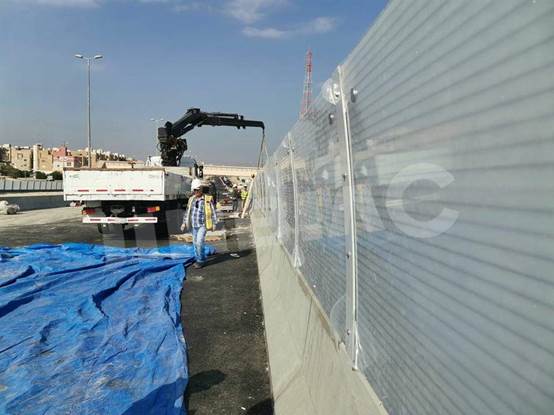
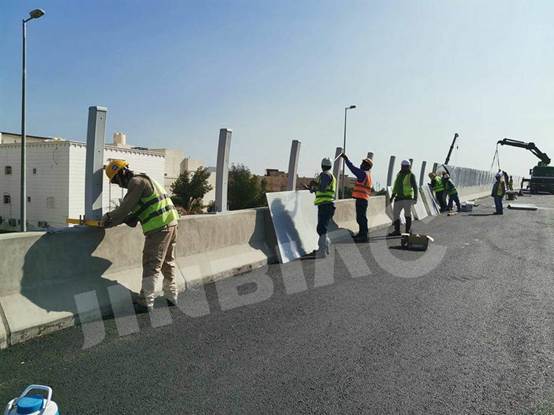
The project at a glance
| Extent | Sabah Al-Salem to the Seventh Ring Road, Kuwait City |
| Structures | Six multi-span bridge junctions, continuous dual precast segmental box girders, 5 to 7 spans of 40 to 45 m; total deck area 36,000 m² |
| JINBIAO scope | Design, approved barrier materials and all accessories for the section |
| Barrier length | 8,000 m |
| Installation completed | 27 January 2020 |
Why the specification asked for a noise and vision barrier
The original project description does not call for a plain acoustic wall. It calls for a noise and vision barrier, and that second word carries real weight on this corridor. A noise barrier running beside a rebuilt urban highway does two jobs at once: it interrupts the direct sound path from carriageway to the buildings behind it, and it blocks the sightline between them.
The visual duty changes the design in ways that are easy to underestimate. A panel chosen purely for acoustic insertion loss can be opaque, reflective and visually heavy at close range; a panel chosen purely for screening can be acoustically thin. On this section the noise barrier had to hold both duties across eight kilometres, which means the specification had to fix a panel build-up and a post spacing that satisfied the acoustic calculation and the visual requirement at the same time, rather than optimising one and compromising the other later.
Six junctions, one continuous line
A noise barrier on a bridge deck is not the same object as one on grade, and the junction structures dictated most of the detailing. The six junctions are continuous dual precast segmental box girders, erected span by span in runs of five to seven spans at 40 to 45 m each. Continuous means the deck moves. Expansion joints at the ends of each continuous unit, camber built into the segments, and live-load deflection under traffic all act on whatever is bolted to the deck edge.
In practice that sets three requirements. Anchorages have to develop into a deck edge with limited embedment rather than into a generous concrete plinth. The noise barrier has to accommodate longitudinal movement at each joint without opening a gap that leaks noise or admitting water. And the posts have to stay plumb through the camber, or the panels rack and the joints stop sealing. None of this appears in an acoustic calculation, and all of it decides whether the noise barrier still performs five years after handover.
Heat is the design driver
Kuwait’s summer does more to a noise barrier than to a road. Ambient peaks are high, and a dark or uncoated metal surface sits well above ambient in direct sun, so the panel and post assembly cycles through a large daily temperature swing, every day, for decades. Three consequences follow.
Thermal movement has to be designed in, not absorbed by slotted holes discovered on site. Coating has to be specified for UV exposure and for the chalk-and-fade cycle that follows, because a coating that fails is not a cosmetic problem when the substrate beneath it is what the corrosion protection depends on. And the infill has to tolerate the same cycling without settling, compacting or shedding dust into the cavity.
The project record notes that the finished noise barrier withstood the local extreme heat, which is the plain-language version of a specification that had already accounted for it.
Getting 8,000 metres there inside the window
Infill material, posts, panels, fasteners, sealing profiles and connection brackets all have to arrive in the right quantity and the right sequence, because a noise barrier is installed as a chain and a missing bracket stops the line. Eight thousand metres of noise barrier is also a shipping problem before it is an installation problem: panel lengths, nesting, protection of coated faces in transit and container loading all determine whether the site can maintain its own programme.
What the delivery record shows is that quality and delivery held, and that the work was completed inside a limited window. On a live urban highway that is the honest measure, because the constraint is never the factory.
Handover
All noise barrier installation was finished on 27 January 2020, and completion photographs were submitted to mark the handover. The assessment recorded at handover — quality held, delivery on time — is the sort of statement that reads as routine and is in fact the whole objective on a programme of this kind.
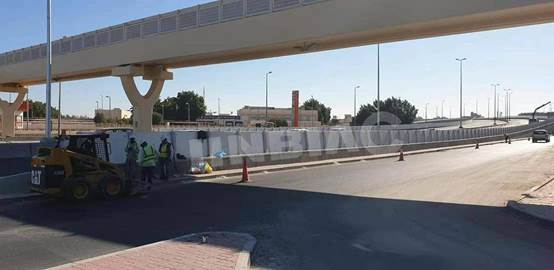
What this project shows for desert highway work
- Treat heat as a structural and coating design input for the noise barrier, not a note in the specification.
- Resolve deck movement at continuous bridge units before the noise barrier geometry is fixed.
- Where a noise barrier must also screen, decide the panel build-up at specification stage rather than after acoustic selection.
- Plan accessories and packing as part of the noise barrier delivery schedule, because the installation chain fails at the smallest missing item.
Representative noise barrier systems for this class of work include the permanent noise control barrier range and, where the corridor also needs daylight, transparent acoustic panels. For the structural side of deck-mounted work, the post and anchorage guide covers the detailing that decides long-term performance.
Post time: Oct-30-2020