
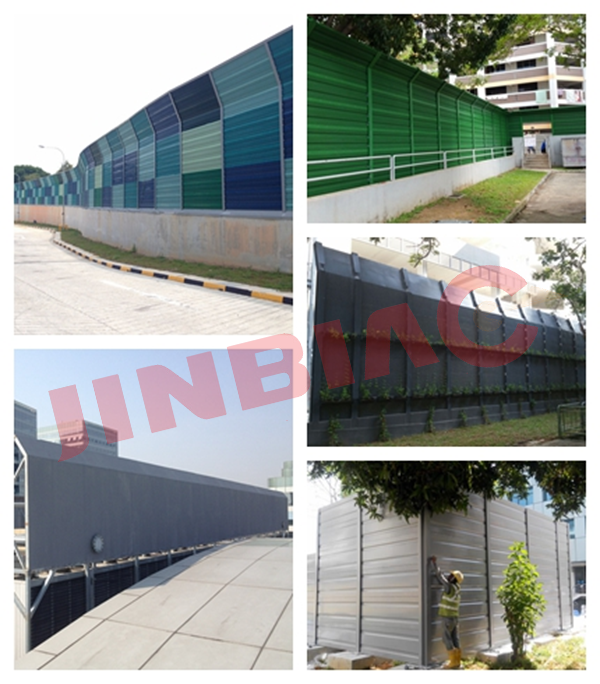
A list of completed noise barrier projects is only useful if it helps a buyer recognise their own problem in someone else’s. Five corridors, five different constraints: a viaduct serving a waste facility next to a live metro line, a city flyover where the view had to survive, a high-speed railway that loads its barriers aerodynamically, a ring road where nothing short of full enclosure would do, and the unglamorous work around cooling towers and plant rooms.
Each of the five noise barrier project entries below is a different answer to the same question — where does the sound actually leave, and what is allowed to stand in its way.
The five, at a glance
| Tuas View Basin, Singapore | Viaduct access road, metal barrier with louvered openings |
| Zhelimu Road, Hohhot | Urban viaduct, transparent barrier with barrel-shaped top |
| Xi’an–Yinchuan high-speed railway | Rail corridor, barrier designed for train-induced wind pressure |
| Shenzhen Outer Ring Expressway | Fully enclosed barrier over the carriageway |
| Plant and building services | Cooling towers, air-conditioning units, residential plant |
Tuas View Basin: a noise barrier beside a working railway
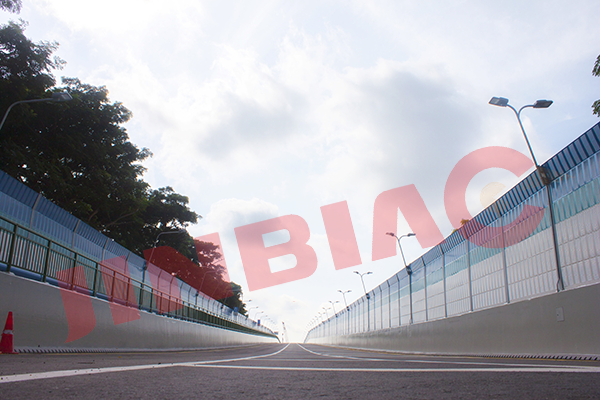
The Tuas View Basin scheme was initiated by Singapore’s National Environment Agency and comprises two permanent viaducts running from Tuas South Avenue 9 to the basin, providing access to the NEA Integrated Waste Management Facility. JINBIAO supplied the permanent noise control barriers for the viaducts — the P.N.C.B. system described for that project is a powder-coated assembly with a 1 mm metal skin and mineral wool infill, rated STC 29 with NRC 0.95.
Two details make it instructive. The first is that the barrier had to be erected alongside a live MRT line, which turns lifting and fixing into a possession-window problem rather than a construction problem. The second is the louvered openings: a noise barrier that must ventilate or admit air is not a solid wall, and the acoustic consequence has to be calculated rather than assumed. This is the same trade-off that makes louvered metal barriers useful where airflow cannot be blocked.
Zhelimu Road: keeping the view on an urban viaduct
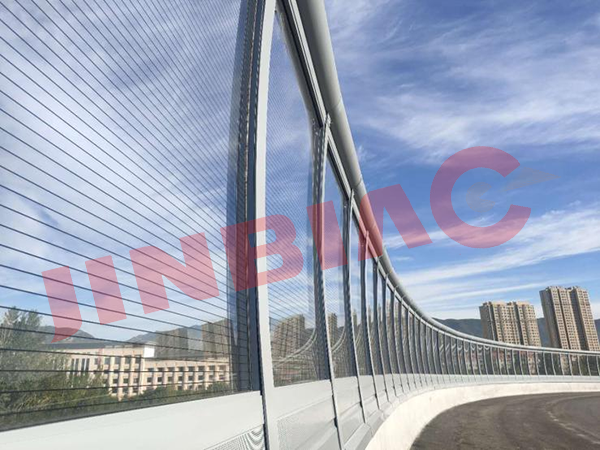
The Zhelimu Road viaduct in Hohhot needed the opposite emphasis. In a city centre, a transparent noise barrier does two jobs — it takes the edge off the traffic noise and it stops the structure from reading as a wall across the neighbourhood. The detail that makes this project distinctive is the barrel-shaped element along the top, which is a shape decision as much as an acoustic one: a curved top changes how the noise barrier reads from street level and how it terminates against the sky.
Transparent panels are the right answer where the receiver is close and the visual objection is strong. They are the wrong answer where the corridor has walls on both sides, because they reflect rather than absorb. Choosing between the two is a site question, not a product preference.
Xi’an–Yinchuan: when the train loads the noise barrier
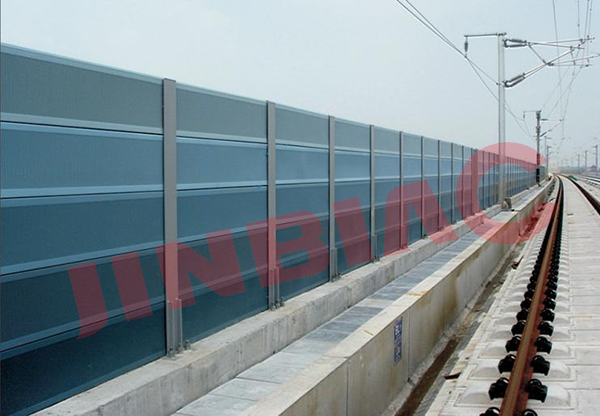
The Xi’an–Yinchuan high-speed railway runs 617.9 km between Shaanxi and Ningxia at a design speed of 250 km/h and opened in December 2020. At that speed a train is not only a noise source; it is a moving pressure pulse. A noise barrier close to the track sees repeated aerodynamic loading as each train passes, and the structure has to be designed for that cycle rather than for a static wind case alone.
JINBIAO produced a special design for this corridor specifically to withstand the wind pressure generated by train operation. That requirement is the reason a rail noise barrier cannot simply be a road barrier with a different colour: the load case, the fatigue duty and the applicable standards all differ. It is also the distinction covered in the railway acoustic barrier range.
Shenzhen Outer Ring: full enclosure
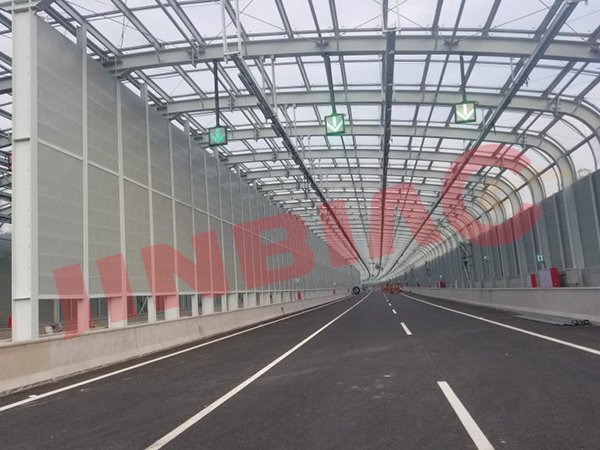
Where a road runs through a dense area and the receivers are close and high, a roadside wall stops being sufficient because the diffraction path over the top is too short. Full enclosure removes that path altogether by putting a roof over the carriageway. The acoustic result is the strongest available, and it brings a set of obligations with it: ventilation, heat build-up, fire strategy, lighting, maintenance access and the structural weight of a roof span.
Full enclosure is therefore a decision about the corridor, not about the noise barrier. It is chosen when nothing less meets the limit, and it is the reason fully enclosed systems are specified as an engineering package rather than a panel order.
Cooling towers, plant rooms and the quiet end of the market
The fifth entry is the least photogenic and the most common. Cooling towers, air-conditioning units and building services produce noise from a compact source on a roof or in a plant room, usually next to people who did not expect it. The treatment is closer to an acoustic enclosure than to a roadside noise barrier, and the constraint is almost always access: the plant has to keep working while it is being quietened.
This is where a noise barrier project stops being about kilometres and starts being about a single unit. The air-conditioning acoustic barrier and cooling tower barrier systems come from the same production line as the highway panels, which is why the coating and infill specification is not improvised for each job.
How to read a noise barrier project list
- Match a noise barrier project on constraint, not on sector: a live railway and a live carriageway pose the same possession problem.
- Ask what the noise barrier is not allowed to block — views, airflow, access, sightlines.
- Establish whether the load case is wind or train-induced pressure before pricing.
- Treat full enclosure as a corridor decision with a maintenance obligation attached.
If one of the five resembles your site, the fastest route is to send the layout and the receiver positions rather than a request for a panel price.
Post time: Mar-24-2021