
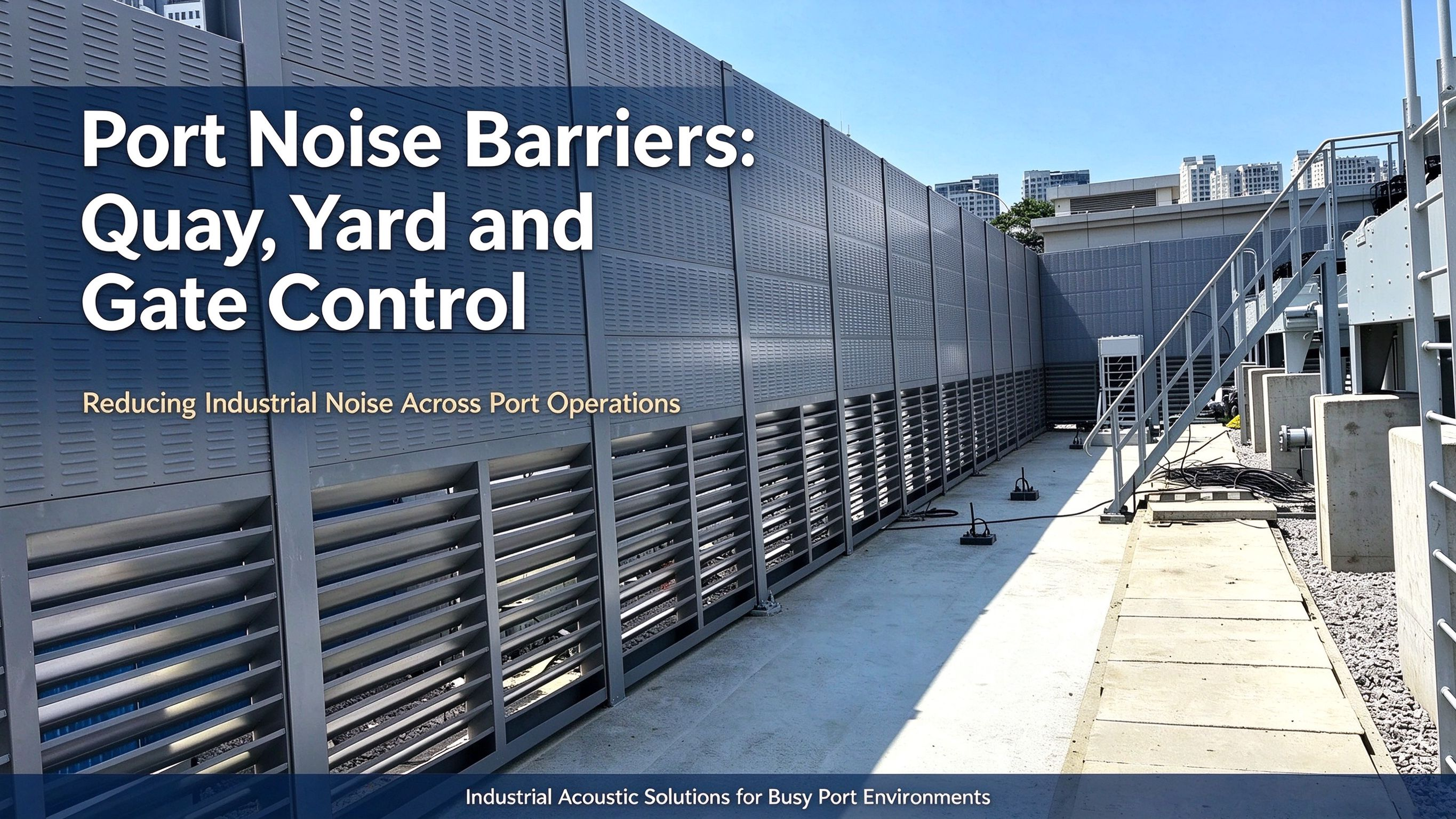
Ports are usually treated as an industrial cousin of the highway noise problem, and that assumption produces barriers which meet a specification and then fail on site. A port does not generate one moving line source travelling at speed. It generates a dozen unrelated sources, most of them stationary, many intermittent, and several of them elevated tens of metres above the quay. A port noise barrier has to answer that reality, which is why the placement decision matters more than the panel choice.
What actually makes the noise in a port
Before a port noise barrier can be sized, the source inventory has to be written down, because the mix decides whether a barrier helps at all.
- Ship-to-shore cranes. Trolley travel, hoist braking and gantry motion, radiated from 20 to 40 m above quay level.
- Rubber-tyred gantries. Diesel generator sets running at stack height, often the dominant source in a container yard.
- Reefer racks. Hundreds of compressors running continuously, producing tonal low-frequency noise that resists attenuation and generates complaints out of proportion to its level.
- Gate and queue traffic. Trucks idling, braking and accelerating, concentrated at a single point.
- Ship auxiliary engines at berth. Hotelling load radiated from hull and superstructure, which is why shore power changes the picture entirely.
- On-dock rail and bulk handling. Coupling impacts, conveyors, stackers and hopper discharge.
- Pile driving during construction. Impact noise in air and, more significantly, underwater.
Only two items on that list behave like road traffic. The rest are point sources, and point sources reward different geometry.
Why a boundary port noise barrier alone often underdelivers
A four metre port noise barrier on the fence line looks convincing on a drawing. Put a reefer stack 200 m behind it and the receiver beyond, and the port noise barrier intercepts a modest fraction of the sound paths, because the barrier is nowhere near either the source or the receiver. Height buys little at that distance, and the money spent on extra metres would have done more around the racks.
Sound from dispersed sources also arrives from many directions at once. A single straight port noise barrier covers an arc, not a circle, so noise travelling obliquely around the ends passes untreated. On a highway every source lies on one line and a parallel wall intercepts nearly all of them, which is exactly the assumption that does not transfer to a port.
Three placements, and when each wins
Enclose the source
Wrapping a reefer bank, a gantry engine compartment or a gate lane puts material where the sound is created, and it is usually the least expensive reduction per decibel available in a yard. A well-built enclosure reaches reductions of 15 dB(A) or better at close range, because it removes the direct path rather than bending it. The trade-off is operational: ventilation, heat rejection, plug access and maintenance all have to survive the enclosure.
Barrier the boundary
A port noise barrier on the perimeter earns its cost when the dominant sources are low, concentrated and close to the fence line, and when the sensitive receivers sit immediately behind it. Conveyors, stackers and gate queues fit that description. Ship-to-shore cranes and stacks 300 m inland generally do not.
Treat the receiver
Rarely the first choice at a port: the receivers are usually public roads, neighbouring industry or housing outside the fence, which the operator does not control. It remains relevant for administration blocks, gatehouses and control rooms inside the estate, where acoustic glazing and ventilation treatment are cheaper than reshaping the yard.
The coastal environment decides the structure
At a port the structure, not the acoustics, usually sizes the posts. Marine exposure places these sites in corrosivity category C5-M under ISO 12944, so hot-dip galvanizing to ISO 1461 plus a suitable coating system and stainless fixings are baseline rather than an upgrade. In cyclone or typhoon zones the wind load governs post spacing and foundation depth, and a panel chosen for its absorption figure may be structurally unsuited. Both questions are covered in more detail in the guides to barrier posts and structural design and to foundation types, and the logic carries over to marine sites unchanged.
Salt also attacks the acoustic medium itself. Mineral wool and perforated facings degrade when sea air and dust combine, so an absorptive panel that performs well inland can lose its advantage within a few years at a quay. Where absorption is genuinely required, closed-cell or protected facings are worth the premium.
Security, sightlines and the fence line
A port perimeter is a security boundary before it is an acoustic one. ISPS requirements, CCTV coverage and patrol sightlines all have a claim on the same line of ground, and a solid port noise barrier that blocks a camera view will be cut down or compromised later. The workable pattern is a composite: an absorptive or reflective lower section doing the acoustic work, with a transparent upper tier or open mesh above it preserving supervision.
Fence and port noise barrier are normally one structure rather than two. Combining a barrier with a welded mesh panel above avoids a double line of posts and a maintenance strip nobody can reach, an approach borrowed from double welded mesh perimeter fencing. Where the acoustic duty is light and the security duty is not, a louvred metal barrier keeps a measure of through-visibility at lower cost than glazing.
What a port barrier must not obstruct
- Crane rail gauge and boom clearance above the quay
- Fire lanes, hydrant access and emergency egress
- Storm drainage and surface run-off paths
- Reach stacker and terminal tractor turning radii
- Reefer plug access and maintenance walkways
Each of these has removed more port noise barriers than acoustics ever did. Raising them at the design stage costs a meeting; discovering them during installation costs a change order.
Measuring whether it worked
Environmental noise at a port boundary is normally assessed under ISO 1996-2, with the receiver positions and the time slice agreed in advance. Two details decide whether the result is meaningful. The first is the residual level: ports rarely have a quiet baseline, so the comparison has to be against the same operating condition rather than against silence. The second is tonality. Reefer compressors produce a distinguishable tone, and several frameworks apply a penalty for it, which means a port noise barrier that removes broadband level but leaves the tone audible may not satisfy the limit on paper or the neighbour in practice.
Specification points that actually decide the outcome
- Source inventory with levels and operating hours, not a single overall figure
- The dominant source named, and the placement strategy justified against it
- Receiver positions and the assessment standard, agreed before construction
- Corrosivity category and coating system, stated explicitly
- Wind load case and the resulting post spacing
- Security and sightline requirements drawn on the same section
A port noise barrier is a siting decision wrapped in a structure. Panels are the easy part, and treating them as the design is how projects end up with a wall that photographs well and measures badly. Representative systems for yard and boundary duty include the permanent noise control barrier range and, where works move around the terminal, temporary barriers.
FAQ
1. Can a noise barrier reduce port noise?
Yes, but placement decides how much. A boundary port noise barrier typically contributes 5 to 10 dB(A) at nearby receivers. Enclosing a compact continuous source such as a reefer bank or gantry engine often achieves more, and costs less per decibel, than adding height to a perimeter wall.
2. What is the noisiest part of a port?
It depends on the terminal type. In container yards the rubber-tyred gantries and reefer racks usually dominate, with gate traffic second. Bulk terminals are dominated by conveyors, transfer points and ship unloaders. Cruise and ferry berths are dominated by ship auxiliary engines, which shore power can largely remove.
3. How tall should a port noise barrier be?
Height follows from the source and receiver positions, not from a standard figure. Three to five metres suits a port noise barrier working against low sources close to the fence. Where the dominant source is a crane forty metres up, height at the boundary achieves very little and the money belongs at the source instead.
4. Do salt and wind affect barrier choice?
Substantially. Coastal sites fall into corrosivity category C5-M, so galvanizing, coating systems and fixings all have to be specified for marine exposure. In cyclone zones the wind load sets post spacing and foundation depth, and it can rule out panels that would be acceptable inland.
5. How is port noise measured for compliance?
Usually as environmental noise under ISO 1996-2 at agreed boundary or receiver positions, compared against the same operating condition rather than an empty terminal. Where the dominant source is tonal, such as reefer compressors, a tonality penalty is often applied, so removing level without removing the tone may not meet the limit.
Post time: Oct-26-2026