
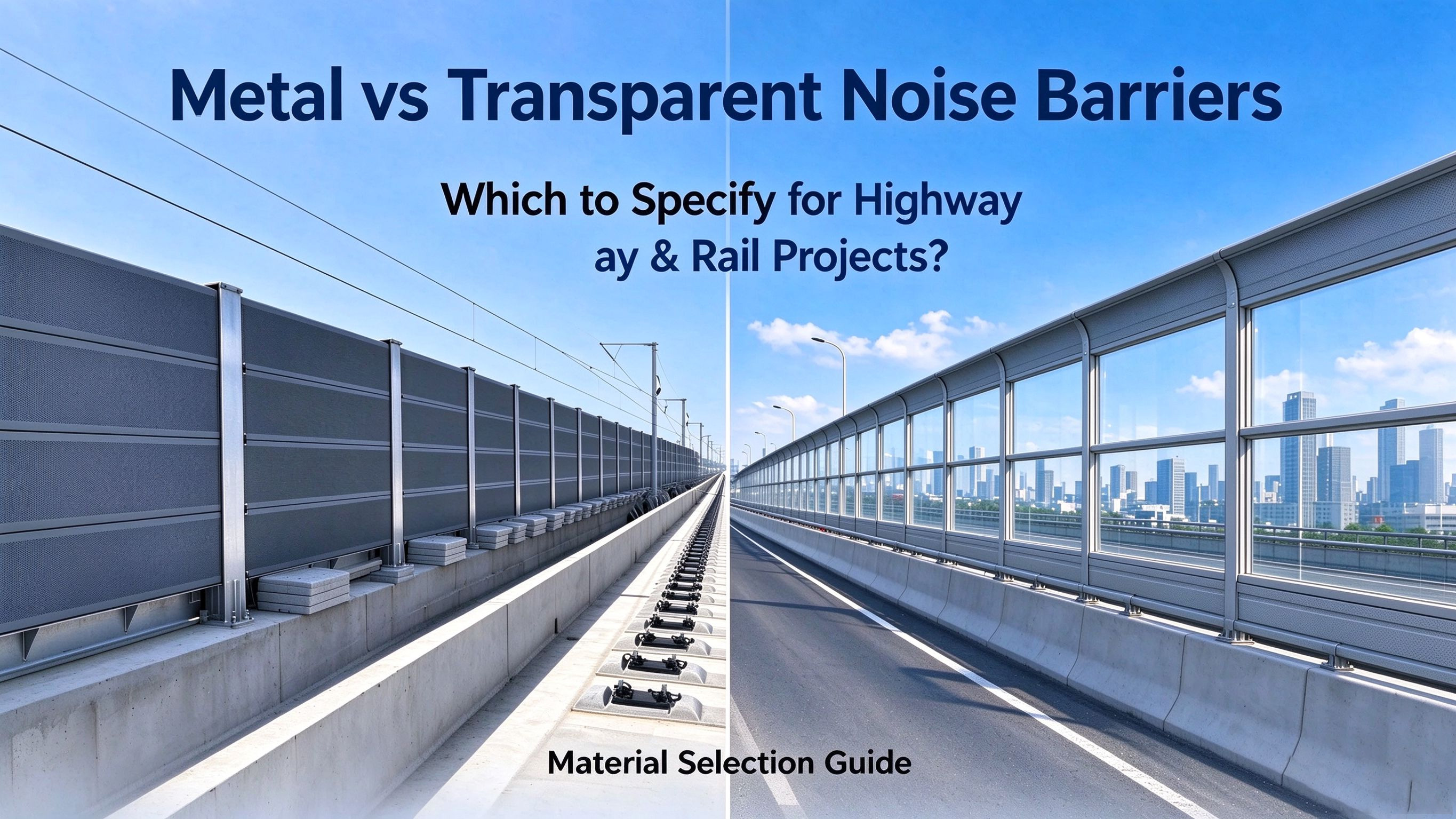
On most projects the question arrives late. The alignment is fixed, the receivers have been counted, and someone asks which panel to write into the specification. The answer is rarely “metal” or “transparent” in the abstract. It is the noise barrier that satisfies the constraints the corridor actually imposes, and on highway and rail projects those constraints differ more than the catalogues suggest.
This article treats the two as specification choices. For a general comparison of panel types, our guide to highway noise barrier materials covers the ground. What follows is the part that changes when the same two materials work beside a carriageway or beside a track.
The two noise barrier systems, in one paragraph each
A metal noise barrier is a rigid panel: a perforated or louvred facing over a mineral wool core, carried on steel posts. The perforated face absorbs sound rather than reflecting it, which is what makes metal the default where there are receivers on both sides. It is opaque, takes a wide range of colours, and carries mass.
A transparent noise barrier is a sheet system — acrylic, polycarbonate or laminated glass — in the same kind of frame. It transmits light and preserves the view, it is reflective rather than absorptive, and for the same area it is lighter than an absorptive metal panel. Our article on acrylic, polycarbonate and glass covers the sheet materials.
Why the railway noise barrier answer is often different
Most specification guidance is written for roads. A railway imposes five constraints a highway does not, and each can override the acoustic preference.
Overhead line equipment and electrical clearance
Beside an electrified line the noise barrier sits in a zone where clearance to live conductors governs height and position. It cannot simply be raised until the acoustics work. It has to be set back from the track, or designed within a height limit, and that limit often rules out the tall absorptive panel the noise model asked for.
Aerodynamic loading from passing trains
A train at speed pushes a pressure wave ahead of it and draws a transient behind. Panels and fixings close to the track see repeated, cyclic loading that road vehicles do not produce. Fixings, gaskets and panel stiffness must be specified for it, and a noise barrier that performs beside a carriageway may flex or fatigue beside a track. Ask for the basis on which the fixing was sized, not only the acoustic report.
Possession time and how a panel is replaced
Road noise barriers are maintained from the verge with a van and two people. Rail noise barriers are maintained in a possession, in a window measured in hours, often with no road access. A damaged transparent panel can usually be carried by hand; a metal panel of the same area needs plant. Panel mass becomes a maintenance decision, not only a structural one.
Sightlines the operator will not trade away
At stations, on curves and on the approach to level crossings, the infrastructure manager must see the track, the platform and the signals. That requirement is not negotiable for acoustic reasons, and it is the most common reason a transparent section appears inside an otherwise metal noise barrier.
Trackside access, ballast and drainage
Foundations must sit clear of tamping and of cable routes, and the noise barrier must not trap water against the ballast shoulder. Those constraints usually fix the barrier line, and the line fixes the achievable reduction.
Where a metal noise barrier is the right specification
An absorptive metal noise barrier earns its place where receivers sit on both sides and reflection must be controlled; on long opaque runs where no one is trading a view; where the target needs mass; where graffiti and impact are expected; and where the planning authority wants a colour that matches the surroundings. It is the wrong choice where daylight or a view is a condition of consent, and on rail it is the wrong choice where a possession is too short to lift the panel.
Where a transparent noise barrier is the right specification
A transparent noise barrier earns its place at stations, on viaducts over streets and on bridge decks, wherever the operator or a planning condition demands a sightline. It is the wrong choice on both sides of a narrow corridor, because two reflective faces bounce sound between them and the benefit falls away. It is also weaker at low frequency, since the sheet carries less mass. Two points decide many rail schemes: transparent panels need cleaning, and fire performance matters in enclosed or tunnel-adjacent locations, where acrylic — a thermoplastic — is restricted by some infrastructure managers and polycarbonate or laminated glass is used instead.
The standards are not interchangeable
Road noise barriers are tested under EN 1793-1 for absorption and EN 1793-2 for airborne sound insulation, with non-acoustic performance under EN 1794-1 and EN 1794-2. Railway noise barriers sit under the EN 16272 series. A panel with a road test report is not automatically acceptable in a rail noise barrier specification, and substituting one for the other is a quiet way for a scheme to fail at acceptance. Expect a fire classification to EN 13501-1 and, for rail, the aerodynamic basis for the fixing. For durability, ISO 1461 covers hot-dip galvanizing, EN 13438 covers powder coating on galvanized steel and EN 10169 covers pre-coated steel.
Noise barrier decision matrix by corridor condition
| Corridor condition | Usual specification | Why |
|---|---|---|
| Urban viaduct, housing both sides | Absorptive metal, full height | Reflection control as much as blocking |
| Rural embankment, receivers one side | Absorptive metal | Mass and cost, no view obligation |
| Station platform | Transparent upper tier over metal | Sightlines and daylight |
| Bridge or viaduct over a street | Transparent, or hybrid | Daylight below, deck weight limits |
| Tunnel portal | Metal, fire-rated | Fire performance, no view to keep |
| Level crossing approach | Transparent at the sightline | Driver and pedestrian visibility mandatory |
| Long run, no view requirement | Absorptive metal | Lower maintenance, faster replacement |
What to write into the noise barrier specification
- State the noise barrier target as insertion loss at named receiver positions, not as a panel rating alone.
- State the absorption class where a reflective face would affect receivers opposite.
- For rail, require EN 16272 series evidence, a fire class to EN 13501-1 and the aerodynamic basis for fixings.
- Give a maximum weight per replacement panel, and say how it is handled in a possession.
- Express transparency as a sightline requirement — what stays visible from where — rather than naming a material.
- Specify base and joint sealing explicitly; leakage decides the delivered result more often than the panel.
- Name the finish system, its standard and the colour reference.
Two mistakes that show up on site
The first is specifying a material where a noise barrier performance was meant. A clause naming “transparent acrylic upper tier” invites a thinner sheet than the acoustic model assumed; the clause never said what the panel had to achieve. The second is forgetting the opposite side: absorptive metal one face, reflective transparent the other, in a corridor narrow enough for the two to interact — and the measured reduction lands below design.
Frequently asked questions
1. Can metal and transparent panels be combined?
Yes, and on rail projects they usually are: an absorptive metal lower section with a transparent upper tier, keeping the sightline where the operator needs it while the metal absorbs.
2. Is a transparent noise barrier as effective as a metal one?
Usually not, particularly at low frequency, because the sheet carries less mass than an absorptive metal panel. It is specified where the sightline or daylight requirement outweighs the acoustic difference.
3. Which option costs less?
It depends on height, area, frame and fixings, and comparing the panel per square metre does not reflect the total. Transparent sheet is often the higher material cost; frame and maintenance can move the total either way.
4. Which lasts longer?
Both can serve for decades when the coating or sheet grade suits the environment. Transparent panels are more exposed to impact and need cleaning, while a coated metal noise barrier depends on the finish system and on touching up damage at the base.
5. Do I need different evidence for a railway?
Yes. The EN 16272 series applies to railway noise barriers and is not interchangeable with road evidence under EN 1793 and EN 1794. Add the fire classification and the aerodynamic basis for the fixing.
Getting the decision right
The choice between a metal and a transparent noise barrier is settled by constraints, not preference: what must stay visible, who is on the other side, how the panel will be replaced, and which test series the client will accept. Send the alignment, the receiver positions and the sector — road or rail — and we will set out where the constraints point, and where a hybrid answers better. The wider context is in our guide to noise barrier specification, our comparison of metal and concrete barriers and our note on transparent versus absorptive panels on bridges; the system details sit on our metal microporous and acrylic transparent product pages.
Post time: Oct-19-2026